
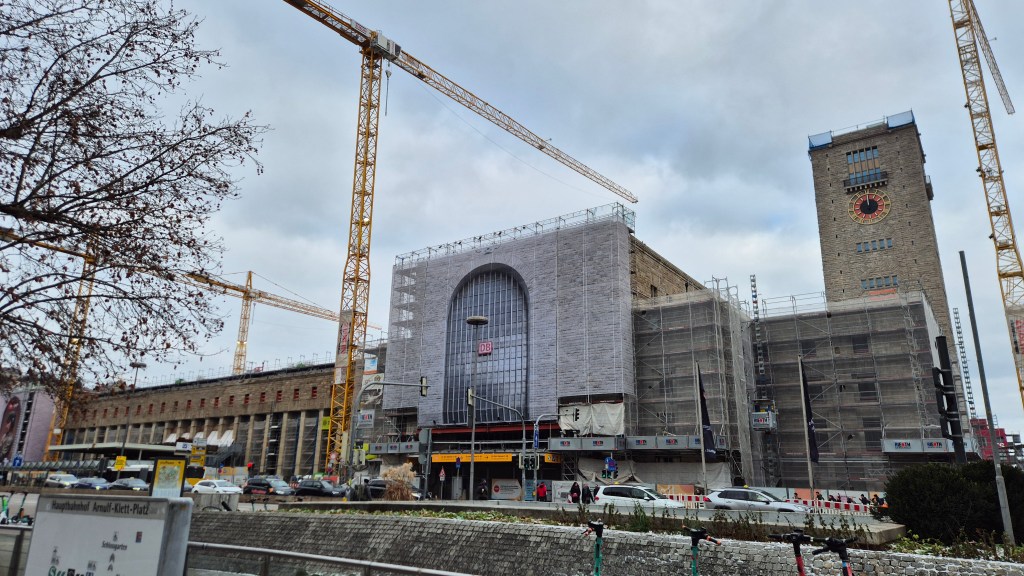
Having arrived in Stuttgart over an hour later than planned onboard an TGV service from Paris (read about that here), I was immediately confronted by the giant building site that is Stuttgart Hauptbahnhof as is undergoes transformation through the ‘Stuttgart 21’ project. Unfortunately, this means that there is a very limited concourse area at the end of the platforms, and it is a 10 or so minute walk around the edge of the building site to reach the S-bahn station. Whilst it seems the works will greatly improve the station, both operationally and from the passenger point of view, the current arrangement really isn’t giving the greatest first impression of the city.
I had originally planned to have a bit of a wander around the city centre upon arrival, however by the time I had reached my hotel it was around 90 minutes later than planned and so I decided to just head to a burger restaurant over the road for some dinner and then grab an early night. Big Bunss is the stereotypical ‘hipster’ burger restaurant, serving a range of specials alongside the classic hamburger and cheeseburger. I can’t actually remember what I ordered, nor did I take any photos, but I do remember it being delicious and washing it down with a Fritz Cola (no Coca-Cola here!) So, after an early start and a drag of a travel day, I headed back across the road to my hotel and settled down for an early night, hoping to have a good day of exploring the following day.
The following morning I grabbed some breakfast at the hotel before checking out, deciding it was better to check out early and leave my bag at the station, than have to head back out to the hotel later in the day. With no firm plans, I decided to purchase a public transport day ticket for €7 and made my way back to Stuttgart Hauptbahnhof where the luggage lockers are conveniently located neat to platform 16 where the sleeper train to Budapest departs from. With a walking tour booked for 1100, I decided to check out the Stuttgart 21 exhibition which is located at the station but with this not opening until 1000, I headed to the main road at the front of the station to find a café with somewhere to sit (all the food vendors in the station are takeaway only).
After a coffee, a pastry and some people watching, I made my way along the 400m long passageway that temporarily connects the station with the rest of Stuttgart, arriving back at the Stuttgart 21 exhibition just after 1000 to find it still closed. Seemingly although the big sign outside shows it open 1000-1800 everyday, Google showed it being closed until Wednesday and so I gave up and went for a wander around the Schlossgarten whilst waiting for the walking tour to start. This began on Königstaße, Stuttgart’s main shopping street with our guide, Javier from Argentina, giving a bit of an introduction to the city with us all then agreeing to keep the stops relatively short due to the cold weather.
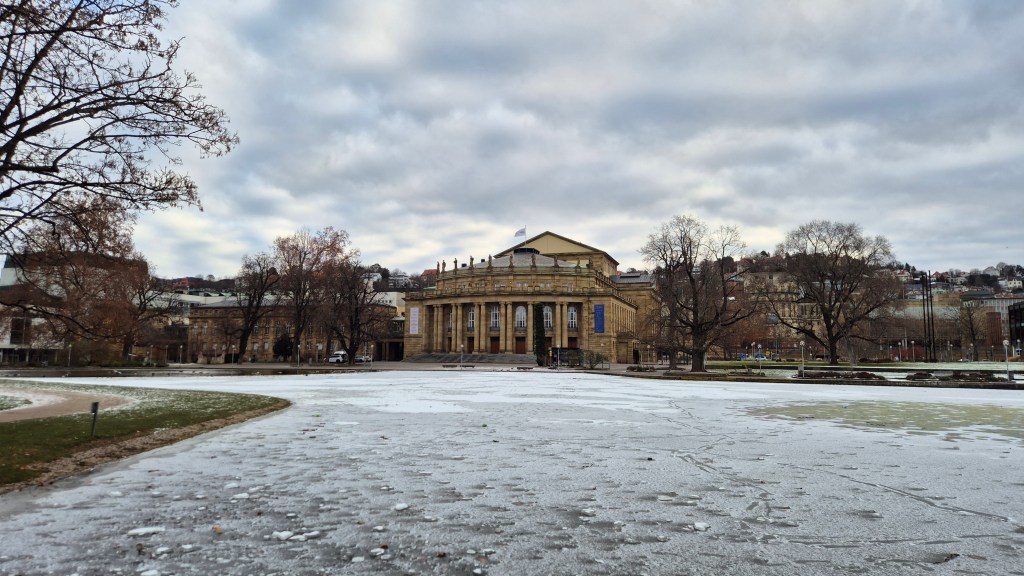
Stuttgart is Germany’s 6th largest city and is one of its key industrial centres, known for its automotive industry and home to Porsche and Mercedes-Benz as well as for its building sites (such as Stuttgart 21 which has been under construction since 20120) and for its wine produced from the vineyards of the Neckar valley. The tour took us back into the Schlossgarten and to the 1909 opera house which, having been the only building to survive the bombing of central Dresden during WW2, subsequently lost its entire roof to a large storm in 2021. The Schlossgarten also provides views of the Stuttgart TV Tower, which was the first of its kind in the world when it was constructed in 1956, as well as the reconstructed Neuss Schloss and Museum of Modern Art which sit on the edges of the Schlossgarten.
As we continued around Stuttgart city centre, we covered some of the history of the city and the relatively short-lived Kingdom of Württemberg as well as its four Kings, Frederick; William I; Charles; and William II. William I has a statue in the square named after his son, Charles, sitting next to the walls of the Altes Schloss which dates from the 10th century, although was rebuilt in the 1970s following destruction during a 1931 fire and World War 2 bombing. In a small part of the basement of the Altes Schloss there is a museum dedicated to the Claus von Stauffenberg who attempted to assassinate Hitler in 1944.
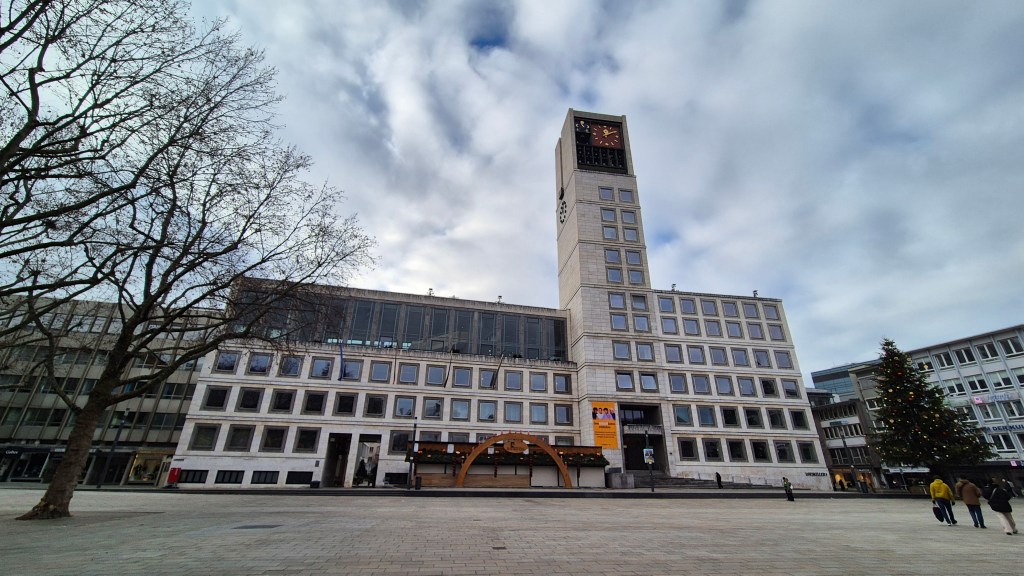
Next up on the tour was Stuttgart’s Market Square and new city hall, the latter being an example of the functional architecture that was prevalent across Germany in the post-war era. Under the market square there is also a huge bunker, although this is only open to visitors one day a year on the Long Night of Museums (usually the third Saturday in May). From the market square we passed the rebuilt Stiftskirche and its two towers, with the Romanesque one being original having been used as a wayfinding point by Allied bombers. Entering into Schillerplatz on the opposite side of the Altes Schloss to Karlsplatz, there is a statue to the exiled playwright Friedrich Schiller, one of Germany’s most important classical playwrights.
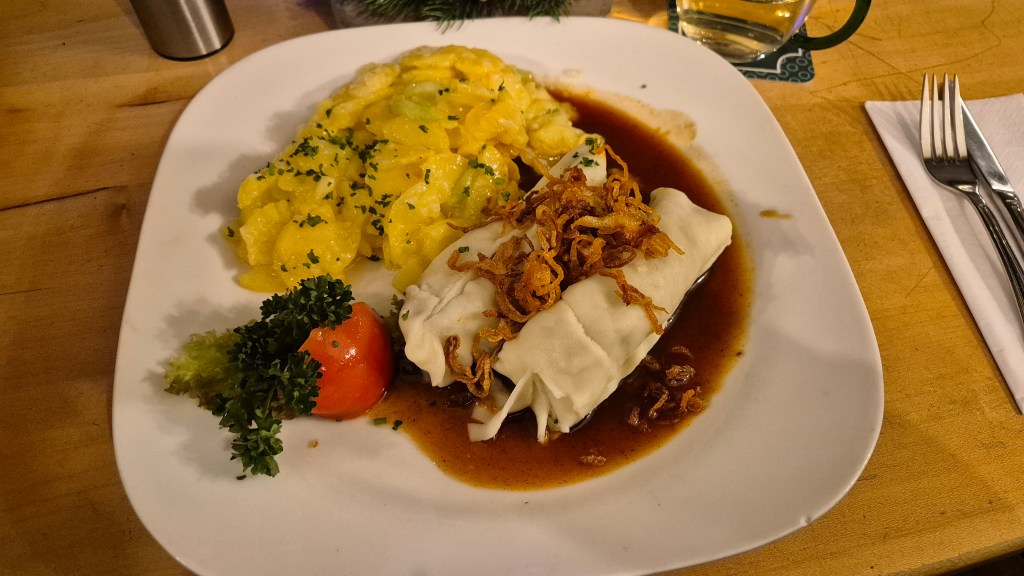
The walking tour ended in Kleiner Schlossplatz which overlooks the larger Schlossplatz below, an ideal location for me as it was close to a restaurant I had seen for lunch. Ochs’n Willi is a Bauhaus style restaurant that serves traditional Schwaben and German dishes and given I was in the historic Schwaben region I felt it was only right to go for some traditional dishes. Starting off with Maultaschensuppe (clear meat soup with filled pasta squares), I then went for Maultasch as my main course. We’d tried this when we were in Lindau during the summer (read about that here) and these pasta squares filled with pork and spinach are absolutely delicious and certainly worth choosing when you have the option. Finally I finished the meal with a Schwaben apple cake and the whole meal was washed down with a glass of local Risling wine.
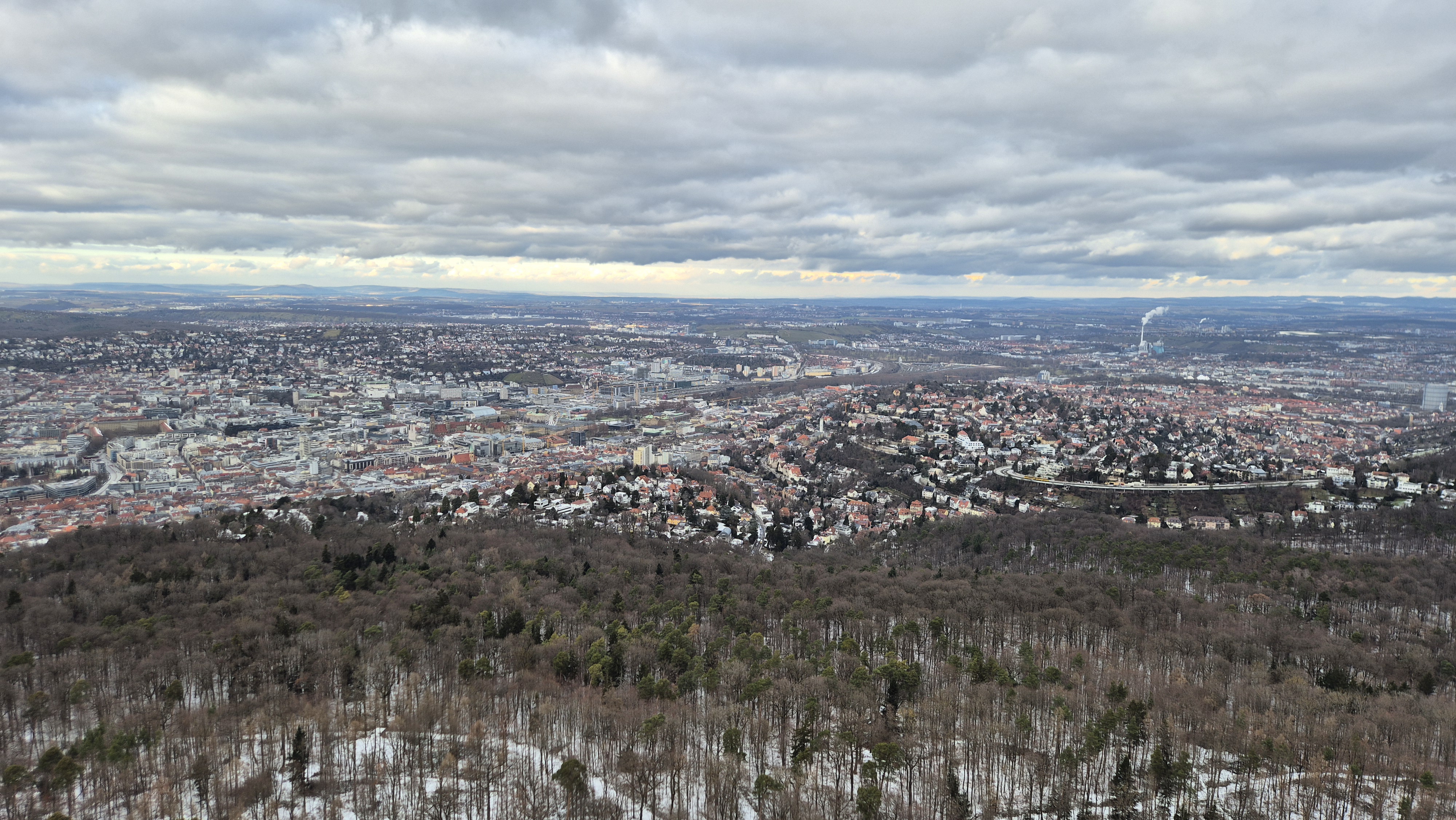
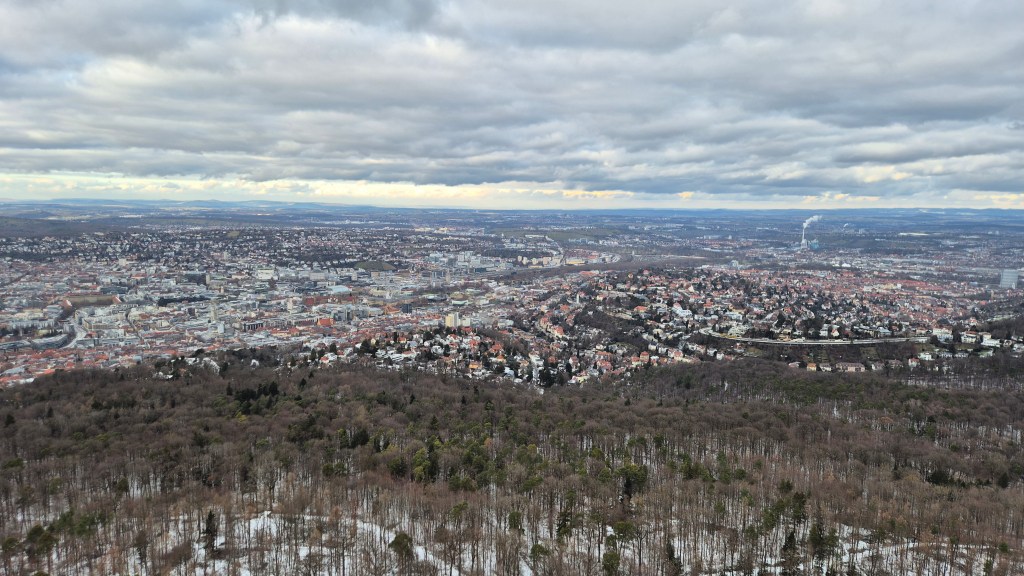
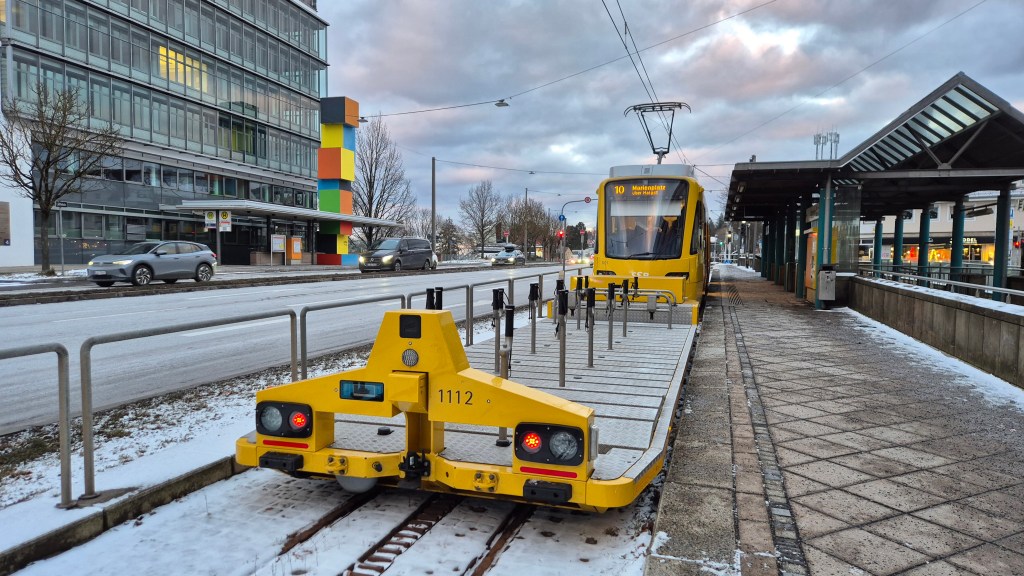
After a very filling lunch, I headed out into Schlossplatz and down to the U-bahn platforms to catch a tram out to Ruhbank (Fernsehturn). Whilst most German cities U-bahn networks are a metro/underground style railway, Stuttgart’s is just its former tram network buried in some tunnels through the city centre. Interestingly some of the platforms have dual level platforms to allow the heritage museum trams to run, with part of the network also dual gauge to facilitate this. From the Ruhbank (Fernsehturn) U-bahn station it’s about a 10-minute walk through some woods to the TV Tower, which costs just €12.50 for a ticket to the top. From the open-air viewing platforms there stunning views out across both the city of Stuttgart and the wider region. There’s also a café/restaurant one floor down from the top, but I’d recommend making a reservation if you want to visit here as it was very busy during my ascent and so I gave it a miss. The TV Tower is open 1000-2200, however the path through the woods from the U-bahn station didn’t seem to be lit, so it might be best to do it during daylight hours!
Catching the U-bahn back into town I alighted at Charlottenplatz and took a short walk from there back to Karlplatx to visit the Stauffenberg-Erinnerungsstätte (Stauffenberg Memorial). You may know the Stauffenberg assassination attempt on Hitler from the Tom Cruise film ‘Valkyrie’ which depicts the events of the 20th July plot, however the Stauffenberg Memorial exhibition focuses a lot more on the people involved rather than the plot itself. I found the exhibition interesting as it was a bit of WW2 history I wasn’t really aware of, despite having done Nazi Germany for A-Level history and did end up watching the film on my return to the UK. The exhibition is also free to enter, and only takes around 30 minutes to look around in detail, so it worth a visit if you have some time to spare.
With darkness falling on Stuttgart and the temperature dropping even lower, I decided to do a bit of Railgeeking and tick off Stuttgart’s two railway oddities. The first meant catching the U-bahn to Marienplatz where the lower terminus of the Stuttgart Rack Railway is located, affectionately known as the ‘Zacke’. Connecting Marienplatz to Degerloch, the 2.2km line climbs 210m across its length and has a dedicated single line with a passing loop halfway at Wielandshöhe. The Zacke has three dedicated electric cogwheel trains, along with bicycle carrying carriages and has its own depot, which oddly is combined with a theatre, with the train parking in a glass walled foyer each evening. After a round trip on the Zacke, it was back onto the U-bahn to head further out of the city to Südheimer Platz from where you can catch the Stuttgart Seilbahn. This funicular connects Südheimer Platz with the Stuttgart Degerloch forest cemetery at the top of the hill with two beautiful teak carriages still operating having been constructed at the time of the funicular’s opening in 1929.
Catching what I believe was the penultimate funicular of the day back down the hill, I headed back into the city centre, grabbing some dinner at the McDonalds near Schlossplatz before making my way back to the Hauptbahnhof to catch the next train of the trip. Stuttgart struck me as a bit of an odd city, trying to attract tourists but not quite getting it right. This might have been due to the first impression the station gave, or the fact I was visiting on a Sunday during January, but the city didn’t quite click with me. However, I’ll always give somewhere a second chance so maybe I’ll return during the summer months in a few years when the construction has finished to give the city another go. Until then Stuttgart!


4 thoughts on “Stuttgart – The Swabian Metropolis”