
Back in March Beth and I had a random Wednesday off work together and so rather than pottering around wasting the day, we decided to head to Dublin for a day trip adventure! We arrived in the Irish capital on an Aer Lingus flight from Birmingham (read about that here) and if you have read that blog, you’ll know that I hinted we had issues getting into the city.

When I last visited Dublin back in 2020 and that era now defined as ‘pre-Covid’, I had been able to purchase a ‘Leap Card’ which covered all Dublin public transport for 24 hours and included two express bus routes into the city centre, the 747 and 757. Unfortunately, these routes have been suspended and I failed to properly check our options before we purchased the Leap Cards which now only include some local bus routes from the airport which would have further delayed us getting into the city.
As such, having paid €9 each for a Leap Card, we paid another €14 each for a return ticket on the 782 Dublin Express. We eventually reached the city centre two hours after landing and I’ll admit that I had not reacted well to the frustration and stress. The delay meant we missed the free walking tour we were booked onto and so we made the decision that our first stop was to find somewhere for an early lunch, regroup and replan.
Crossing the River Liffey we headed to a Dublin institution, Brother Hubbard (North), which is located just north of the river near the National Leprechaun Museum of Ireland. For those that live in the South-west of England, you may know the chain Boston Tea Party and Brother Hubbard has a very similar vibe to this. I opted for the Full Hubbard breakfast, whilst Beth went for the Pork Benedict and we were both very happy with our choices.
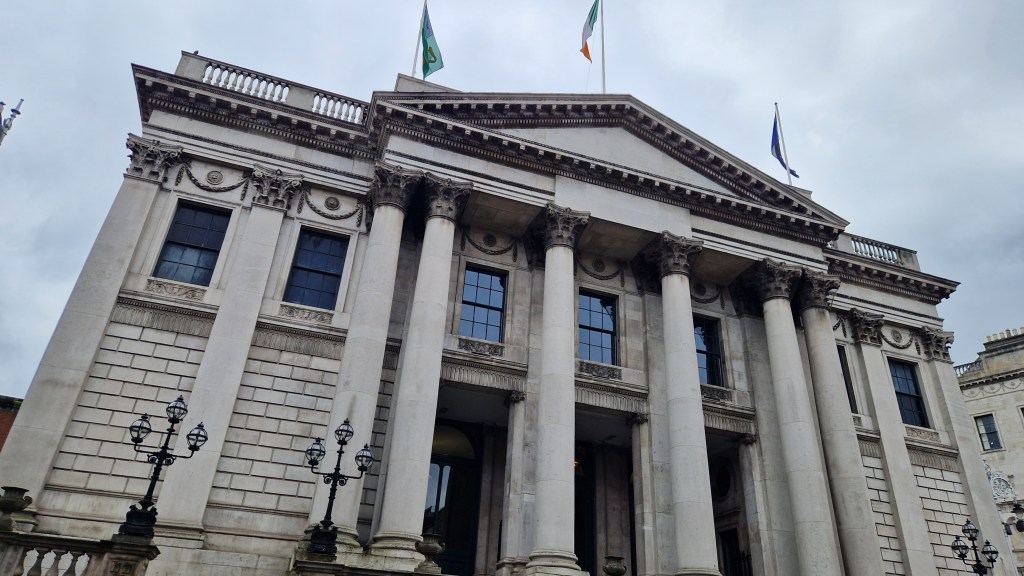
Over lunch we decided that we’d head up to Dublin Castle where we could do a self-guided tour of the State Apartments. Enroute to the castle we passed Dublin City Hall, an impressive building sitting at the top of Parliament Street at the junction with Dame Street. Constructed between 1769 and 1779, Dublin City Hall was originally used by the city’s merchants as the Royal Exchange but in 1850 was purchased by the City Corporation for use as the City Hall. The building was held as a garrison by the Irish Citizen Army during the 1916 Easter Rising and it was not far from the building, at Dublin Castle, where guard James O’Brien became the first casualty of the rising.
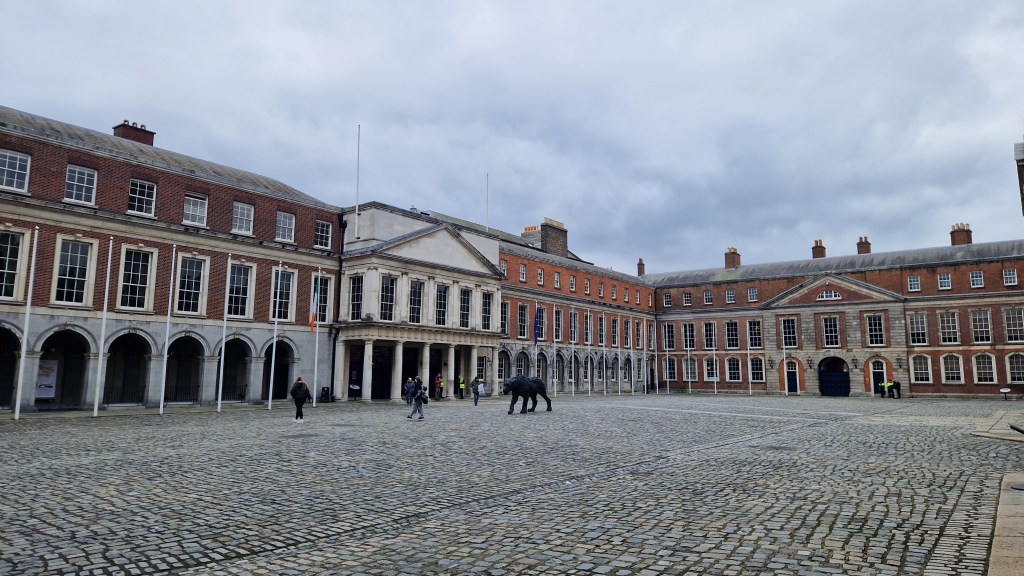
Rather than head up Castle Street directly to the main Castle courtyard, we headed along Palace Street and entered the castle via the eastern gate between the Record and Powder Towers. We arrived around 15 minutes before one of the guided tours of the castle began and so decided to pay the €12 for this as it covered parts of the castle we wouldn’t be able to see otherwise.
The tour started with us heading across the courtyard back to where we had come from and to a door next to the remains of the Powder Tower. This took us into the undercroft of this part of the castle which contains a small part of the flow of the River Poddle and the surviving remains of earlier fortifications. Having headed down to the steel walkway that has been installed two or three floors underground to allow groups to explore this area, we headed back up to ground level and to the next stop, The Chapel Royal.
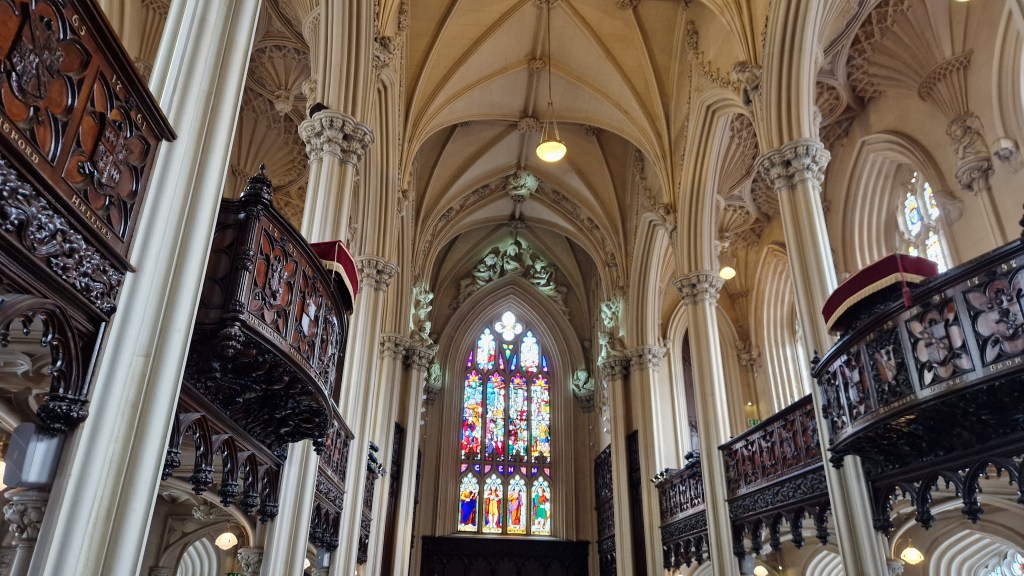
With the exterior walls being built of limestone, The Chapel Royal does not initially seem unusual, however upon closed inspection of the inside, its construction is quite fascinating. Built on soft ground near the castle’s original moat, The Chapel Royal needed to be as light as possible and so, not only was it constructed with a timber frame but the interior is also all made of wood, with the pillars and detailing all painted to look like stone.
The interior of The Chapel Royal was beautiful, with colourful stained glass windows, numerous coats of arms carved into the woodwork and a pipe organ which is one of the largest I’ve seen but unfortunately doesn’t work. Since The Chapel Royal was originally closed due to structural problems in the 1980s, it is no longer an active place of worship, however thankfully it was restored and re-opened in the 1990s and is open to the guided tours and occasionally for concerts and other events.
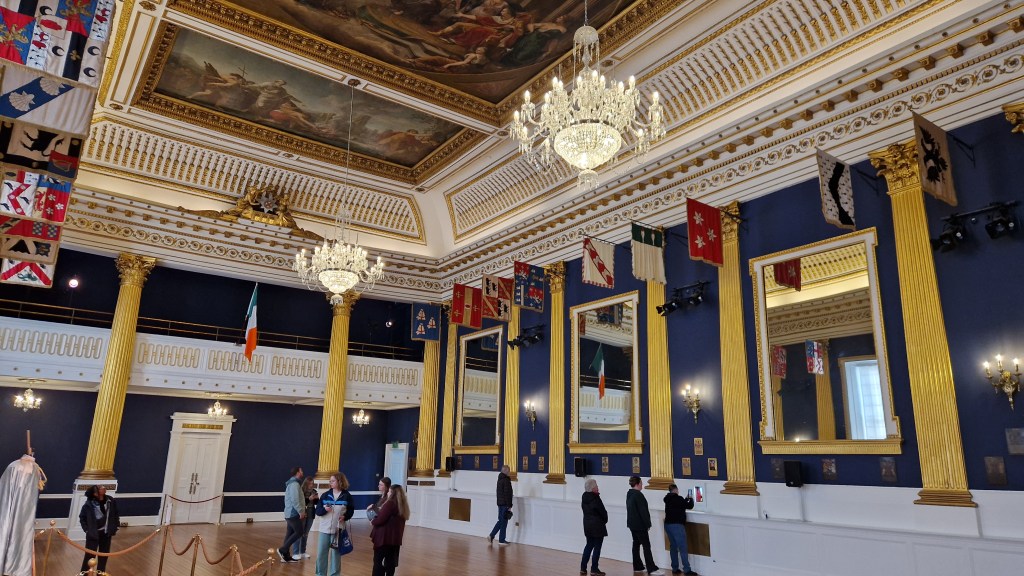
From The Chapel Royal we headed back into the main castle courtyard and to the State Apartments, the only part of the castle visited on the tour that can be visited when not on a tour. Our guide took us around the various rooms of the apartments, giving us some of their history before ending the tour in Saint Patrick’s Hall, the grandest room of the State Apartments and allowing us to continue exploring at our own pace.
Having looked around the State Apartments a bit more, we felt we had got more than our money’s worth and so decided to head to the next place we wanted to visit. The George’s Street Arcade was recommended to Beth by a friend and the collection of independent shops, cafés and food vendors is certainly worth a look around.
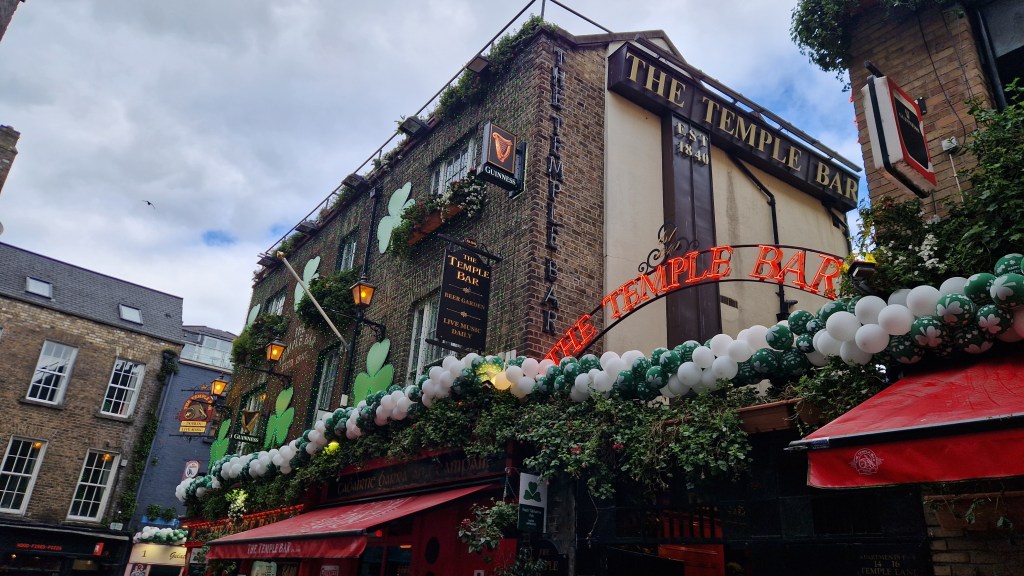
From the George’s Street Arcade we headed back towards the River Liffey and decided to tick off something we knew was a tourist trap but we could atleast we could say we had done it. Temple Bar is famous for being the centre of Dublin’s nightlife, however the flower covered pub, The Temple Bar, is a tourist attraction 24/7. We headed inside to have a break and enjoy possibly the most expensive drinks we have ever bought, whilst enjoying the performance of a local musician.
Our penultimate stop in Dublin was Trinity College, Ireland’s oldest university and one of the seven ‘ancient universities’ of Great Britain and Ireland alongside the Universities of Aberdeen, Cambridge, Edinburgh, Glasgow, Oxford and St Andrews. Trinity College is home to the Book of Kells, and you can pay €25+ to access ‘The Book of Kells Experience’ which allows you to see the religious text as well as visit Trinity College’s Old Library. Despite these tourist attractions costing a significant sum to entre, the grounds of the campus are open to the public for free during the day and despite the college being one of Dublin’s main tourist attractions, can provide a respite to the hustle and bustle of the city. We decided to just sit and people watch for a while, before heading back into the city to catch a tram a few stops to our final stop of the day.

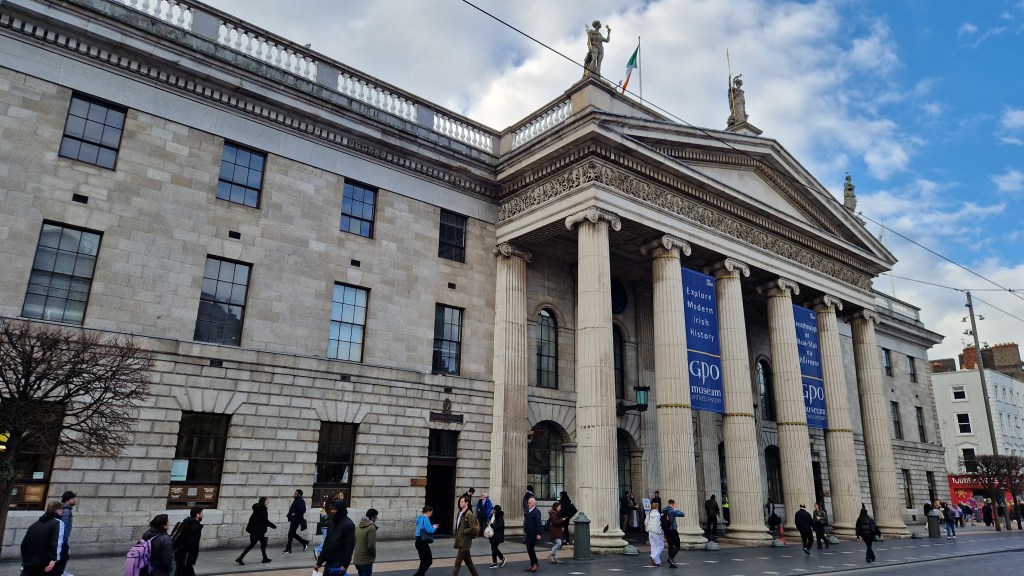
Having paid €9 for the Leap Cards earlier in the day, I was determined to use them at least once and so we took possibly the most expensive tram ride of our lives, two stops from Dawson to O’Connell-GPO and the General Post Office (GPO). The GPO is the former headquarters of An Post, the Irish Post Office and still operates as a registered post office, however it is also one of Dublin’s, and Ireland’s, most famous buildings. Serving as the headquarters of the leaders of the 1916 Easter Rising is a key part of the city’s and country’s history.
It was outside the GPO that on 24th April 1916, Patrick Pearse read the Proclamation of the Irish Republic, declaring Ireland’s independence from the United Kingdom and during the course of the rebellion the building was destroyed by fire, not being rebuilt until 1929. The GPO now houses a museum, “GPO Witness History” that focuses on the Easter Rising and has on display an original copy of the Proclamation of the Irish Republic. Unfortunately, we didn’t have time to visit the museum, although it is definitely on our list of places to visit when we return to Dublin in the future.
With our time in Dublin coming to an end, we headed back to the north bank of the River Liffey to catch a bus back to the airport and it was here we encountered something else Dublin is famous for, horrendous traffic! Thankfully we’d left plenty of time to get the bus back, but we ended up waiting around 40 minutes for what is advertised as a 15-20 minute service. We were also lucky with our positioning at the bus stop as we managed to be the first onboard, and some of the people furthest from the doors ended up being left behind.
As with my previous visits to Dublin, I really enjoyed exploring the city, although admittedly this time wasn’t without some stress. Given the city is easily visited as a day trip from the UK, we’ll definitely be back, even if that’s only to visit the GPO museum which we didn’t get chance to do this time.
 Flights & Times
I just returned from Dublin. You are right about the traffic! Thanks for the view of the Castle. We didn’t get to see it while we were there.
LikeLike