
Operator: European Sleeper
Headcode: ES 453
Route: BRU-BER
Class: Sleeper
Seat: C3 S21
Date: Friday 5th January 2024
After an afternoon exploring the Belgian capital (read about that here), I headed back to Brussels Midi/Zuid station with plenty of time to collect my back, grab a waffle and an overnight picnic from some of the shops in the station and get my self ready for a journey with Europe’s newest Sleeper operator. From Brussels I was travelling with European Sleeper through Belgium, The Netherlands and Germany to the capital of the latter, Berlin.
Unfortunately, European Sleeper tickets don’t provide access to any lounges and in fact I don’t believe there is even a first-class lounge for those travelling with Eurostar (formerly Thalys), DB or SNCB. European stations do display paper timetables for the entire day including the platform numbers they are scheduled to depart from and so I headed up to platform 6 around 40-minutes before departure ahead of the service being displayed on the station screens.
As I should have expected, not long after having sat down to wait on platform 6, a member of Eurostar staff helping passengers boarded the correct half of their services advised that the platform for my service had been changed to platform 3. Heading back down and over, I settled down for another 10 minutes or so to then find once again that the platform had been altered to platform 7. Really, I should have just stayed on the main concourse until it was on the boards, however the limited seating had been my motivation to head to the platforms.
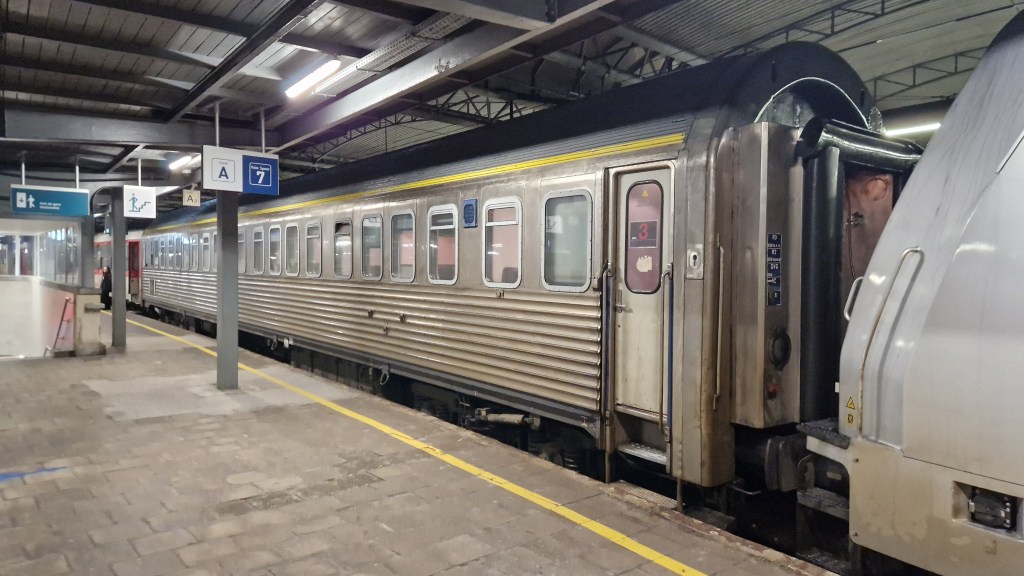
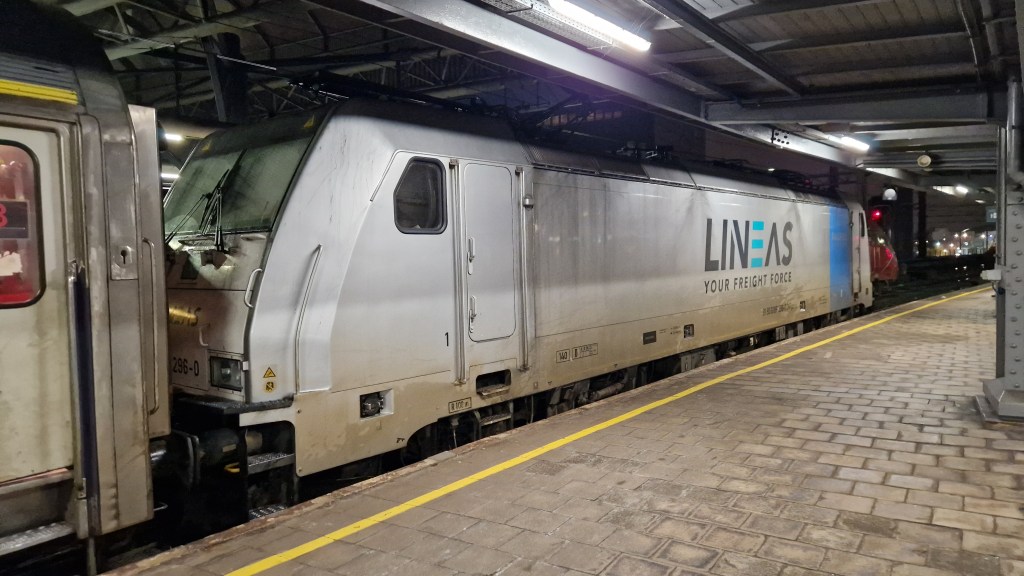
With around 15 minutes to go before departure I was on the correct platform, however had to spend a few minutes getting my bearings owing to the absurd formation of the train with coaches 2 and 4 at the rear, but coach 3 being at the front immediately behind the loco. After a quick stop to get a photo of our locomotive I boarded the sleeper carriage to find my room. European Sleeper operates a single sleeper carriage on this service (combined with some couchette and seater cars) and this certainly has a unique look, with American style fluted stainless steel outer walls. Originally constructed in the mid-1950s, the carriage was completely rebuilt in the 1990s to its current layout along with having received a more recent refurbishment.
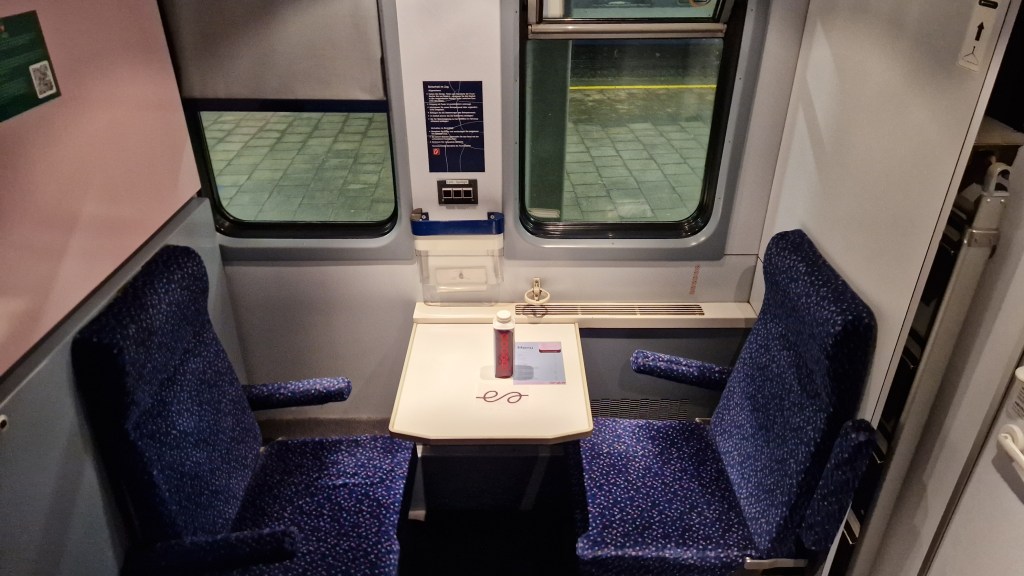
Onboard all of the sleeper rooms can accommodate up to three people, with the top bunk being fixed in place above head height and the middle and lower bunks folding away. Unfortunately, with the last major overhaul having happened in the mid-1990s, facilities are fairly limited with a single shaver plug above the sink, no Wi-fi and the fixtures being a bit rough around the edges. However, the bonus is that, even with the bottom bunk lowered, there is a fixed seat to relax in in the evening which is pretty comfortable. Each room has a sink hidden in a cupboard but no ensuite facilities, with two toilets being available at the end of the corridor next to the sleeper attendant’s office.
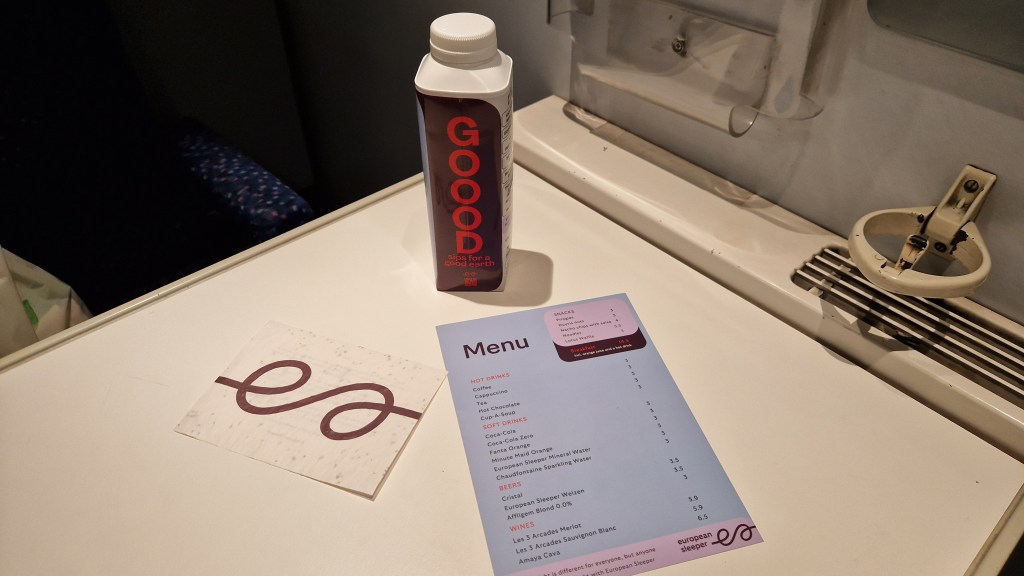
Settling into the room, I found a bottle of water along with a ‘plantable’ welcome card and a menu of snacks and drinks available for purchase. We departed one minute late and not long after the sleeper attendant came round to complete a ‘check-in’ process, offer a free drink from the menu (I went for the European Sleeper Weizen Beer) and confirm my choice of drink for breakfast (I of course went for coffee).
After departure from Brussels we were scheduled to have nine stops enroute to Berlin with one in Belgium, seven in The Netherlands and one in Germany. The stop at Antwerp went without issue and we were soon heading through the Belgian and Dutch countryside to Roosendaal, although on this section of the journey we certainly seemed to ‘trundle’ along and it seemed to take forever to cross the relatively short distance to the Dutch border.
From Roosendaal we took the slower ‘classic’ route to Rotterdam via Dordecht and as we crossed the Hollands Diep on the original 19th century Moerdijk bridge we could see the high-speed HSL Zuid crossing the newest of the three bridges above us. Following our stop in Rotterdam I managed to grab the attention of the sleeper attendant as they passed in the corridor and had them lower the bottom bunk so I could grab some sleep.
The stops at Den Haag HS, Schiphol Airport and Amsterdam Centraal passed before I was able to get to sleep and as we headed out of the Dutch capital there were a couple of fairly hard stops between Centraal and Science Park stations. Whilst the sleeper rooms are comfortable, they are certainly a little rough around the edges and during the harsher of one of these stops, one of the blinds popped up. It also seemed to be impossible to turn down the PA system within the room and so the announcements made it hard to settle down until the guard stopped for the night.

Having fallen asleep not long after Amsterdam Centraal, the stops at Amersfoort, Deventer and Ban Bentheum all passed whilst I slept. With an early arrival into Berlin, I had set my alarm for 0500 and woke as we were stabled in a loop near Spandau on the outskirts of Berlin. Getting ready for my day in the German capital, the room’s plumbing seemed to struggle with pressure and so filling the sink took a while.
45 minutes before our scheduled arrival into Berlin Haupbahnhof the guard made a good morning announcement in English, French and German and not long after this breakfast was delivered to my room. This consisted of a croissant and a small ‘selection box’ of bits and pieces along with a cup of coffee, with the selection of food being pretty reasonable although the seed crackers were a bit odd.

Leaving our loop around 0600, we passed the Grunewald depot of BVG (Berlin’s public transport operator, where the units forming morning U-bahn services were beginning to depart. Adjacent to the Olympia-Stadion station on line U2, various chords and junctions allow trains access from this depot to the U-bahn network.
Our approach to Berlin Haupbahnhof took us along Berlin’s Stadtbahn, the 11 kilometres of raised railway that runs through Berlin’s city centre from Charlottenburg station in the east to Ostbahnhof in the west, carrying both S-bahn suburban services as well as regional, intercity and international trains. Arriving at the multi-level Central station at 0624, we were one minute early on the published amended schedule and six minutes late compared to the one at the time I booked.

My journey with European Sleeper was a pleasant one, although certainly not the most luxurious that I’ve had, with the sleeper car needing a bit of an update. Its good that another sleeper operator has joined the European market and since European Sleeper have begun operating, NightJet have also announced a Brussels to Berlin service. With European Sleeper having also recently announced an extension of the service to Dresden and Prague, I’m looking forward to trying out their service again in the future and seeing whether there have been any improvements.
Lounge 0*
Seat/Facilities 3*
Food 3*
Service 5*
Punctuality 5*
Overall Rating 16/25 (read about my rating system here!)
 Flights & Times
5 thoughts on “BRU-BER European Sleeper – Single Sleeper”