
Arriving in Aarhus, the largest city on Denmark’s Jutland peninsula and the country’s second largest city, on a Ryanair flight from Stansted (read about that here), I headed outside the airport’s shiny new terminal to catch the airport bus into the city.
Timed to meet arriving and departing flights, the 925X bus is the only way to really get from the airport to the city on public transport and costs 115DKK (£13.25) one-way for the 45–50-minute journey. The service is run with modern coaches which are comfortable with plenty of leg room and include air vents, reading lights, USB and European power sockets.
The 925X drops you off outside Aarhus’s main railway station from where you can also catch the city’s ‘Light Rail’ [Tram] system. I’d timed my visit to be on ‘Car Free Sunday’ which appears to be the last Sunday each month and during which there is free travel on the Light Rail and local buses (not the 925X) within the city.
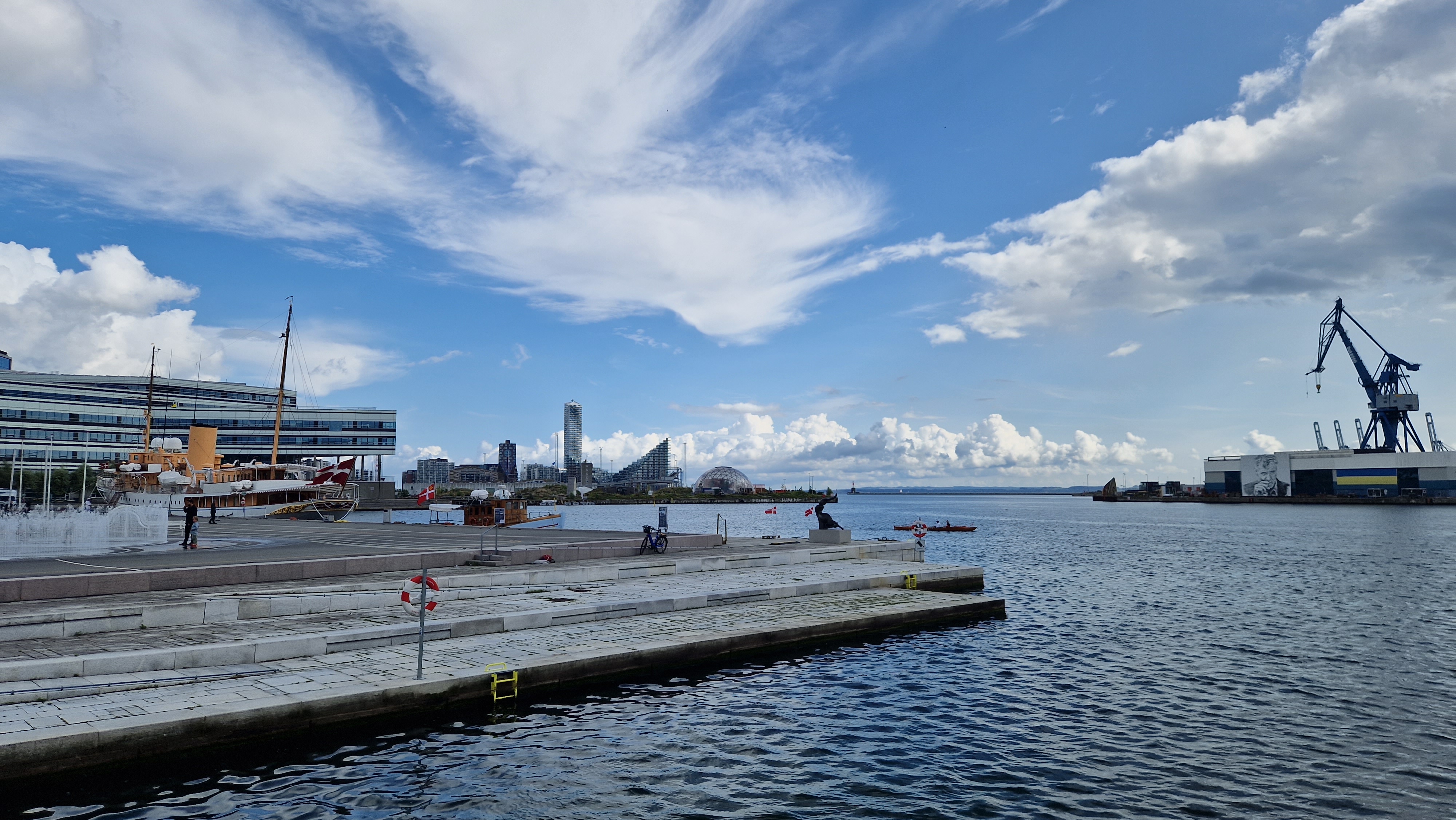
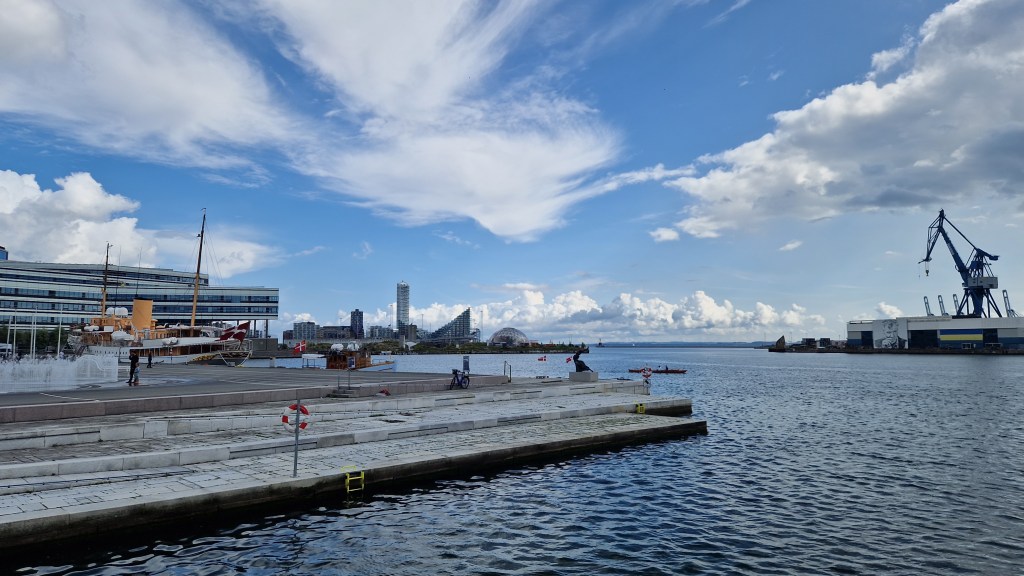
After a short hop of two stops on the Light Rail, I got off by the harbour and spent a few minutes admiring the view of the regenerated inner harbour, including the historic dock crane and customs house that stand as a reminder to the harbour’s original use. There was also a restored steam ship moored on the quay, but I didn’t write down its name so have no idea what it was or what it was doing there.
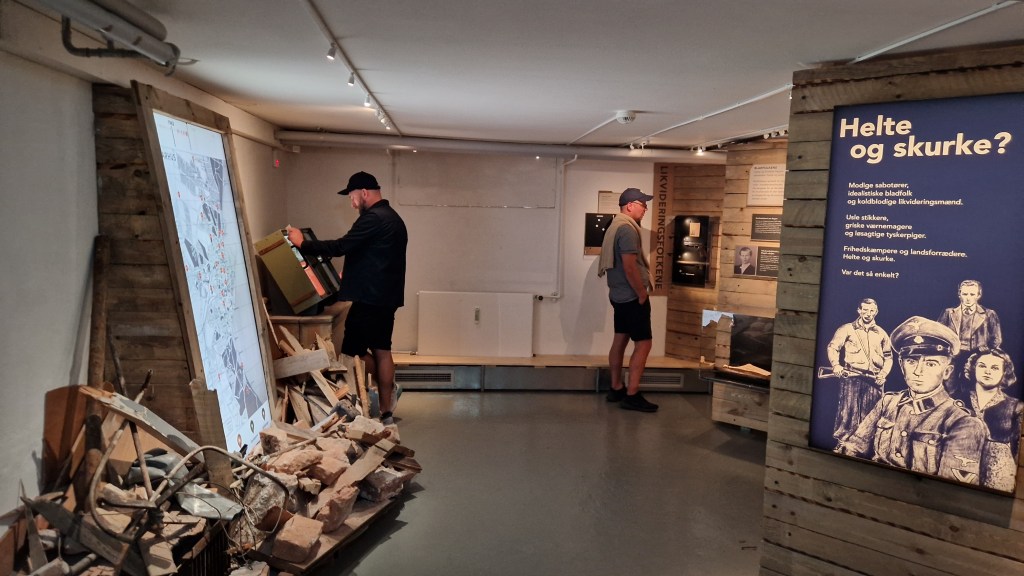
A short walk from the harbour front is the Occupation Museum, telling the story of the city’s time under Nazi Occupation and housed the former HQ of Gestapo. Entry cost 75DKK (£8.64) and a booklet of English translations for the displays is provided at the ticket desk. There’s also German & French (I think) translations available.
The museum was really interesting and included real stories of individuals during the occupation, told by way of ID cards and readers in some of the display stands. The museum took about an hour, but could take a bit longer if you look at every item on display in detail (I skimmed over some of the smaller objects). Its definitely worth a visit though as Denmark is not necessarily part of Europe immediately associated with the war, the focus of school history lessons having been on the D-Day landings etc.
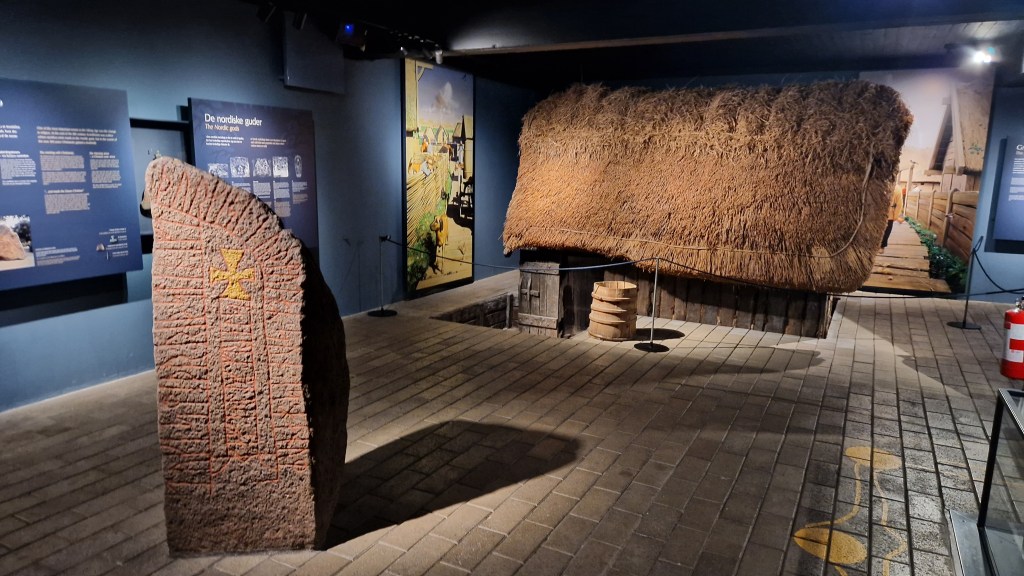
My next stop was the Viking Museum, located three meters underground at the level the streets were during the Viking period. This is a nice little museum, costing just 30DKK (£3.46) entry via an honesty machine at the entrance and only took me around 30 minutes to look around. There’s a Viking longboat, model of the city during Viking times and a mock-up of a Viking Pit House, along with various displays telling you about the city during that era.

With two museums under my belt it was time for a late lunch and so I headed across the road from the Viking Museum to Mackies’ Pizza. Whilst pizza is not a traditionally Danish food, Mackie’s Pizza is an Aarhus institution. I opted for the Mackie’s Special followed by some Jamaican pancakes and washed down with some local Tuborg beer. In total this came to 289DKK (£33.30), a little on the pricier side than I’d usually pay but this is Scandinavia.
As I was sitting any enjoying my lunch, I was able to witness a parade that seemed to be part of the Aarhus Festival. With a band, people in costume and generally a lot of noise, the parade was followed by a lot of locals into the main square, before returning 30-minutes or so later. Having had a look online, the festival is quite a big thing with various free music events at the city’s Music Hall along with lots of other things.

Day 1 pretty much ended there as I headed to my hostel to check-in and have what turned out to be a danger nap… So an early start to Day 2 to make up for lost time led to me being at Cross Café for breakfast not long after they opened at 0830. Here they allow you to choose three items from a selection for 115DKK and this plus a coffee and a fresh orange juice came to 242DKK (£27.88).
From Cross Café I started my self guided tour of Aarhus, heading first to Lille Torv (Little Square), one of the oldest public squares in Aarhus and situated in the Latin neighbourhood. This area was originally an area of marsh outside the city but was drained in the 13th century with the square created in 1250. Throughout the 20th century, Lille Torv was a hub for the city’s trams, resulting in it becoming congested and a challenge for pedestrians, however the reopening of the Aarhus river in the late 1990s resulted in the trams being rerouted and the square becoming fully pedestrianised.
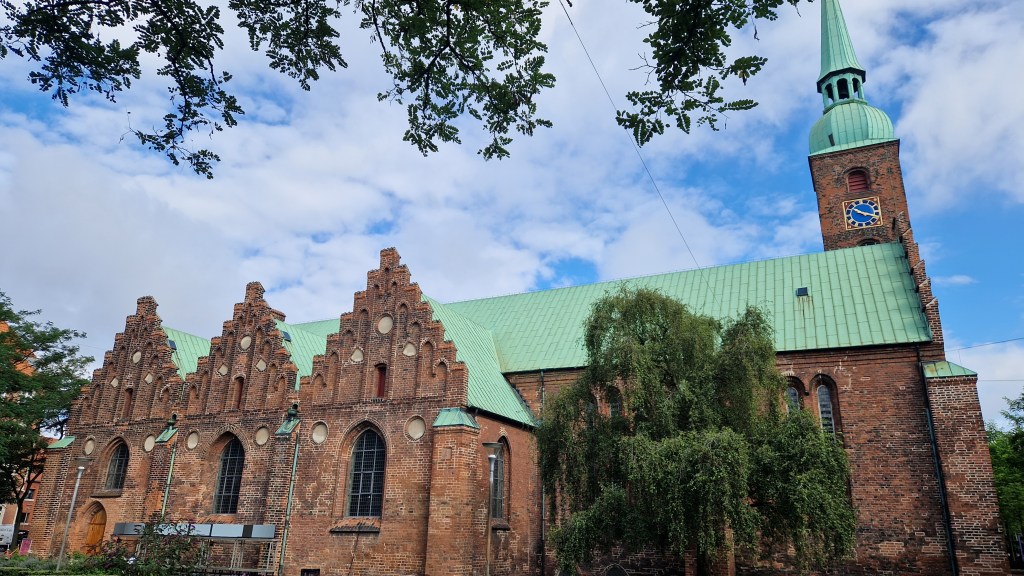
Just down the road from Lille Torv is Vor Frue Kirke, the Church of Our Lady, formerly the priory church of the Dominican Our Lady’s Priory. Originally constructed in the 11th century, the church was completely rebuilt in the 13th century and expanded over the next 300 years. Only the stone crypt remains of the original church and you can see this and the rest of the beautiful interior for free when the church is open.
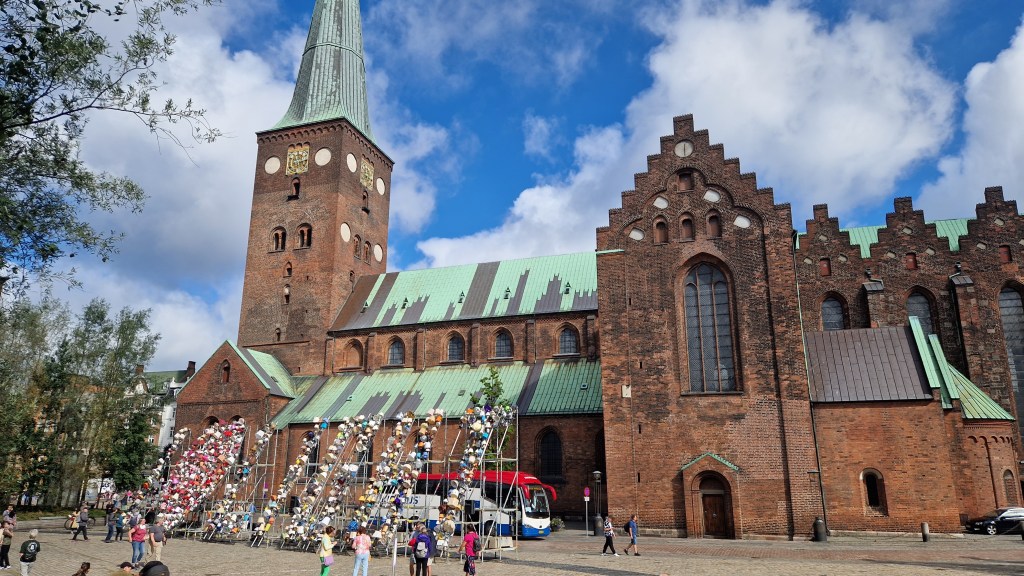
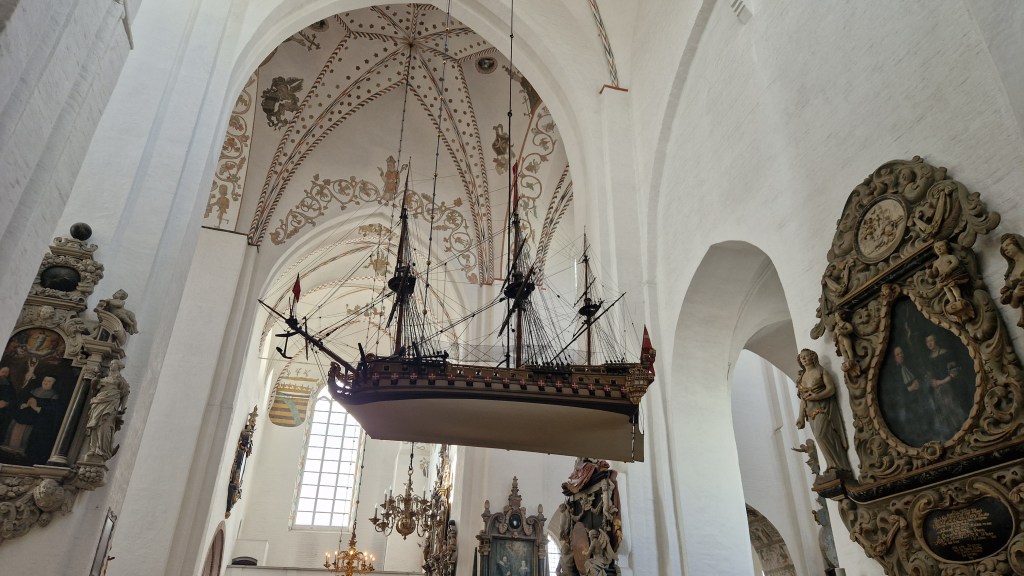
Heading back to the centre of the city, my next stop was another church, the Aarhus Domkirke or Aarhus Cathedral. Again, entry is free so head inside to have a look around and see if you can find the model ship hanging from the ceiling. This is reported to have been made in Holland for Russian Tsar Peter the Great, but washed ashore when the ship it was being transport on sank during a storm. Found by some fishermen near Skagen it was subsequently offered as a gift to the Cathedral and is the largest ship in any Danish church.
Also located on Bispetorv (Bishop’s Square) is the Aarhus Theatre, a grand 19th century building that replaced the old theatre that was nicknamed Svedekassen (The Sweat Box). Constructed in just two years, the Art Nouveau building opened to the public on 15th September 1900 and is the largest provincial theatre in Denmark. On the way to my final stop of the day from Buspetorv, I passed Aarhus’ most famous piece of street art, ‘The Seagull’s Kiss’ a large mural painted onto the end of a house. Why its here or what it represents I’m not sure but it’s a bit odd.
With an hour or so before my bus back to the airport, I headed for Aarhus Street Food, a large market of collaborating street food traders housed in what I think is an old bus garage, next to the city’s bus station. Housing 30 or so food and drink traders, there are large indoor and outdoor seating areas with plenty of space to hold large groups of friends. Given I turned up as it opened at lunchtime, it was reasonably busy and the food I had from ‘The Burger’ was excellent. The portions were huge and I definitely suffered from my eyes being bigger than my stomach so unfortunately didn’t manage to finish everything before heading back to the station.
With my time in Aarhus coming to an end (or so I thought – foreshadowing for the next blog) I caught a very busy 925X back towards the airport. Aarhus is a lovely little city, really easy to get around and with lots to do. If you have more time there are the larger ‘Den Gamble By’ and Steno museums to explore, both of which definitely look worth a visit. In summary, if you have a long weekend free and are wondering where to go, head to Aarhus!
 Flights & Times
Interesting report. Breakfast looked interesting, if expensive! 😀
LikeLike