
Having arrived in Rimini onboard a Trenitalia Frecciarossa from Bologna (read about that here), I had two nights and about one and a half days based on the Adriatic Coast. Whilst I wanted to spend some time exploring the city itself (more about that next week), the main purpose of my stay was to tick off another micro-nation, San Marino.
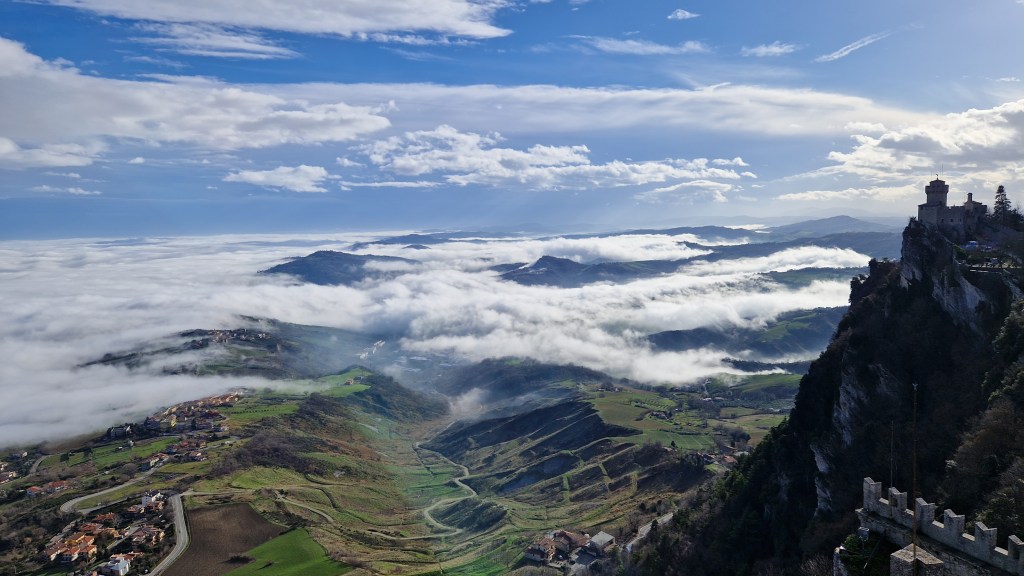
The world’s fifth-smallest nation, San Marino covers just over 61km2 of the Apennine Mountains and their foothills. San Marino has an estimated population of 34,892, meaning you could fit the population into Leeds United’s Elland Road stadium and have just short of 3,000 empty seats. Not that you’d want to do that of course… With the north-eastern tip of San Marino sitting less than 10km from Rimini, the Italian city has become the gateway to San Marino.
To reach the mountainous micro-nation from San Marino there is a semi-regular bus service which leaves from a stop close to Rimini railway station. During the winter there are eight buses in each direction each day, with the timetable increasing during the summer. Tickets cost €6 each way and can be purchased from the Tabaccheira newsagents/money shop directly opposite the station (two doors down from Burger King). The bus stop is a bit further down the road, outside the Hotel Napoleon and is the same stop that the airport shuttle bus leaves from.
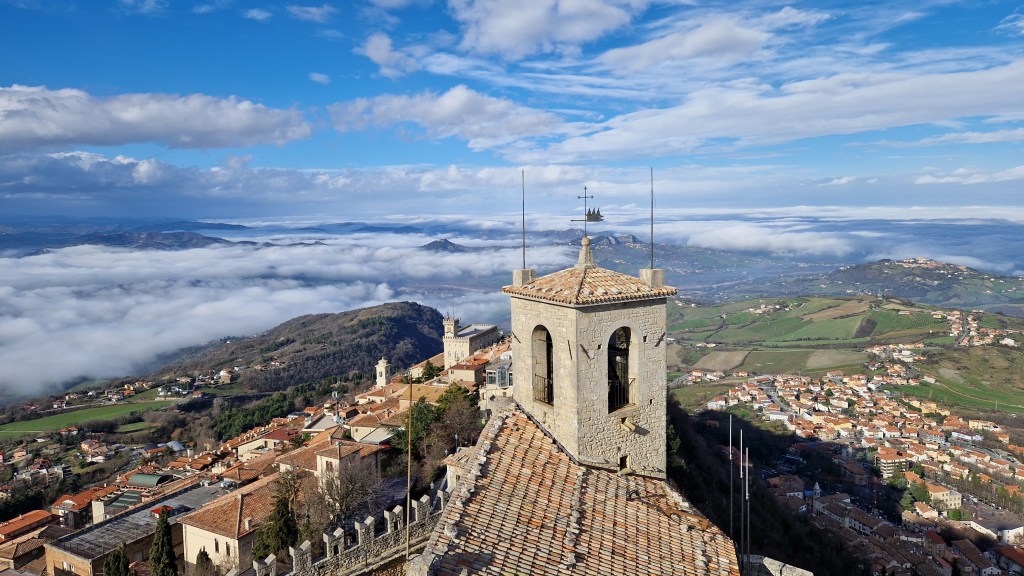
As the bus makes it way out of Rimini, it provides an opportunity to see some of the city’s sights, including the Arco di Augusto. The journey to the City of San Marino (capital of the Country of San Marino) takes about 50 minutes, although the border is crossed about halfway through the journey. As you’d expect, the border is rather unremarkable, with just a small sign indicating you’ve entered San Marino.
With the weather in Rimini rather grey and miserable, I was concerned about how my day in San Marino would turn out and as we began to climb, much of the lower part of the country, including the national stadium, was shrouded in cloud. As I thought my fears were coming true, we passed through the top of the cloud base, and were treated to glorious views of mountain tops basked in sunlight.

At the San Marino end of the route, the buses use the small coach station on the western slopes of the city. From here, its really easy to enter the old town, with a lift providing access to the next ‘stepped’ level from where you can pass through the Gate of Saint Francis into the streets of the old town.
The City of San Marino is located on the western slopes of the country’s highest point, Monte Titano. As such the streets of the city are all quite steep, with the zig-zag pattern eventually leading to the Guiata Tower, the city’s former fortress and prison. Deciding to climb to the top first and work my way back down through the city, it was the Guiata Tower that was my first destination.
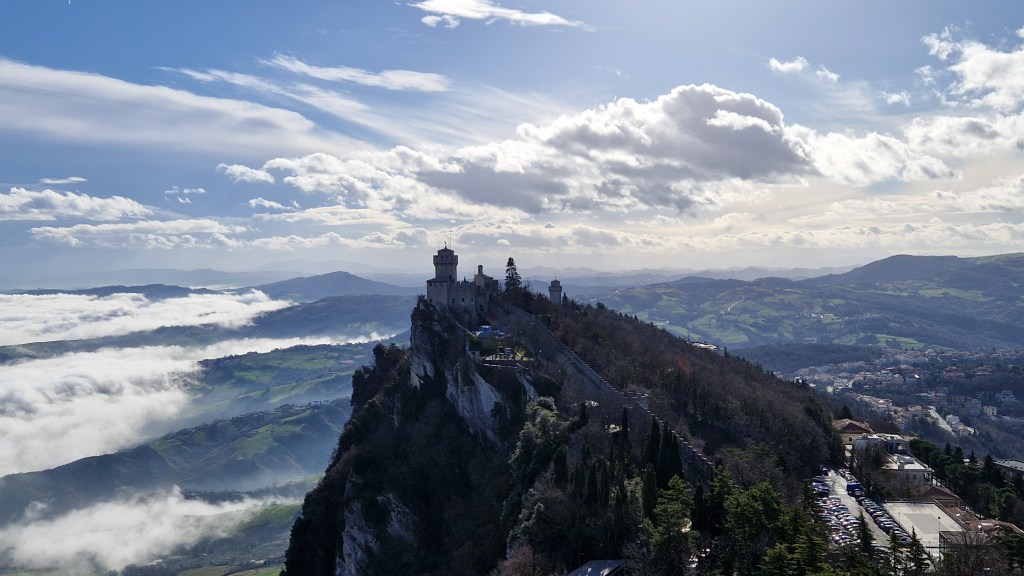
The Guiata Tower is one of the Three Towers of San Marino which sit on the peaks of Monte Titano and are a symbol of the country, appearing on the national flag and coat of arms. Whilst the Cesta Tower (the 2nd tower) sits on top of Monte Titano’s highest peak, the Guiata Tower is the most famous. The 3rd of the Three Towers is the Montale tower, which sits slightly further out of the old town on the smallest summit.
Access to the Guiata Tower costs €3 and can be purchased either as part of a San Marino museums ticket or standalone. The museums ticket costs €8 and includes access to up to three of the museums that are run by the San Marino tourist board with there being seven to choose from, including both the first and second towers, the State Museum and the Public Palace.
Having climbed to the Guiata Tower, I was absolutely stunned by the views from the top and could see the entire city of San Marino. I’m pretty sure most of the country would be visible from the tower, however the sea of low cloud meant that I could only see the various mountain summits during my visit. As part of the Tower’s complex there’s also a small chapel and garden which you can explore, with the chapel being just inside the main entrance on the left.
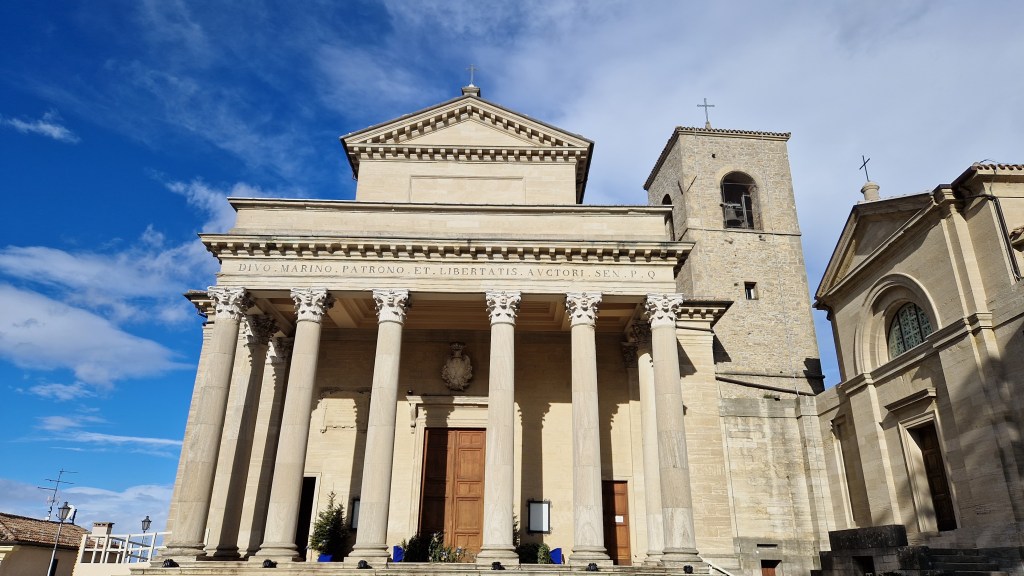
Having spent longer than planned staring at the views, I headed down the Guiata Tower and started to make my way back down through the city. My next stop was the Basilica del San Marino, San Marino’s main church and the co-cathedral of the Catholic Diocese of San Marino-Montefeltro. The present Neoclassical church was built in 1836 and replaced one dating from the 7th century, with relics of Saint Marino being enshrined within.

I decided not to go into the Basilica del San Marino and continued down to visit another place I could enter with my combined museums ticket, the Palazzo Pubblico. This is both San Marino’s city hall, parliament and seat of government and is a beautiful three-story building with a clock tower that sits overlooking the western slopes of the city. Topped with battlements, the Palazzo Pubblico was constructed in the late 1800s with a refurbishment completed the renowned architect Gae Aulenti in 1996.
With the combined museum ticket, you get free entrance into the Palazzo Pubblico, and are able to wander around the public areas at your own pace. There’s also an introductory video in Italian, which the staff kindly set up the subtitles on for me, which gives a great overview of the country and the building. Whilst the main hall of parliament isn’t fully open to wander around, you are allowed to enter through the doors into the hall and admire the stunning fresco on the back wall.

Having explored the Palazzo Pubblico as much as I was allowed, but with so much more to see, I decided to continue my wander around the city. Popping into the National Museum, another location included in my museums ticket, I had a quick look around to see what was on display and its very similar to a lot of city museums. Obviously being just a few hundred miles from the capital of the Roman Empire, there’s plenty of Roman artifacts along with other exhibits showing the country’s history.
With about 90 minutes until the next bus back to Rimini, I decided it was time to do the most important thing in San Marino, try some food. Finding a restaurant (Ristorante Bolognese) near the Chiesa San Francesco, I opted for an excellent seafood platter with some fries for good measure. I was stunned when the food arrived, along with some lots of free bread, as there was absolutely loads! The food was great and despite my best efforts I wasn’t able to finish it all. An added benefit of my pitstop was I missed the area of slightly higher cloud that came with rain and unfortunately blocked the view from the window for part of my meal.

Heading back down to the coach station to catch the bus back to Rimini, I was in awe at the small country of San Marino. I received such a friendly welcome from those I interacted with and was stunned by the views at every corner. San Marino needs to be top of your list of places to visit, and you can tie it in with a visit to Rimini as well. More about that next week!
 Flights & Times
Looks a wonderful place to have visited! Well done on crossing another “small ‘un” off the list! 😀
LikeLike