
This is the second of two blogs covering our time based in the city of Dresden, with part one pausing just before lunch on our third day exploring the city. That morning, we had visited Dresden’s beautiful Frauenkirche before jumping back on the sightseeing bus tour round to the Lingnerschloss, one of the trio of Schlosses that sit high above the north bank of the Elbe out towards the Blaues Wunder brücke. If you want to check out the other posts from our holiday so far, the first part of our time in Dresden is here, with other posts here, here, here, here, here and here.
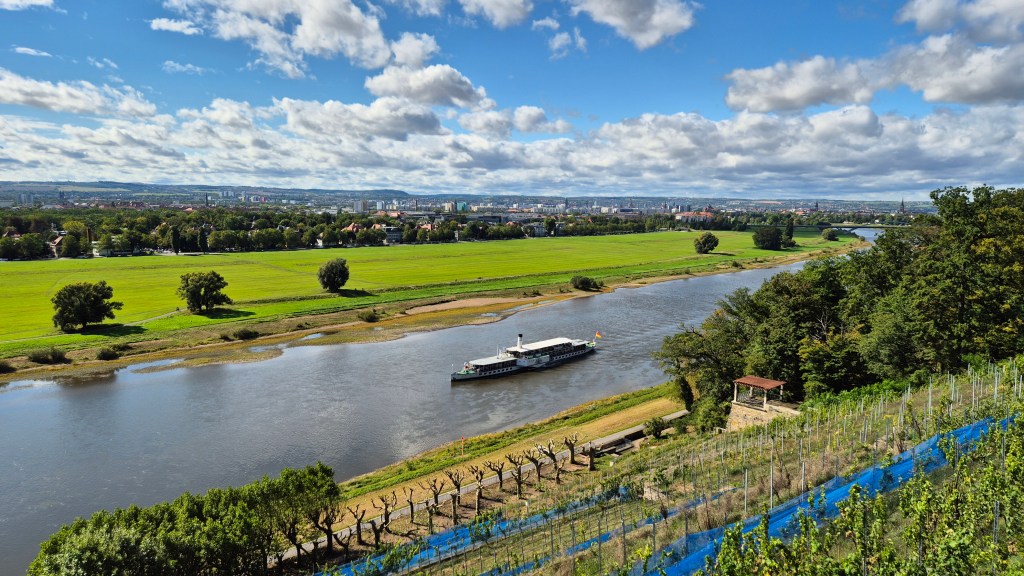
The Lingnerschloss is officially known as Villa Stockhausen, however its more widely known name comes from its most famous former owner and resident, Karl August Lingner, inventor of Odol mouthwash. Constructed in the 1850s on behalf of Prince Albrecht of Prussia as a home for his chamberlain, however the Prince himself called the schloss home until his own schloss, the neighbouring Albrechtsberg Castle was completed. These days the Lingnerschloss is an events venue, with a restaurant and bar situated on either side of the terrace, with the former serving some excellent local dishes such as the Saxon sausages and mash with sauerkraut that I went for. Food always tastes great though when accompanied by a refreshing local beer and stunning views!
After lunch, we headed back out to the main road to catch the sightseeing bus back to the city as, by this point, I had done the first half of the tour twice but hadn’t yet done the second half. Unfortunately, we ended up waiting more than half an hour for a bus, and in that time watches multiple trams pass us on their way back to the centre, however eventually a bus arrived. The second half of there tour took us around parts of the Neustadt or New Town, including the old Stazi prison, the State Chancellery, Finance Ministry and Japanese Palace. The latter was originally built in 1715 but was extended between 1729 & 1731 to house the Japanese porcelain collection of King Augustus the Strong.

The bus tour is meant to finish by heading across the Elbe via the Carolabrücke, however following the bridge’s collapse in September 2024 it heads back across the Augustus Bridge and takes a diversion along the south bank of the river to get back onto the final part of the tour. Unfortunately with the road closures in place as a result of the Carolabrücke’s collapse, this final stretch of the tour took much longer than expected and by the time we got back to the centre, we didn’t have too much of the day left. Our plan had been to visit the museums of the Residenzschloss, however with only a couple of hours left until it closed, it wasn’t really worth it at this point, so we instead went for an ice cream at Sächsische Eismanufaktur on Schloßstraße and visited the Lindt shop before heading back to Freital.
Our next day exploring the area around Dresden came after our day trip to Prague and, having got back late after a long day, we decided to have a more leisurely day and tick off something a bit closer to our accommodation. The Weißeritzalbahn, or Weisseritz Valley Railway, operates from Freital-Hainsberg station and is one of three steam operated narrow gauge railways that are ran by the Saxon Steam Railway Company, which is part owned by the regional transport authority VVO. With the line running just over 26km along the Weisseritz Valley, the Weißeritzalbahn climbs around 350m on the 86 minute journey from Freital to Kurort-Kipsdorf. We started off our day by doing the full length of the line to Kurort-Kipsdorf and having 20 minutes there whilst the locomotive took on water and ran round the train. Then it was back down the line for around half an hour to the town of Dippoldiswalde which seemed to be the largest town along the line other than Freital.
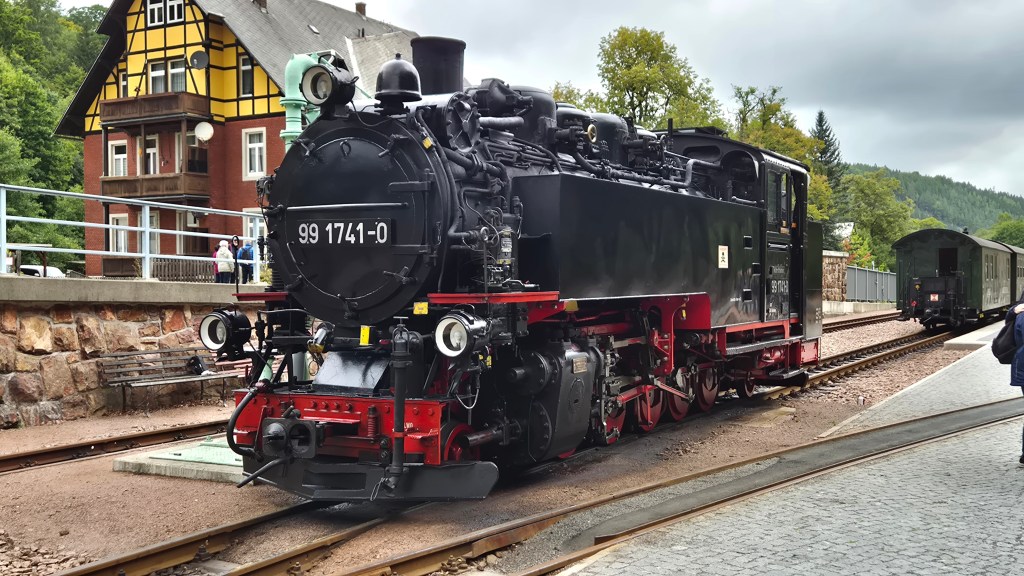
The standard Weißeritzalbahn timetable has two services that run the full length of the line, giving you around four hours at any of the intermediate stations if you decide to jump off and explore. On weekends and public holidays between the end of March and start of November, there is also a third later train which runs between Freital and Dippoldiswalde (and return) allowing you to either have a later start to your day or spend longer exploring. From Dippoldiswalde station we took a wander into town, having lunch at a Greek restaurant that has since closed down and taking a look around the market square, before we headed to the MiBERZ mining museum located in part of the Schloss.
MiBERZ is all about the early medieval mines that are underneath Dippoldiswalde and a lot of the surrounding area which was really interesting to learn about and definitely worth the €5 admission, although Google translate saved the day as there are no English translations. The mines lay forgotten until the area was hit by the 2002 Central European floods and since then have been extensively explored by archaeologists. As well as telling the history of the mines, the museum has lots of artifacts that have been recovered, including part of a manual wooden winch from the 12th century.
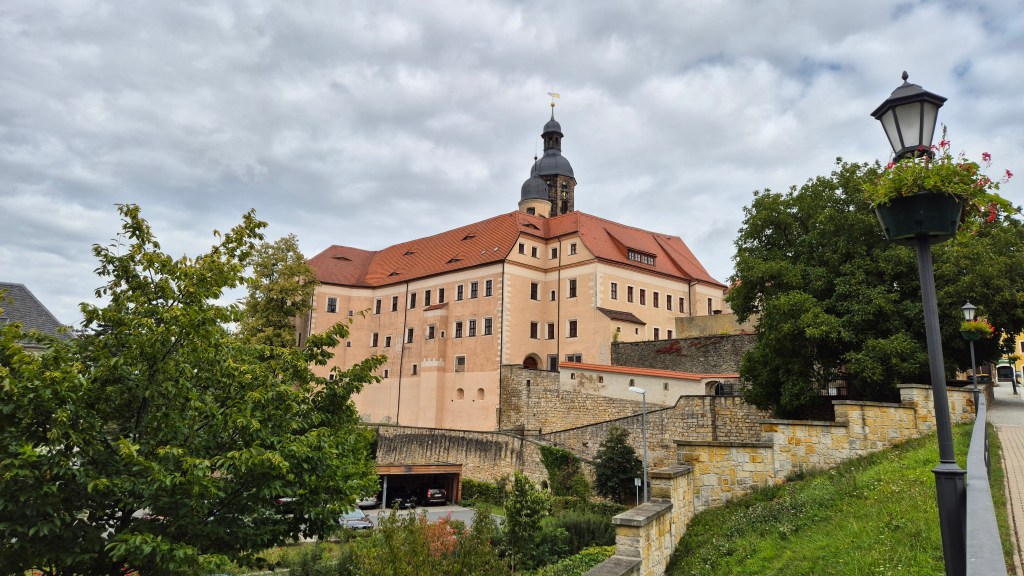
After our visit to MiBERZ, we headed to Café Achat for some coffee and cake before making our way back down the hill to the station. Dippoldiswalde is a nice little town and also has the City & Country Museum that we didn’t visit, so with lunch you can certainly make the most of four hours between trains in the town. The journey back from Dippoldiswalde to Freital is just under an hour and I spent part of this stood on the outside veranda of our coach to get some photos of the beautiful scenery and we headed back down the valley. As a relaxed day out, especially if you’re based out in Freital, the Weißeritzalbahn is a option. We got the 0925 departure and got back around 1630, having had four hours at Dippoldiswalde. A round-trip ticket is €30 each for adults and these allow you to break your journey in one direction.
Our final day in the city saw us splitting up into two pairs, and so rather than the ‘small group’ tickets we had been buying for the public transport, we got two ‘family’ tickets as these each cover two adults and are still cheaper than two individual adult tickets. Whilst Beth and her mum headed off to visit Dresden Zoo, her dad and I headed back into the city centre to do a walking tour, however started off back at Bistro & Bar Ecke Frauenkirche for a coffee (and 2nd breakfast). Our walking tour was with Walkitive, a company who run tours in more than 60 cities across Europe and started in the centre of the Neumarkt square in front of the statue of Martin Luther. Our guide, Dominica, started off by taking us through the history of the city from the tribes of the 6th century through the time of the Holy Roman Empire and to the modern era.
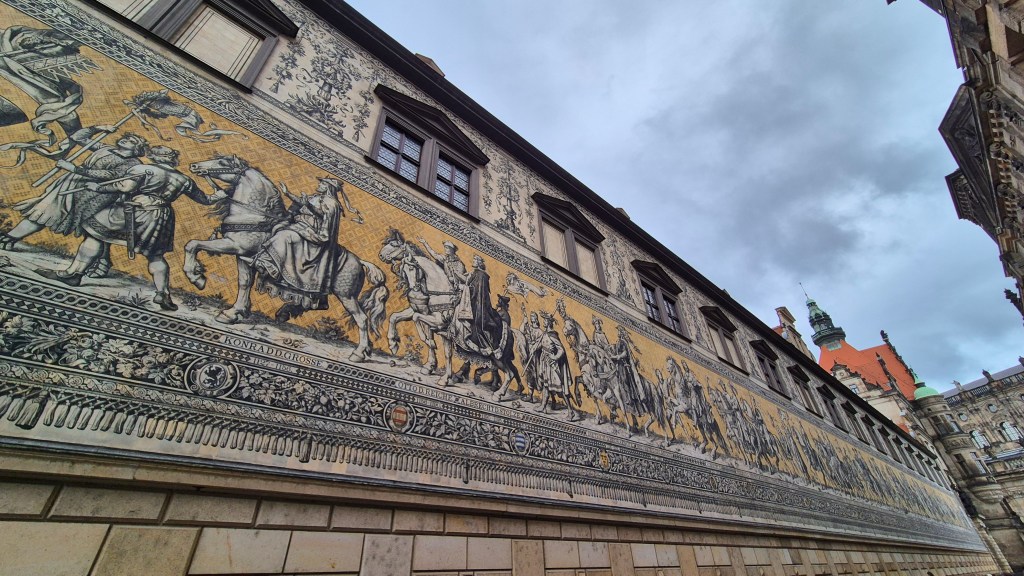
We headed out of the Neumarkt by way of Augustusstraße to the Fürstenzug, a large porcelain mosaic that features all of the rules of Saxony and has a cameo appearance at the end by artist Wilhelm Walther. This mosaic was originally painted between 1871 and 1876 to commemorate the 800th anniversary of the House of Wettin, but was soon replaced by the high-quality porcelain tiles that Dresden is famous for. From the Fürstenzug we headed round the corner into the courtyard of the Residenzschloss which our guide described as the “16th century version of Trump Tower” as it was converted from a fortress to a residential castle by Judas of Meissen as a way to show off his wealth and importance. The present day Residenzschloss was reconstructed between 1980 and 2007 with a mix of restoration and thoughtful modern additions such as unobtrusive clear roof over one of the courtyards.
From the Residenzschloss we headed towards the Altmarkt and the GDR era Palace of Culture which features the “Way of the Red Flag” mural on one side. After learning a bit more about the mural and the way of life during the GDR era, we headed inside to have a look at the public areas before being told about the bombing of Dresden by British and American forces on the 13th and 14th February 1945. These raids dropped high explosive bombs on the city followed by incendiary bombs, and the resulting fire storm that followed resulted in more than 25,000 deaths and more than 50% of the non-industrial part of the city being destroyed. In the latter half of the 20th century lots of the city was rebuilt, with parts being restored to their pre-war glory and others having a mix of styles as architectural preferences developed.
[Pic]
The final stops of the tour were Brühl’s Terrace overlooking the Elbe where we learnt about the history of European porcelain, which was created in Dresden as Meissen Porcelain and Zwinger, the palatial complex and gardens that hosts a ‘zoo’ of porcelain animals collected by Augustus the Strong, under who’s rule Meissen Porcelain was created. Whilst on the Terrace we also learnt about the Cathedral St. Trinitatis which was built as a Catholic church owing to the originally protestant Augustus II wanting to be King of Poland and showing the electors that he could be a Catholic King (I’m not entirely sure that’s how that works!)
After the tour, I decided to head to the Dresden Transport Museum as clearly after all the trains over the previous couple of days, I hadn’t had enough transport! Located just off the Nuemarkt, entry is €11 and there are collections covering road transport, rail, aviation and shipping. The displays in each collection tell the general history of that form of transport as well as Dresden’s own use of it, whilst also sharing the limitations of its development during the GDR era. I just took a general wander around the museum, spending around 90 minutes looking around, however there is lots of detail that I didn’t look at and also an audio guide via a QR code that if you want to use it. There’s also a model railway on the top floor that is ’displayed’ a couple of times per day, however my visit didn’t line up with these so all I was able to see were some glimpses through the glass.

With a bit of time before we had all agreed to meet up in the Altmarkt, I took a wander to the eastern end of the Altstadt to have a look at Kurländer Palais and City Museuk buildings before making my way back to the Palace of Culture for a drink in the café. This café seemed to have a similar vibe to many library cafés with it being a place locals visit to have a drink whilst taking some time to work or read. The only downside is that in the afternoons the glass frontage of the Palace of Culture creates somewhat of a greenhouse effect, with the café becoming very sunny and warm! Finally, I took a wander across the Altmarkt to the Holy Cross Church which is free to enter (or €5 to climb the tower) and has a beautiful white plastered interior to spend a few minutes admiring.
With us leaving Dresden the following morning and heading across Germany to our base for the 2nd half of our holiday, our time in the city was coming to an end. However, before heading back to our accommodation to pack, we did decided to enjoy some time exploring the Autumn Market that was taking place in the Altmarkt and have try some of the delicious food that was on offer alongside a beer or two. Ultimately Dresden is an excellent city to visit and one that I feel is still underappreciated, possibly in part due to the lack of direct flights from the UK. There is plenty to see and do within the city itself and its also a great base from which to explore wider Saxony or even head across the border into Czechia. So, if you want to visit somewhere a bit different for your next holiday in Europe, why not head to Dresden.
 Flights & Times