
For our two-week holiday in Germany, we had decided to split our time between two base locations and, having travelled from Peterborough by train, ship and more trains, we had arrived in our first destination onboard the European Sleeper. The city of Dresden is the capital of the German state of Saxony and third largest in the former German Democratic Republic after Berlin and Leipzig. As the historic seat of the Electors and Kings of Saxony, since the reunification of Germany in 1990 Dresden has become a cultural and educational centre of the country and is one of the most visited cities in Germany.
We were staying outside the city centre, in the town of Freital, and so purchased a “Small Group Day Ticket” covering two zones (Dresden and Freital) for €30.90 which covers up to five people on all the buses, trams and trains within the fare zones. There are also family tickets which cover two adults and up to four children, as well as individual day tickets, although if you’re travelling as a pair or a group the family and small group tickets end up working out as better value for money. The city has an extensive tram network that skirts the edge of the old town, as well as a good S-bahn network that connects the suburbs with the Haupbahnhof, so its easy enough to stay outside the city centre and travel in each day.
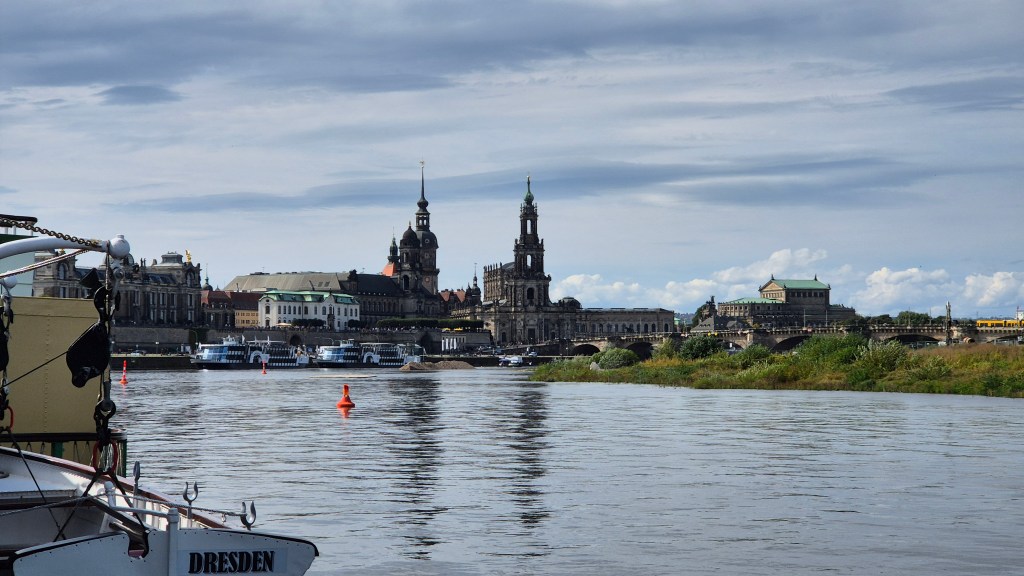
Not being able to check in to our accommodation until after 1500, we had a few hours to spend in the city before heading out to Freital and so, after leaving our bags in lockers at the station, we jumped on a tram to Theatreplatz on the edge of the Old Town. As first impressions go, Dresden knocks it out of the park with beautiful historic buildings all over the city centre that genuinely left me speechless. More impressively is that all the buildings are reconstructions, with much of the city having been destroyed by British and American bombing towards the end of World War 2. During both the pre and post reunification eras, the local government has supported the reconstruction of significant historic buildings, making Dresden the impressive city of culture that it now is.
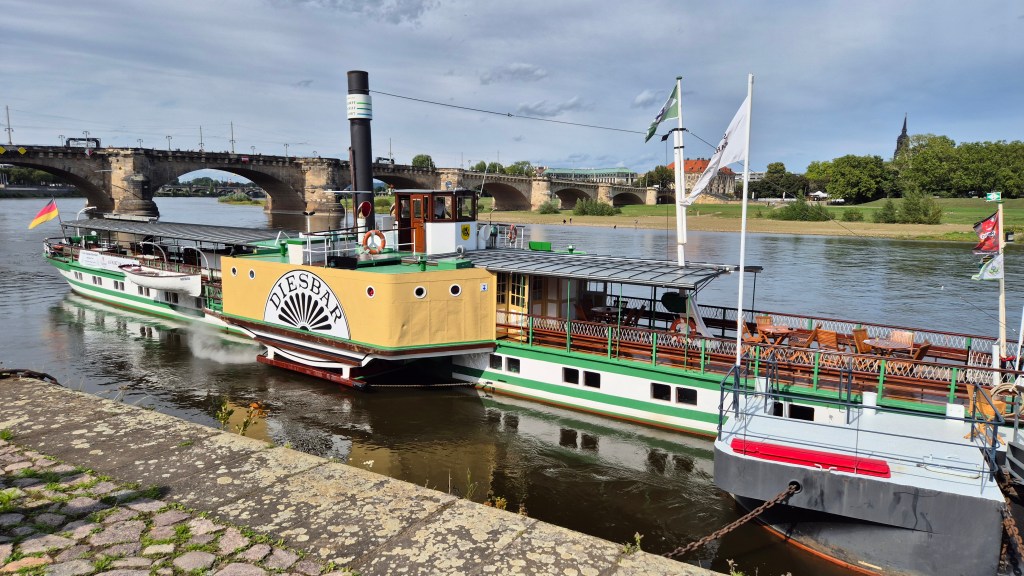
Wanting to enjoy a relaxing sit-down activity, we headed to the riverside to get tickets for the ‘Bridges of Dresden Cruise’ operated by Saechsische Dampfschifffahrt and their fleet of historic paddle steamers. With a bit of time to kill before the 1145 departure, we headed to Bistro & Bar Ecke Frauenkirche for some drinks and cake (I’d highly recommend here) before heading back to the river to board the paddle steamer Diesbar. The ‘bridges’ cruise took us upstream to the Blaues Wunder Bridge, passing the stunning buildings of the Saxon Finance Ministry and Royal Saxon Ministries on the north bank of the Elbe. Sitting towards the back of the steamer, we were able to get a stunning view of the Dresden skyline as we headed upstream away from the city.
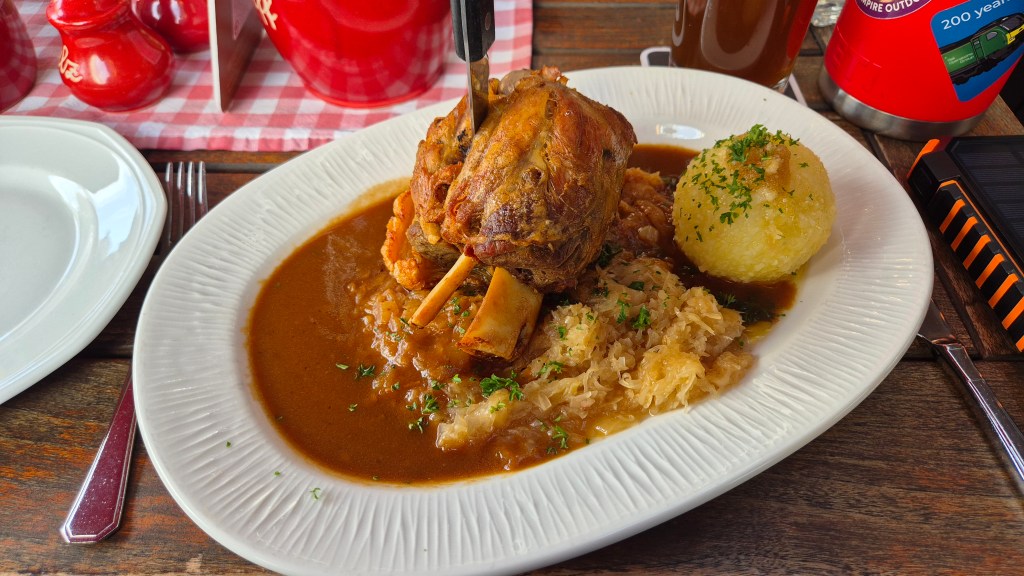
After reaching the Blaues Wunder Bridge and stopping at a pier just beyond, the trip took us back downstream, beyond the city centre and under the Marienbrücke before turning around again near Pieschen. I’d certainly recommend a boat tour as a way to get an alternative view of the city and it was a very enjoyable two hours, however, make sure to take a cushion as the wooden seats get a bit uncomfortable after a while. Arriving back on dry land, we made our way back through the city walls at Münzgasse to Bierhaus Dampfschiff for a late lunch where I went for the traditional German dish of Pork Knuckle with potato dumplings and sauerkraut which was very good! Then it was back to the station to collect our things before heading out to Freital to find our accommodation.
Our first full day in Dresden started later than planned for me as I woke up feeling unwell and so I ended up heading into the city around 1400 to meet up with the others who had spent the morning doing the sightseeing bus tour. Starting off with a late lunch back at Bistro & Bar Ecke Frauenkirche, I went for the meatballs with mash which were splendid and full of flavour. Of course, we went for desert as well as I had a slice of their delicious fruit cream cake which was perfectly ‘light’ to follow my main course. Beth and I then headed back to the sightseeing buses and did the first half of the tour to take us to Loschwitz on the north bank of the Elbe and the location of our afternoon activities.
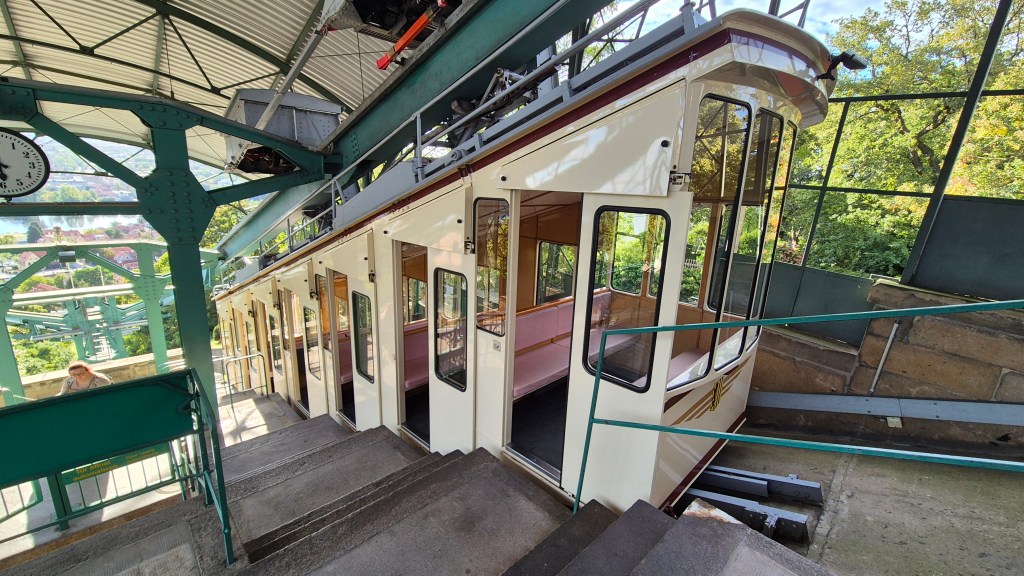
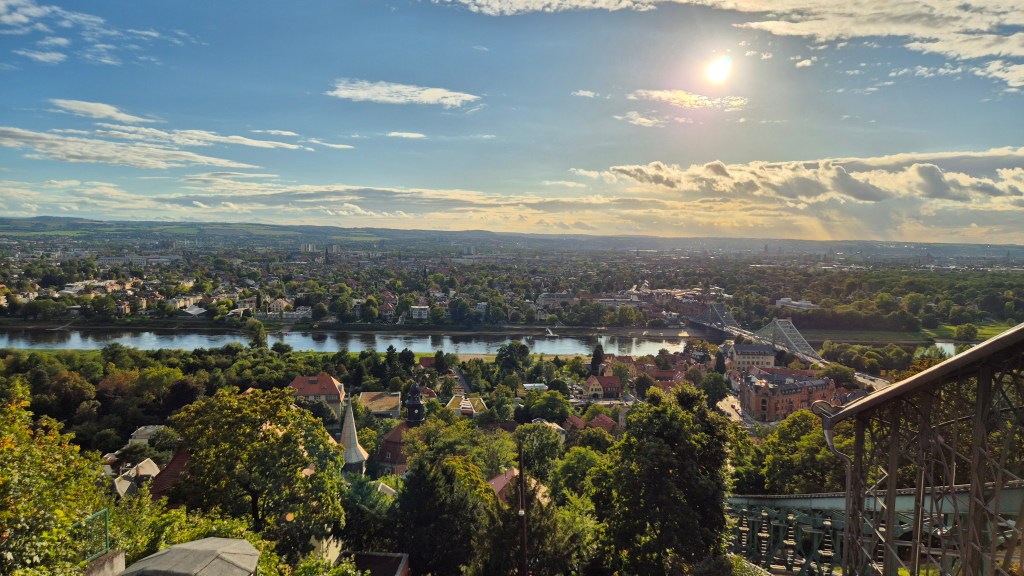
It wouldn’t be a trip with me without a bit of railway geekiness and Dresden offers multiple opportunities for this geekiness with Loschwitz home to not one, but two interesting railways. First up was the Schwebebahn Dresden or Dresden Suspended Railway (or Dresden Danglebahn), which connects Loschwitz with Oberloschwitz. The Schwebebahn Dresden is one of the world’s oldest suspended railways, having entered service in 1901, and covers a distance of 274m with a maximum incline of 39%. At the top there is a great viewing area on top of the station building giving great views of the city and surrounding area, although I’d recommend heading up in the morning, so the sun is behind you.
The second interesting railway connects Loschwitz with Weisser Hirsch and is just a minutes’ walk away from the Schwebebahn in Loschwitz. The Standseilbahn Dresden (Dresden Funicular Railway) as the name suggests is a funicular railway that climbs the ‘other’ hill out of Loschwitz and travels almost 550m with a maximum incline of 29%. The Standseilbahn traverses two tunnels on its way up the mountain, meaning the views during the climb aren’t as great and unfortunately you can’t really get a view from the top without a bit of a walk around the residential area. If you can only take a ride on one of the Loschwitz railways, I’d recommend the Danglebahn as it provides better views, but both are worth a ride if you have time.
After making our way back down to Loschwitz, we took a walk across the Blaues Wunder Bridge to Schillerplatz on the south bank of the Elbe and headed to SchillerGarten, a restaurant and beer garden that we’d seen from the river the previous day. By the time we arrived, large parts of the beer garden had been closed for the evening, however we were still able to sit on the restaurant terrace and enjoy our meal with a view of the river. To try something a bit different, I went for the Pork Roulade which came with a mushroom filling, red sauce and potato röstis and, as I have come to expect from German food, it was absolutely delicious! The atmosphere was also great, with a gentle buzz, whilst the weather was still warm enough after sunset for us to be comfortable eating outside.
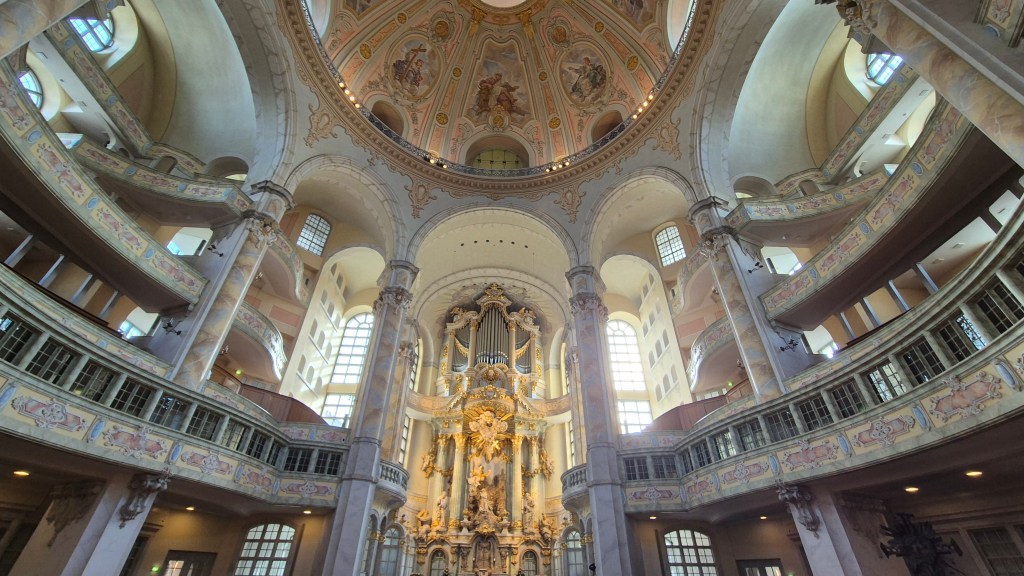
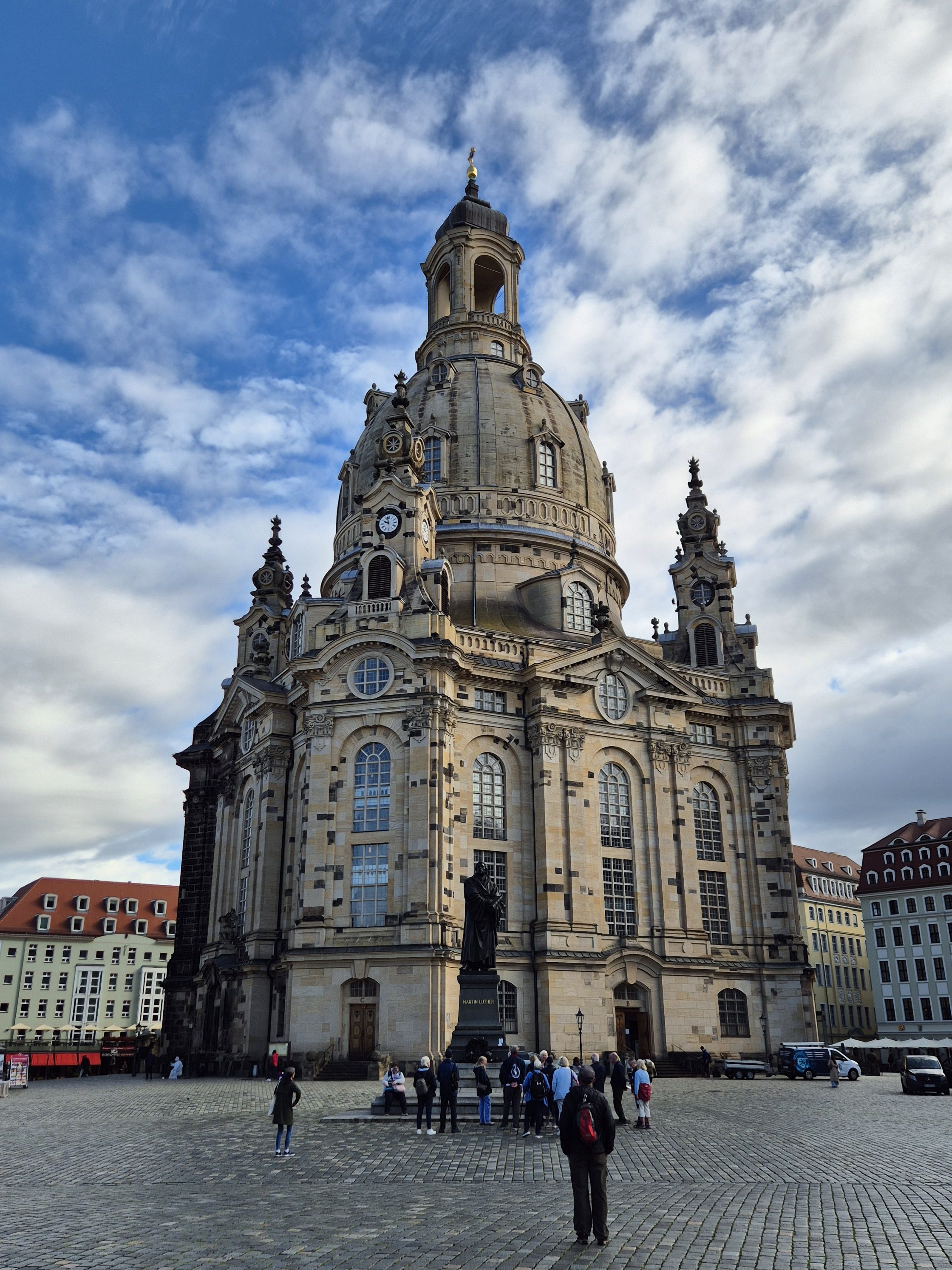
Day 3 started with us heading into the city centre again, this time to visit the Frauenkirche in the centre of the Altstadt. Destroyed along with the majority of the city centre during WW2, the Frauenkirche is actually a relatively recent reconstruction, having been rebuilt between 1994 and 2005, with the current church being the third to sit on this site. The original Catholic church converted to Protestantism during the reformation before being completely rebuilt in the mid-18th century, with the new church featuring one of the largest domes in Europe. Following its destruction in 1945, the local government officials of the GDR decided to leave the ruins in situ as a war memorial and this is how it remained for half a century. Reconstruction of the exterior of the Frauenkirche was completed in 2004 along with the surrounding Neumarkt, with the church’s interior being completed in 2005 and the church being consecrated on October 30th of that year.
The Frauenkirche is free to enter and look around, although there is a fee if you wish to climb the dome, with opening times being 1000-1130 and 1300-1730 Monday to Friday. The church is also open on weekends, however the times are changeable depending on when services are being held, so check the signs outside the doors whilst you’re in the Neumarkt to see when you’ll be able to visit. The interior of the church is stunningly beautiful, with the sun hitting the altar just right during our visit to make the gold shine, and the multiple tiers of seating giving the feel of theatre circles. Even if you only have a couple of hours in Dresden between trains, make sure that visiting the Frauenkirche is the one thing you do as it is absolutely stunning!
Following our visit to the Frauenkirche we decided to take a walk through part of the city we’d not yet seen, exiting the Neumarkt by the statue of Friedrich August II, King of Saxony, and heading down Weißer Gasse to the Kreuzkirche (or Holy Cross Church) at the bottom corner of the Altmarkt. Again, this church is free to enter and look around (something I did later in our stay) and you can climb the tower for a small fee. The church also randomly has a huge Playmobil ‘person’ outside, so we ended up coming to know it as the Playmobil church. Heading into the Altmarkt, we were pleasantly surprised to find that it had an Autumn Festival taking place which seemed a lot like a Christmas Market without the tree, and decided that we’d plan to pay it a proper visit for some food and a look around later in the week.
Having agreed to meet up with Beth’s parents for lunch at the Lingnerschloss, we decided to jump back on the bus tour as we’d got a 2nd day ticket for free when we bought ours online. Having remembered to bring my own headphones with me, I was able to properly hear the commentary this time and had a much more enjoyable experience than the day before. Top tip for sightseeing bus tours, all you need is a standard headphone cable and you can bring your own! Setting off from Postplatz outside the Zwinger, we first headed north to Yenidze, the former cigarette factory known as the ‘Cigarette Mosque’ given its Moorish Revival architecture with elements borrowed from mosques, including a minaret tower.
Then it was back into town passing the former wine warehouse that is now Maritim Hotel to Theatreplatz, the square surrounded on three sides by the stunning buildings of the Opera House, the Zwinger and St. Trinitatis Cathedral. Continuing along the riverside the commentary told us about the fleet of Saechsische Dampfschifffahrt, which is the largest and oldest paddle steamer fleet in the world, before we headed back ‘inland’ to see some of the city’s other sights including the City Hall, Hygiene Museum and VW’s Transparent Factory. Back across the Blaues Wunder bridge for the third time in 24 hours, the bus then took us up the hill that Loschwitz railways climb, before we alighted outside the trio of palaces that includes the Lingnerschloss.
With lunch coming up, this feels like a good point to pause the blog and split it into two, with part 2 of our time in and around Dresden coming up in a few weeks’ time. As it is we are only three blogs into the 18 I expect to come out of our Germany trip, with the next few weeks covering our day trip across the border to Prague. So, if you’ve enjoyed this post and fancy reading about more of our adventures on the continent, why not subscribe to the blog or follow me on social media.
 Flights & Times
One thought on “Dresden – Florence on the Elbe – Part 1”