
Having arrived in Bremen on a Ryanair flight from Stansted (read about that here), the first of three planned trips to Germany I would be taking in 2025 was underway. Rather than just being an extreme day trip, I was staying overnight near the airport and so had plenty of time to explore the city, starting with the historic city centre. Having watched my aircraft depart back to England, it was time to begin my explorations, starting with a short tram ride into the city.
Its really easy to get the tram from Bremen Airport into the city centre, with a stop located right outside the arrivals area. With trams every five minutes (every 20 minutes in the early morning/evening and on Sundays) and only a 10 or so minute journey into the city centre, this is one of the most seamless transfers into a city I’ve experienced on my travels. Tickets cost €3.20 for a single or €9 for a day ticket, so if you’re going to make more than two journeys, its worth grabbing the day ticket. I also think getting a day ticket just removes the stress for the rest of the day, as you can then just hop and off without having to worry about buying a ticket.
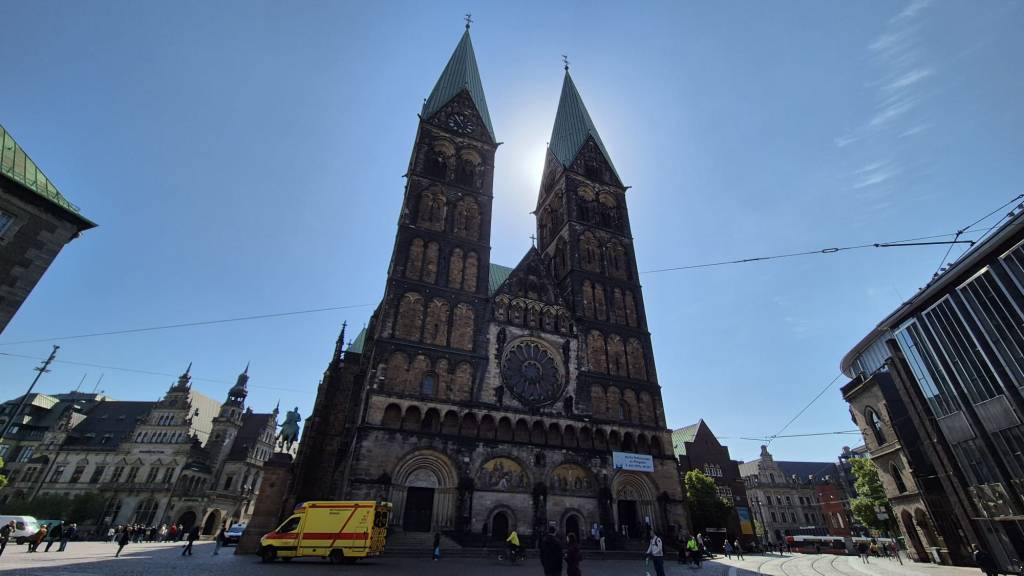
Jumping off the tram at Domsheide, in the shadow of Bremen’s famous Cathedral I decided to head there first for a look around. The oldest parts of Bremen Cathedral, or St. Petri Dom zu Bremen, date back to the mid-11th century when the Cathedral was rebuilt following a fire that destroyed large parts of the city in 1041. The remainder of the Cathedral dates from the mid-13th century, however, there have been changes since then owing to other damage sustained throughout the centuries and various repairs made by the church. The latest restoration was completed in the early 1980s and repaired damage caused by bombing raids during World War 2, with this restoration also being when the structure of the north transept was changed to introduce the current rose window.
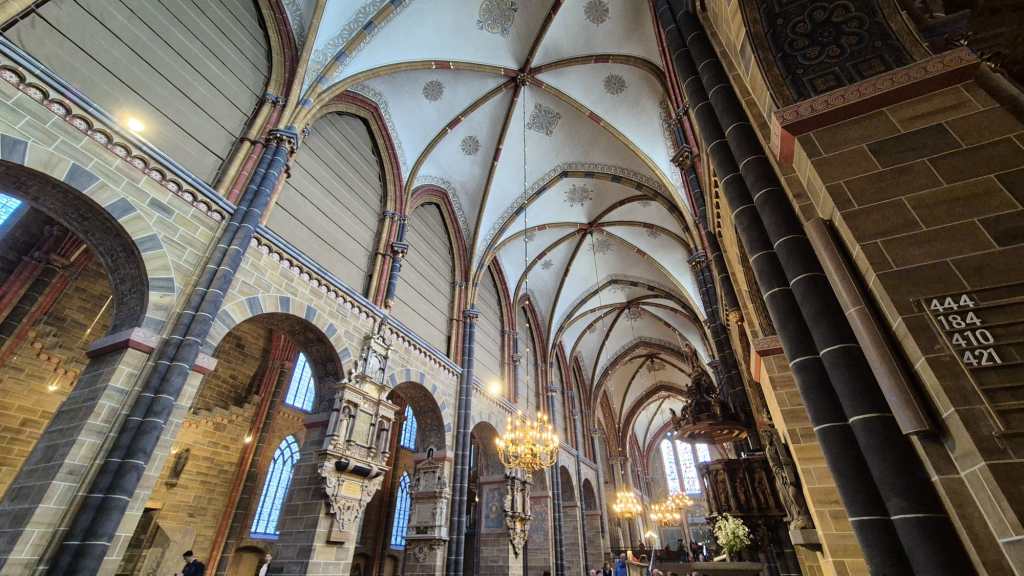
Entry to the Cathedral is free and inside the architectural style surprised me. Despite the Cathedral being an Evangelical church, there was lots of colour and decoration that would be more expected in a Catholic cathedral. Some of the colour comes from the actual bricks, with the columns, walls and arches constructed of a mix of red, black and brown stone, or at least painted in those colours. The white ceiling and large windows at each end mean that the interior of the Cathedral is very bright, almost the opposite of the dirty and blackened exterior. The cathedral is also home to the Dom-Museum, or Cathedral Museum, which is also free to enter. Here there are numerous religious artifacts on display, ranging from religious clothing to silverware and artwork to religious texts, as well as a few archaeological remains from earlier iterations of the cathedral.
Back outside the Cathedral, you’re almost immediately into Marktplatz or the Market Square, which is home to some of Bremen’s most impressive buildings including the Town Hall, State Parliament and Haus Schütting. The latter is Breman’s former Guildhall and has stood on one side of the Marktplatz since the mid-16th century, more recently serving as the city’s Chamber of Commerce and gaining ‘Monument protection’ in 1973. On the sunny spring morning of my visit, the Marktplatz itself had a lively atmosphere with lots of tourists and locals enjoying musicians performing in the square from the outside tables of the surrounding cafés and restaurants.
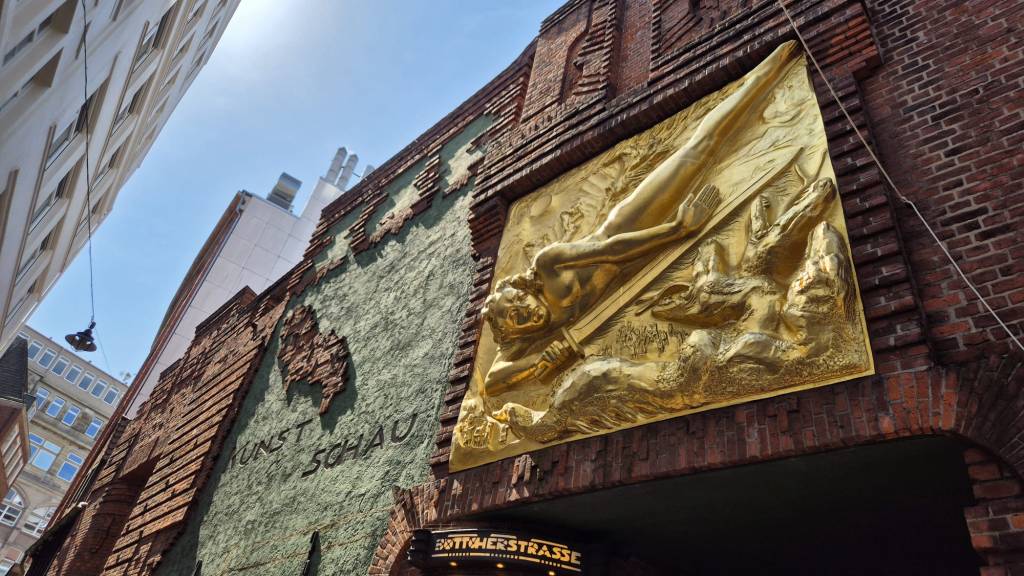
With it being a bit too early to eat lunch, I decided to explore some more of Bremen’s historic city centre and set off on a walk through the back streets towards the river Weser. Enroute I passed along the Böttcherstraße, one of Bremen’s most notable streets, mainly due to its unusual architecture. Most of the buildings on the street were erected during the 1920s under the instructions of Ludwig Roselius, a Bremen-based coffee-trader, with the street being a rare example of a variant of the expressionist style with several buildings being classed as Brick Expressionism. The city-centre end entrance to the street is also home to the Lichtbringer (Bringer of Light) a golden relief by Hoetger, April 1936, showing Michael (archangel) battling the forces of evil.
Reaching the quayside at Bremen Martinianleger I took a wander around the flea market that was taking place at the riverside and admired the sailing ship Alexander von Humboldt, which now resides in Bremen as a hotel and restaurant. Built in Bremen in 1906 and named after German geographer and explorer Alexander von Humboldt who is seen as the father of ecology and environmentalism. Continuing along the riverside as far as the Flagmast Weserufer, I headed back into the city centre via the historic Schnoor neighbourhood.
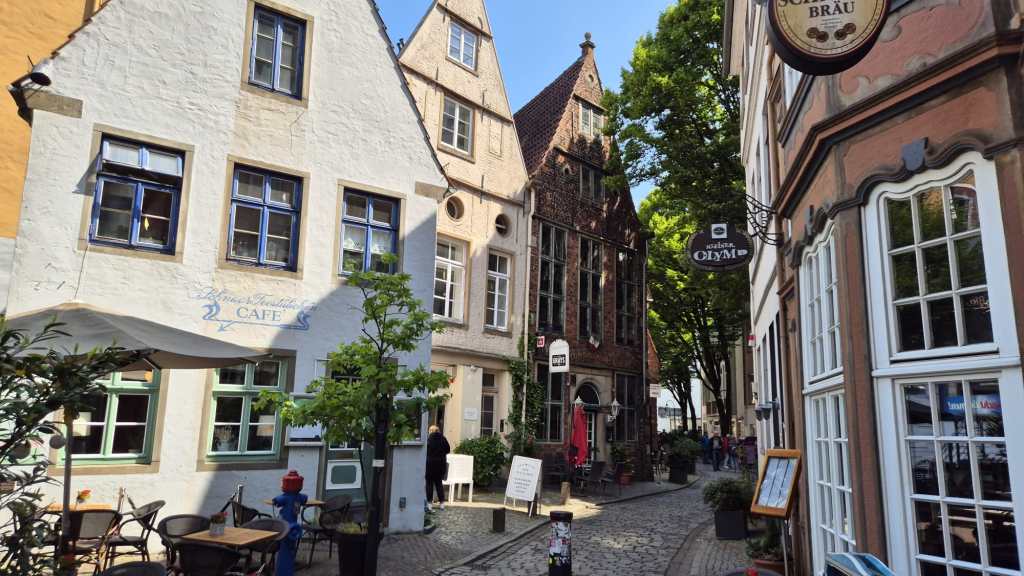
The Schnoor neighbourhood, named after the fact the area produced ropes and cables for the ship building industry (Schnoor is German for string), is the only remaining part of Bremen’s historic city centre that has retained its medieval character. Unfortunately, the neighbourhood became one of the poorest parts of Bremen, resulting in the buildings not being well maintained and, despite the area only receiving superficial damage during World War 2, by the mid-1950s the houses were in a poor state. Thankfully in 1973 the district became protected as a ‘historic district’ under the State Monument Authority, leading to the area being restored to its current charm. Today the oldest houses in the area date back to the 15th century whilst most date from the 17th and 18th centuries.
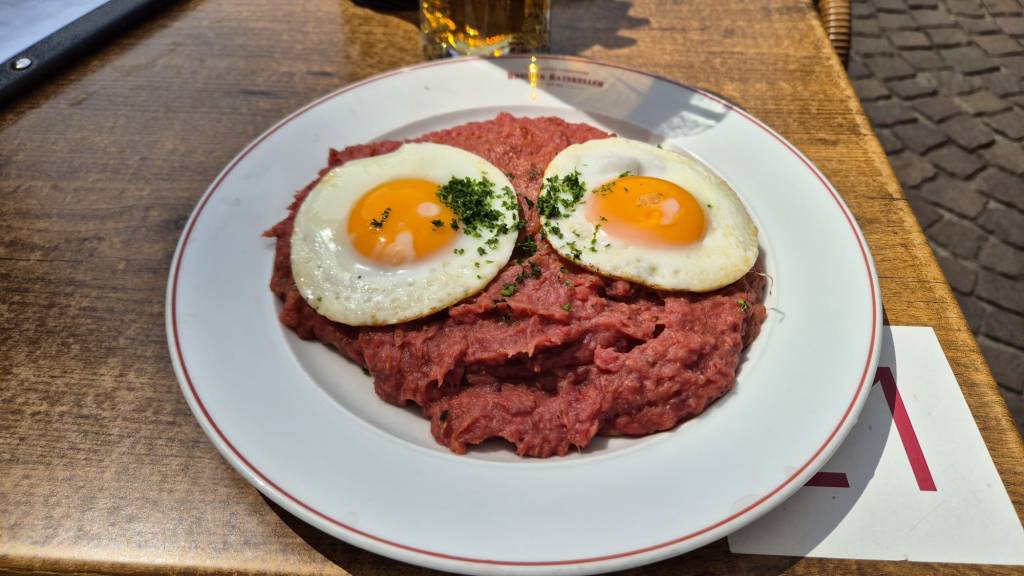
Back in the Marktplatz it was time for lunch and with the weather still behaving itself I decided to go for some alfresco dining at Bremer Ratskeller. This restaurant is actually under Bremen Rathaus (City Hall) in the Ratskeller or Wine Cellar, and its outside seating area was in the square between it, the Church of Our Lady and some of the buildings at one end of the Marktplatz. From my spot, I was able to see into the Marktplatz itself which led to an enjoyable time people watching. For my lunch I decided to have the traditional Bremen ‘Seemannslabskaus’ which is a dish of corned beef with eggs accompanied by a pickled herring and was delicious if not something a bit different. Washed down with a couple of pints of Becks, Bremen’s local beer, and finished off with a very nice and mousse desert, it was a great meal and only cost €34.20!
After lunch, I decided to head back up to the airport for a bit of spotting (see next week’s blog post) and to check in to my hotel, with the intention to head back into the city in the evening. Unfortunately, the bad weather that I’d left behind in England seemingly caught up with me, with the evening and all of my second day in the city mired by rain. After staying in the hotel the previous evening, I couldn’t hide from the weather any longer and so day 2 started with a soggy walk from my hotel to the tram stop and a repeat of day 1’s journey into the city. I did however stay on the tram a bit longer, through to the Hauptbahnhof, where Bremen’s Übersee Museum is located.
Entry to the Übersee or Overseas Museum costs €15 but I’d say this is good value for money given the wide range of exhibits they have. An audio guide is available via your own phone and a QR code on your ticket, whilst there are plenty of English translations around the museum on most, but not all, of the exhibits. As the name suggests, the Übersee Museum focuses on providing an insight into cultures away from Germany and Europe, with there being an area for each of The Americas, Africa, Asia and the Pacific Islands. There was a great mix of exhibits covering the religions and cultures of each continent as well as an excellent temporary exhibition on the Tlingit tribe of Alaska which was really interesting.

As well as the main exhibitions covering the various continents, the museum also had an exhibition on the history of the museum itself and how it was affected by its own country’s history. This included some really interesting information on how the museum has undertaken Provenance research to discover the true sources and owners of various exhibits, and I was impressed by how open the museum was about the darker parts of its history. In the end I spent a good couple of hours exploring the museum, and that was with skipping over some exhibits and moving at a reasonable pace. Realistically you could probably spend at least half a day exploring, it’s a great place to visit if the weather’s not that great.
Lunch on day 2 was at the Übersee restaurant, which is part of the museum building, however, is a separate entity to the museum and is a ‘proper’ restaurant rather than the glorified cafés you tend to get in museums. As I’d be having a sandwich for my tea on the way home from Stansted, I decided to have a decent meal now and went for the Pork Chops with Mushrooms and Potatoes which was amazing, followed by some Apple Strudel. No beers with this meal though, with just a coke to wash down the food, and in total the meal cost €32.60 or £27.45.
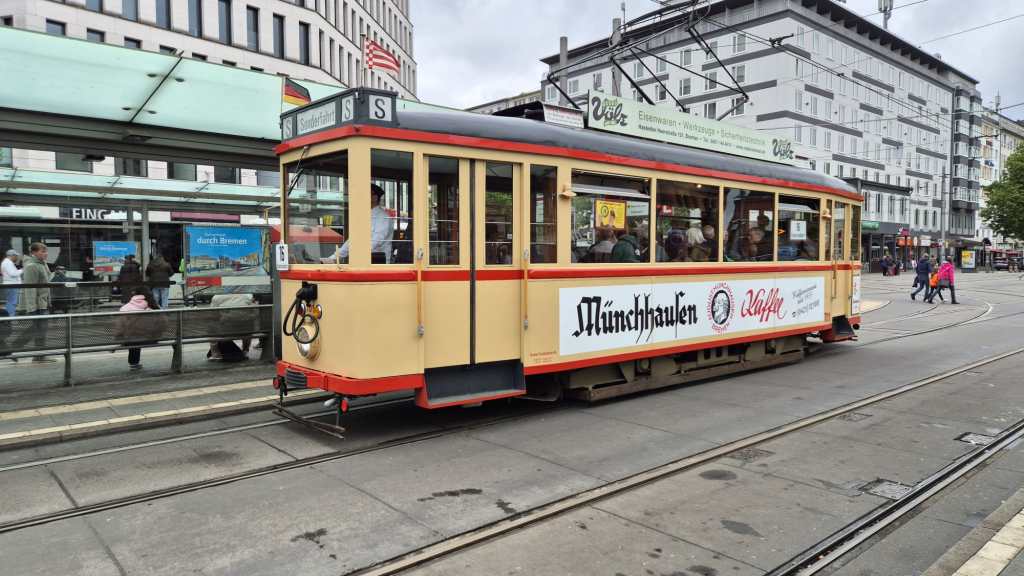
With my time in Bremen coming to an end, it was time to head back to the airport, although as I was waiting for a tram outside the Haupbahnhof I was treated to one of the historic trams belonging to the ‘Friends of the Bremen Tramway’ museum trundling past. Unfortunately, I didn’t have time to take a ride, but the museum is open on the 2nd Sunday of each month, with historic trams operating on Line 9, the ‘Museum Line’ at the same time, whilst there’s also historic trams operating on the City Tour lines 15 and 16 usually on the last Sunday of the month.
I really enjoyed my time in Bremen, although with the weather certainly didn’t do the city justice during my visit. I certainly want to head back and spend some more time exploring, perhaps taking a boat trip along the river or a ride on a historic tram around the city centre. With it only being a short flight from the UK to the northern German city, Bremen feels like its somewhere that a return trip can be planned to quite easily.
 Flights & Times
One thought on “The Free Hanseatic City of Bremen”