
This is the second post covering my time exploring the Basque city of Bilbao and starts midway through my second day in the Spanish city. If you’ve not yet read part 1, you can find that here, and I’d certainly recommend reading it first. An initial wander round the new town, a walking tour of the old town and some excellent food were all under my belt and so it was into the new town for the next bit of exploring.
With one of the stops on Bilbao’s bus tour being outside the Arriaga Theatre, where my walking tour had finished, hopping on the bus seemed the best way to see the main sights of the new town. With the tour officially starting outside the Guggenheim, I ended up doing one and a half circuits, making the most of my €16 as there were definitely bits I didn’t pick up on the first half lap. I think I’ve said it plenty of times of before, but I do think bus tours are a good way to see a city, especially one that the main sites are quite spread out, although the value definitely varies.
After I joined the bus at the Arriaga Theatre we headed back around the edge of the Old Town, crossing the river just before the indoor market and passing the former Church of the Merced that is now the Bilborock concert hall. Looping back around the market, we headed back along the river, passing Plaza Arriaga and the Tinglados that line this part of the riverbank. The Tinglados are covered buildings that were historically used for sheltering goods being unloaded from ships moored on the quayside. These days they are home to a Sunday market, allowing them to continue to be part of Bilbao’s culture and history.

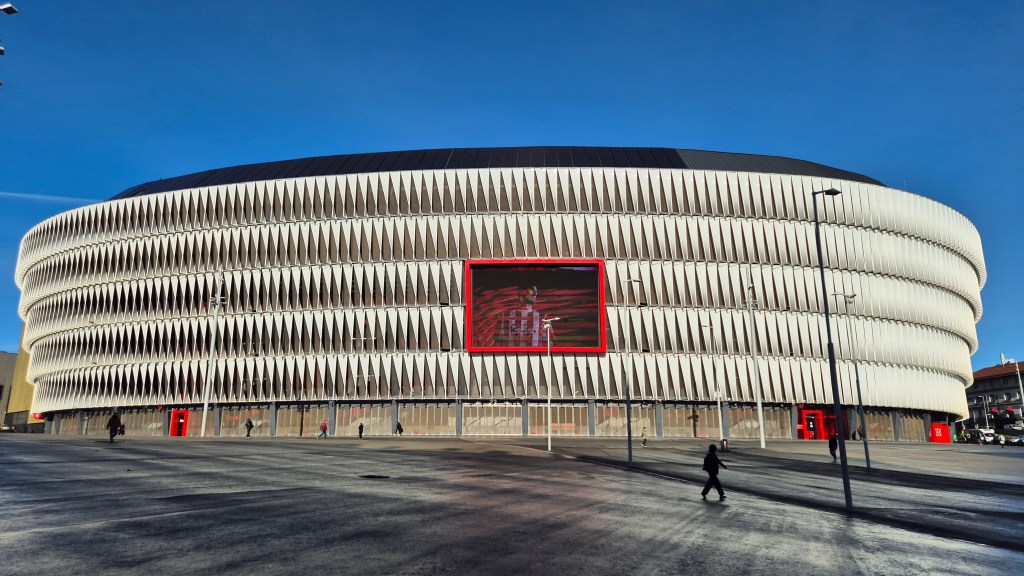
Another notable part of the bus tour was passing San Mamés, the home of Athletic Club Bilbao and the commentary covered the importance of the club to the city and its residents. The current San Mamés opened in 2013 and replaced an earlier ground of the same name on an adjacent site that had been the club’s home for 100 years. The ground was given the name San Mamés as it was built near a church of the same name, which in turn was named after Saint Mammes, an early Christian who was thrown to the Lions. This is also where the club gets its nickname Los Leones, The Lions, from.
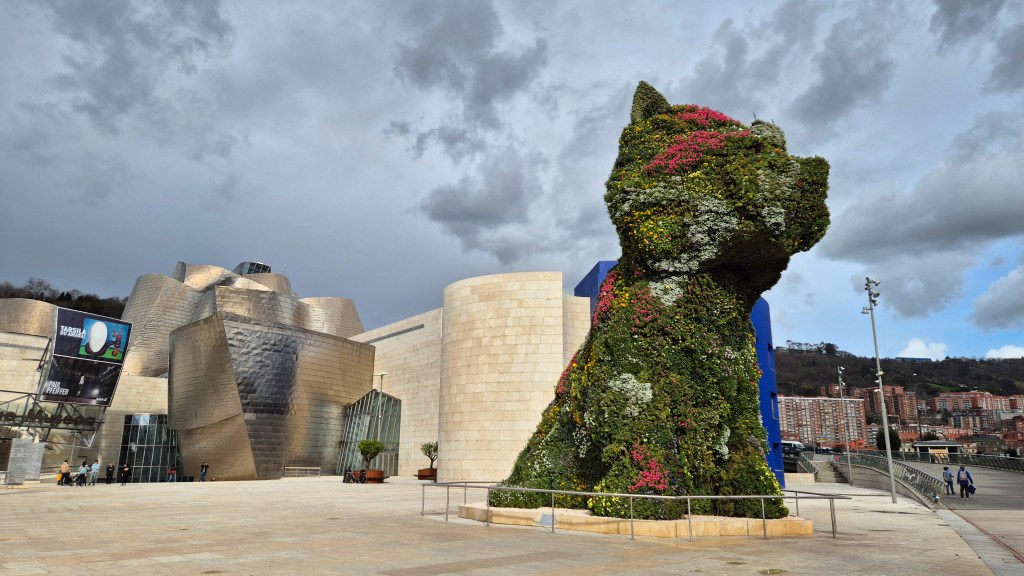
Finishing the bus tour back at the Guggenheim Museum, whilst I wasn’t going to spend the entry fee as art isn’t really my thing, I did decide to have a walk around the outside and along the riverbank to get a look at the striking building and the free to view sculptures that surround it. The building itself was designed by Canadian-American architect Frank Gehry, who was set the brief to design something ‘daring and innovative’. With the exterior ‘lined’ with 33,000 titanium plates, which have ideal characteristics to withstand heat and bad weather, the building continues to shine in the sun nearly 30 years after it was inaugurated.
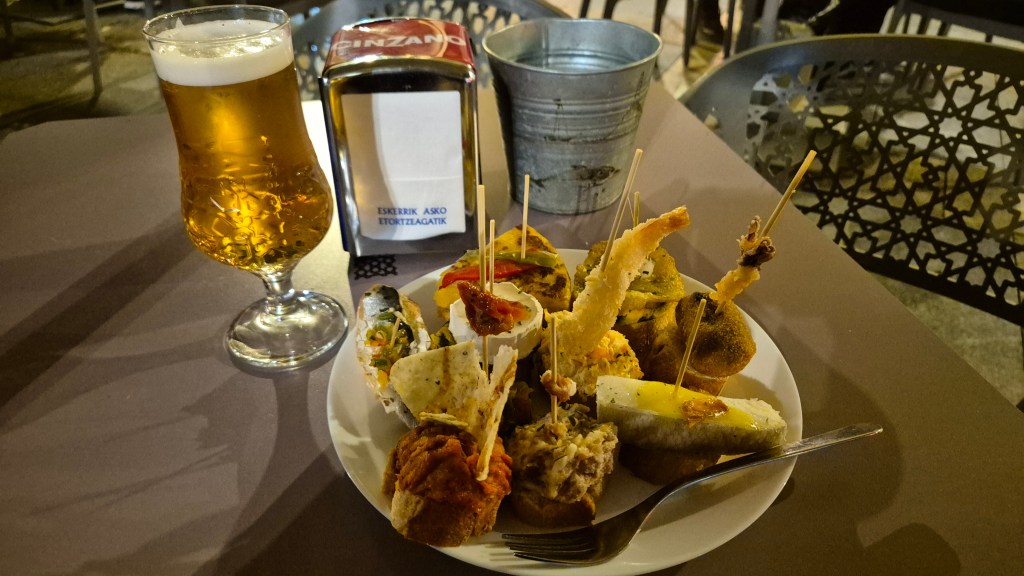
Having had a bit of an adventure into the new town, as the day began to draw to a close I headed back to the old town via tram to find somewhere for dinner. Ideally I wanted to find somewhere serving Pintxos, small, bite-sized snacks, similar to tapas, that are a staple in Basque Country cuisine, however I also wanted somewhere that had a menu of what was on offer so that I could attempt to overcome the language barrier when ordering. Ending up at Iturriza Taberna in Placa Nueva, which had a “Top 10 Basque Pintxos” dish on the menu, I enjoyed sitting out in the square enjoying some excellent food and a couple of beers to round off a great day of exploring.
My final day in Bilbao dawned with some more great weather and, with only a couple of hours until I needed to head to the airport, I decided to head back into the new town and to San Mamés. Having grabbed some breakfast just across the river from the old town, I got on the tram at the Abando tram stop and it was here I discovered that not every tram stop has a ticket machine. The previous day I had been able to buy a ticket from the machine at the Guggenheim stop, however with neither the Abando stop or the trams themselves having ticket machines, I unfortunately had to fare evade €1.50. It did prove to myself the benefit of just getting a day or multi-day ticket that covers your entire stay to save the worry/hassle in these situations.
Outside San Mamés is a stature of legendary goalkeeper José Ángel Iribar, who played more than 600 games for Athletic Club over an impressive 18 seasons and also managed both the club and its ‘B’ team over a span of four years following his retirement. Entry to the tour of the ground is via the club’s museum and entry to both costs €15, or €22 if you book a guided tour. For those, like myself, who don’t join a guided tour there is an online self-guided audio tour that you can follow using your own phone a headphones.
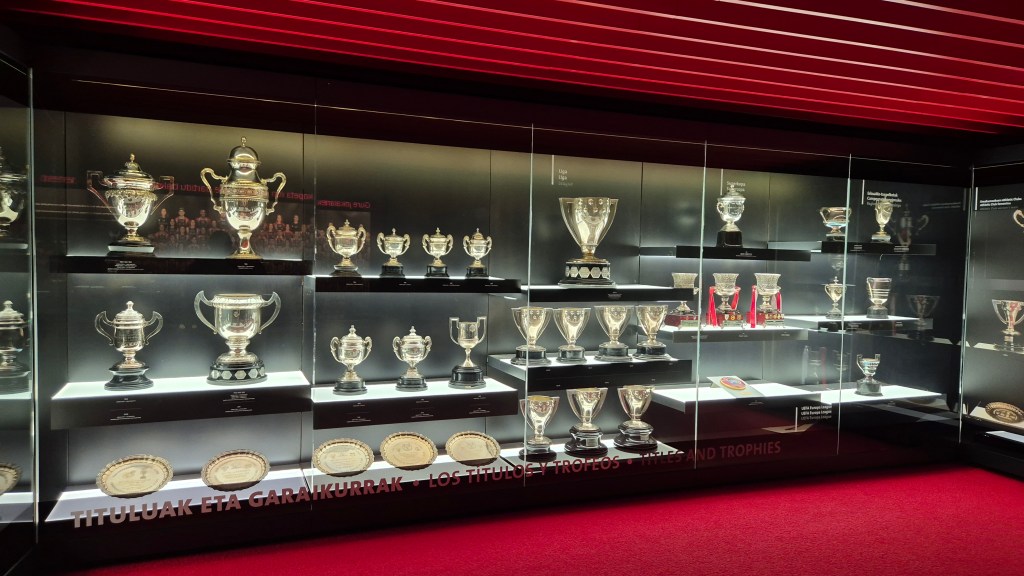
Athletic Club’s Museum at San Mamés is incredible and has an immense collection of club artifacts and memorabilia, whilst also doing a really good job of telling the story of the club’s history and its famous “cantera” policy. The “cantera” policy is where the club only signs players native to or trained in football in the greater Basque Country and since 1911, Athletic has played exclusively with players meeting its own criteria to be deemed Basque. To help Athletic Club achieve success whilst following this policy, it is known for having one of the best youth academy set ups in Europe, and most of the club’s current senior team are academy graduates.
The ground itself is also pretty impressive to walk around and the tour takes you all around the ground including pitch side, the media area and the director’s box, ending in the shop via an exhibit about the club’s Women Team. For a modern stadium, San Mamés still manages to feel like it has a ‘soul’ and as I walked out of the museum to the pitch side I did genuinely have a ‘wow moment’. Whilst visiting a football club’s museum and touring a ground won’t be for everyone, I really enjoyed the time I spent at San Mamés and would certainly recommend it to anyone who has even a passing interest in football.
Unfortunately leaving San Mamés also meant that my time in Bilbao had come to an end and it was time to make my way to the airport ahead of my flight home. Helpfully San Mamés is right next to ‘Intermodal’ a key transport hub and the starting point of the bus route to the airport. The only challenge here was finding where to buy a ticket, and I had to visit the Bizkaibus desk before heading through ticket barriers and down to the numerous bus boarding gates. Thankfully there wasn’t a queue at the ticket desk as by the time I had found where to buy a ticket from, I was running out of time before the next bus, and only just made it onboard. From ‘Intermodal’ it was only 25 minutes or so to the airport, with a few stops at key points through the city, although I’d recommend boarding at ‘Intermodal’ if you want a seat.

I really enjoyed my stay in Bilbao and, although I say this for a lot of places, it is firmly on my list of places to re-visit. The city is both large enough for there to be plenty to do, whilst at the same time being small enough to get around easily and not feel like you’re missing loads, although there is of course all of the area out at the coast which I didn’t even touch on. Everyone I interacted with was friendly and helpful, with generally a reasonable level of English, and given my visit was in February, the weather was nice enough most of the time to be walking around without a coat. Thank you Bilbao for an excellent time!
 Flights & Times
One thought on “Bilbao – Capital of the Basque Country – Part 2”