
The largest city in the Basque Country and the tenth largest city in Spain, Bilbao is set 10 miles inland from the Bay of Biscay on the Nervión river. Founded in the 13th century, Bilbao has plenty of history, mixed with a modern revival over the past few years and so I was looking forward to seeing what it had to offer. Having arrived in Bilbao on what had turned out to be quite enjoyable flight with Vueling from Gatwick (read about that here) I was ready to head into the city to start exploring.

There are a couple of different bus lines heading into town from Bilbao airport which run every 15-30 minutes depending on the time of day, and I caught the 3247 as far as Moyúa Square, which cost €3 and took around 15 minutes. Originally constructed in the late 1870s as a central point in Bilbao’s new town, Moyúa Square took on its current form with a central fountain and English and French style gardens following a refurbishment in the 1940s. The square was completely rebuilt in the 1990s as part of the Bilbao metro project, to allow a metro station to be built underneath the square, and to this day Moyúa Square retains its role as a key hub and central point in the new town, linked at either end to Grand Via.
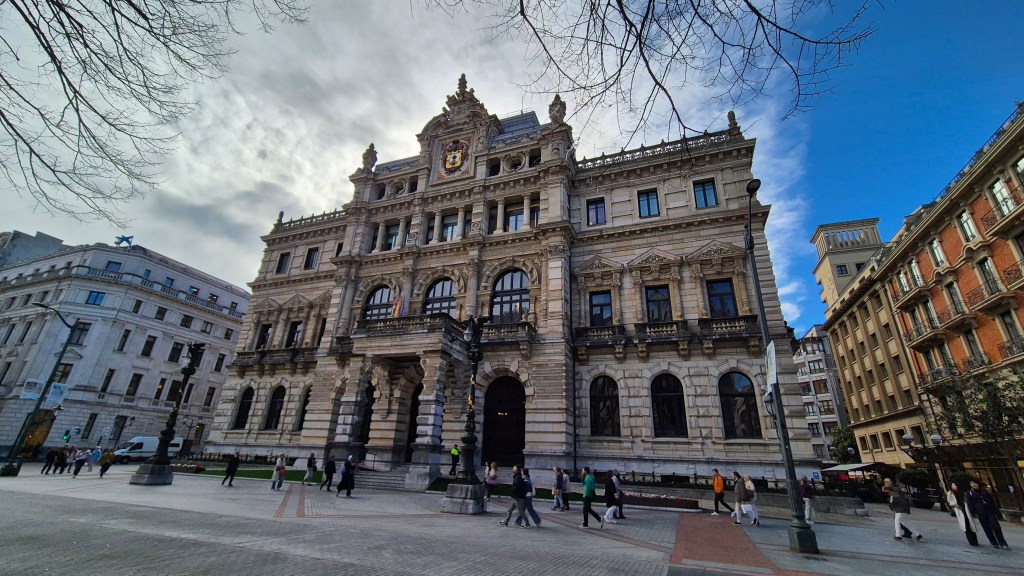
My accommodation was in the old town and so I decided to walk down Grand Via in that direction, getting to see some of the new town’s most impressive and ornated buildings on my way. These included the Bizkaia Delegation Palace, built in the 1890s and now home to the Government of the Province of Biscay, as well as the central office of the BBVA bank. Grand Via is also home to many of Bilbao’s high-end shops, including El Corte Inglés department store, which I did have to explore somewhat as I’d stupidly forgotten to pack a European plug adapter.
At the old town end of Grand Via is Plaza Circular, another key point in the new town, with two connections across the river to the old town starting here, as well as being the home of one of the city’s main railway stations, Abando. Making my way across the river, I reached Plaza Arriaga on the edge of the old town, home to the Arriaga Theatre. This beautiful neo-classical opera house was originally constructed in the late 1880s but was restored in 1985 following severe damage caused during the August 1983 Bilbao flood. The theatre’s location on Plaza Arriaga at the entrance to the old town makes it one of Bilbao’s most recognisable buildings, although in more recent years the Gugenheim Museum has obviously taken top spot.
It was at the Arriaga Theatre that I joined the free walking tour I had booked onto with Basque Free Tours. Unfortunately, I had to break my own rule and book via Freetours as the Basque Free Tours English language website didn’t seem to work. However, if you can, always book direct with the tour company (even if you find the tour via Freetours or Guru Walks) as then they don’t pay commission to the 3rd party. With the tour starting at the Arriaga Theatre we learnt a bit more about it including that this was the first building in the city to have electricity.
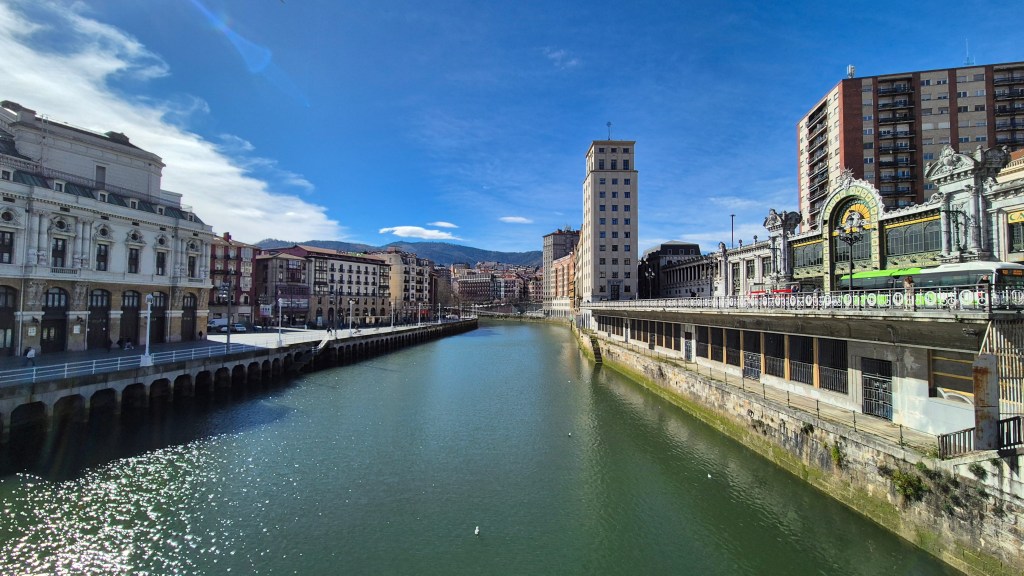
The city of Bilbao is more than 700 years old and was initially founded around a key crossing point of the River Nervión and as time progressed and iron ore deposits were found in the hills around the river, the city grew in prosperity. The original city was formed of seven streets leading down to the river, and these still exist between the Cathedral and Indoor Market. As we walked around the riverside area close to Plaza Arriaga, we reached the Church of St Nicholas which has a plaque showing the height the flood waters reached in the great flood, and I was genuinely amazed at how high this was. Behind the church is one of the many elevators that link the lower riverside areas with the hilltop areas, although our guide told us that this one has unfortunately been out of order for over a decade!
From the riverside we headed to Plaza Nueva, ironically one of the older parts of the city but certainly new when it was built. Plaza Nueva is home to the Basque Language Society and our guide took the opportunity to explain some of the history of the language and how it has become more mainstream in recent years. Plaza Nueva is also a popular spot with locals in the evenings, with bars surrounding the squares serving local pintxo (finger food) and chaquilla wine. From Plaza Nueva we continued to wind our way through the streets of the old town to the Basílica Catedral de Santiago or Bilbao Cathedral.
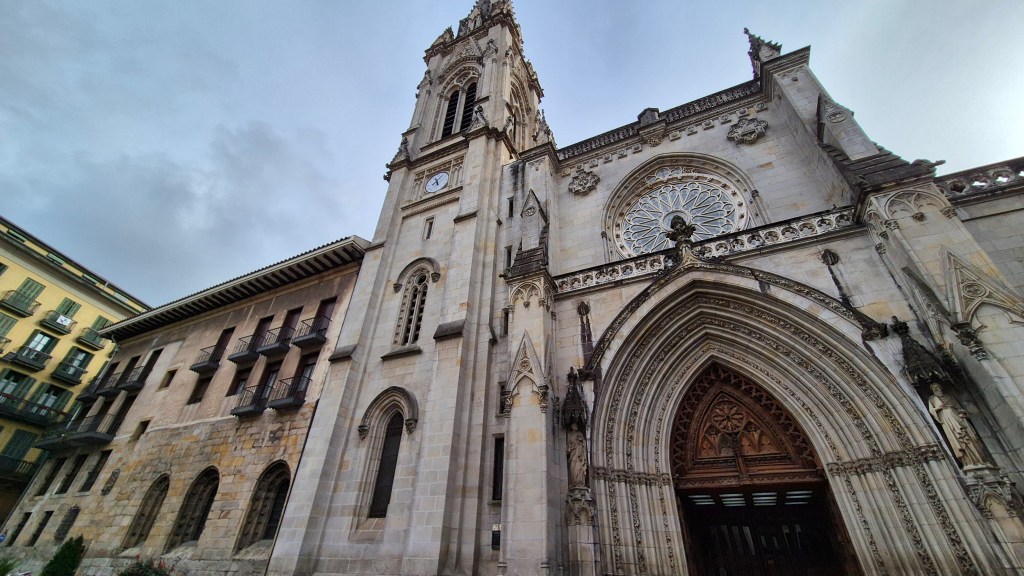
The Basilica of Saint James dates from the 14th and 15th centuries and is a key stop along the Northern route of the Camino de Santiago, being declared a minor Basilica for this reason in 1819. The Cathedral didn’t actually become a cathedral until 1955 and so it is said that Bilbao’s first cathedral was actually San Mamés, home of the city’s football team, Athletic Club Bilbao. In 2015, Bilbao Cathedral was made a UNESCO World Heritage site, as it was included in the expanded boundaries of the Routes of Santiago de Compostela.
From the Cathedral we headed down one of the Seven Streets to the Mercado de la Ribera, Bilbao’s indoor fresh food market. Once recognised by the Guinness World Book of Records as the largest covered food market in the world, the Ribera Market suffered from the Bilbao’s decline and the rise of supermarkets, however a large-scale renovation in the 2010s marked the beginning its revival. Today the Ribera Market is a great place to visit throughout the day (although I’d recommend the morning) and still has a wide range of fresh food available, whilst also offering a bar, restaurant and events space.

Next to the Mercado de la Ribera is the site of the first bridge in the area to cross the River Nervión, ultimately leading to Bilbao’s rise as a major industrial city. On the left bank of the river, opposite the market, our guide stopped to tell us more about Bilbao’s Iron Ore industry and point out some of the former entrances to the mines that emerged onto the banks of the river. At its peak, Bilbao accounted for 10% of the world’s iron ore production and there was a huge trade between the city and Great Britain as iron and coal made their way between the two. This trade and the arrival of migrant workers from Britain, ultimately led to the creation of the city’s football club, Athletic Club Bilbao.
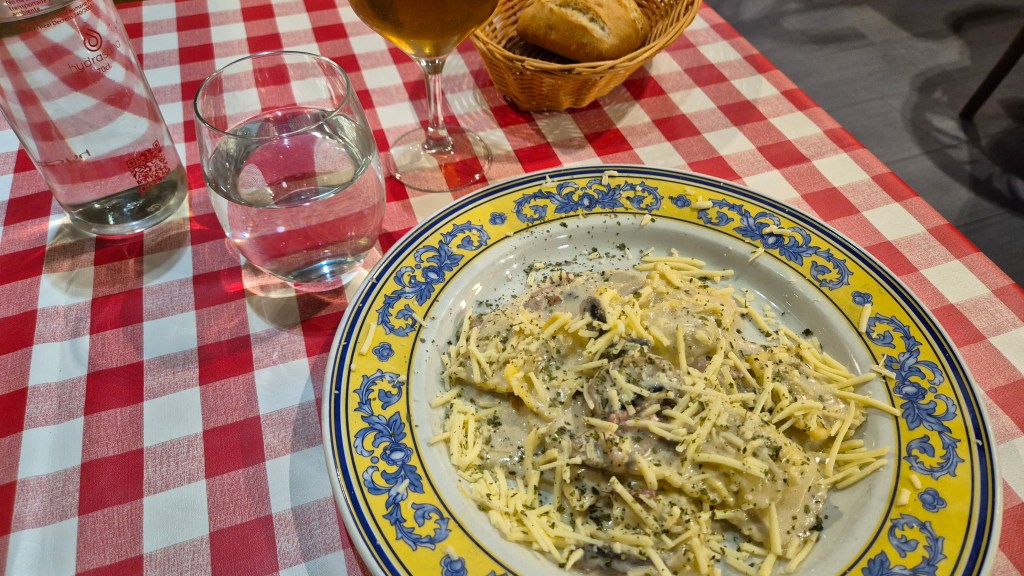
With the walking tour drawing to an end, we headed back to the Arriaga Theatre to learn about the history of the Gugenheim Museum and how its arrival in Bilbao jump started the city’s tourism industry and revitalisation. Having tipped the guide and made the few minutes’ walk to my hotel to drop off my stuff, I headed back out to a nearby restaurant, Olagarro, to try out their set menu. Lots of restaurants in the old town seemed to do daily set menus for around €20, which for a three-course meal and a drink seems like an excellent deal. I chose the ravioli as a started, followed by some delicious pork cheeks for my main course. A Tarte San Marcos rounded of the meal, and it was all washed down with a glass of the local lager, making for an excellent meal.
With plenty of time still left to explore Bilbao, there’s lots still coming up for the blog, however I’ve decided to split my time in the city into two parts. Don’t worry thought, part 2 will be coming next week, so subscribe to get notified when it goes live!
 Flights & Times
One thought on “Bilbao – Capital of the Basque Country – Part 1”