
Operator: Eurostar
Headcode: ER9474
Route: DUS-BRU
Class: Comfort
Seat: C22 S63
Date: Wednesday 9th October 2024
Having had around 44 hours in Düsseldorf, exploring it and the surrounding area, it was time to start making my way back to England. This journey would essentially be the reverse of my journey out, with me first catching a train to Brussels, before changing onto another that would take me through the Channel Tunnel back to London. As with the journey out, the entirety of the journey back I would be travelling with Eurostar, however for the trip home I had upgraded to Standard Premier. Before we start with the journey to Brussels, if you want to check out the rest of the blogs from my Düsseldorf trip, you can find them here, here, here and here.
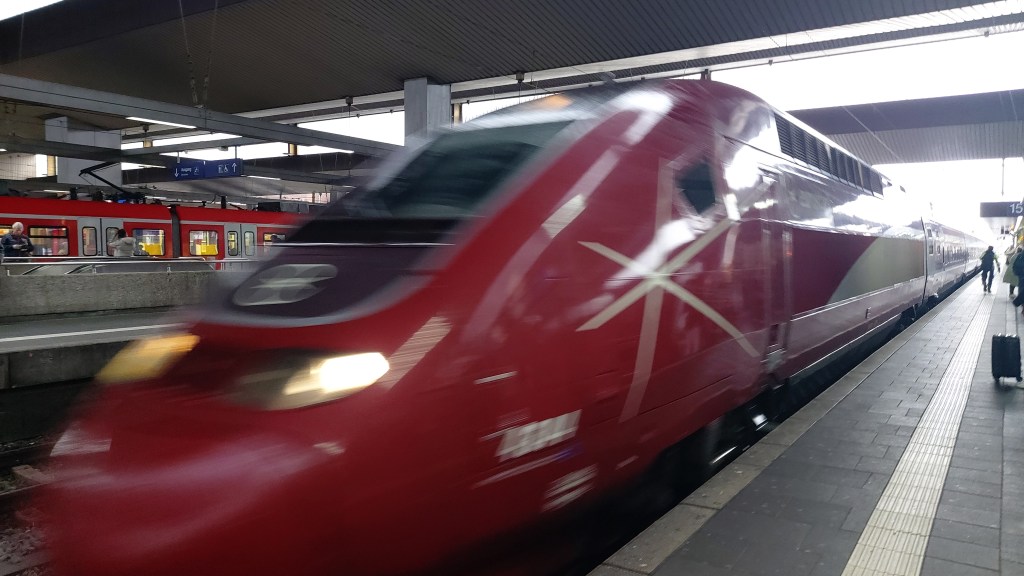
I arrived at the platform around 25 minutes before Eurostar 9474 was scheduled to depart to Brussels, with platform 16 designated for my departure along with around half of all southbound inter-city (ICE, IC, Eurostar and RRX) departures. Unlike most major British stations where ‘service groups’ are not necessarily allocated specific platforms, Düsseldorf Hauptbahnhof appeared to have dedicated platforms (or even pairs of platforms) for different services, with platforms 4-10 (Düsseldorf doesn’t have platforms 1-3 or 8) assigned to ‘RE’ regional services, 11-14 to local S-bahn services, 15-18 long distance services and then finally 19 & 20 for additional ICE services aswell as special trains and car trains.
Whilst this may not seem that important, and to an occasional user of Düsseldorf Hauptbahnhof it probably isn’t, this segregation of services does help improve punctuality by allowing the services to be better separated on the approaches to the station. It also theoretically reduces the knock-on effect for delays from one service group to others, although as I found, that doesn’t stop services sharing the same platforms from impacting on each other. With a scheduled 1624 departure, my service was showing a four-minute delay at 1606 and a six-minute delay five minutes later. This then reduced back down to a four-minute delay, but arriving at the same time as a delayed IC service, meaning just before the train arrived, the platform was changed to the adjacent platform 15.
Whilst the former Thalys part of Eurostar operates two different types of unit, ‘PBAs’ and ‘PBKAs’ only the ‘PBKAs’ (and sometimes ‘e320s’ on load from the Channel Tunnel part of Eurostar) can be used on services to Germany. This is because, despite the European rail network being widely connected across borders, four different voltages of power supply are used in the countries across Eurostar’s network. The ‘PBKAs’ and ‘e320s’ are quad-voltage units, allowing them to be used on Germany’s 15kV network, meaning that if you catch a Eurostar train into Germany, the odds are it’ll be a ‘PBKA’ unit. The ‘PBKA’ unit working my service arrived in from Dortmund a few minutes after our departure time and we departed Düsseldorf at 1624, seven minutes late.
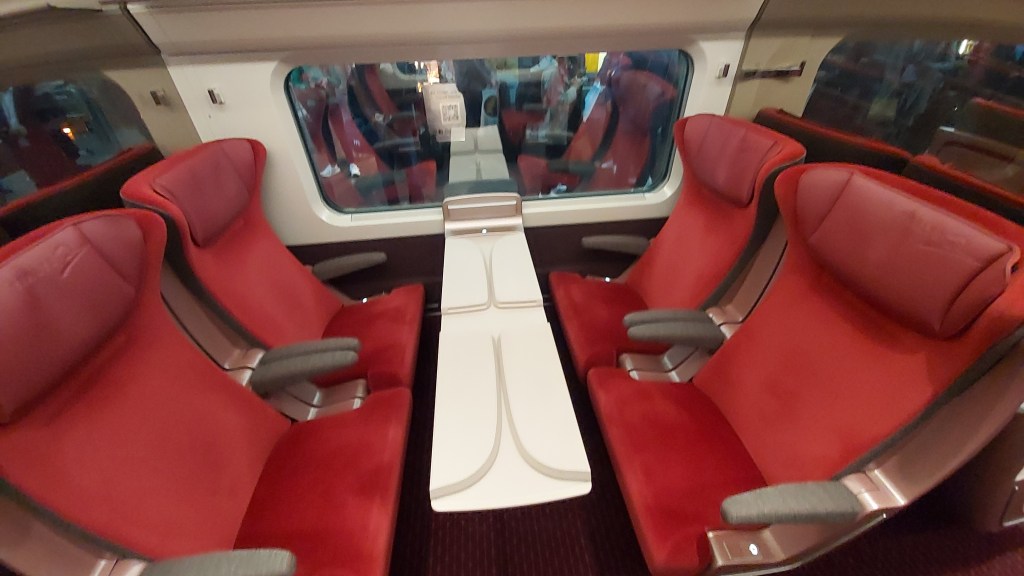
Whilst when booking Eurostar had advertised the class of travel I had upgraded to as ‘Standard Premier’, I was travelling at a point when there was still a difference between the levels of service offered on the two halves of Eurostar. On this former Thalys route, the equivalent was ‘Comfort’ which got me a more spacious adjustable seat, laid out in a 2+1 configuration in a generally quieter carriage. These seats were a mix of groups around tables and ‘airline style’ with large seat back tables and also had European and USB power sockets (although only one of each per pair of seats) along with reading lights. I was in seat 63 in coach 22 (in reality coach 2), which was a rear facing window seat around a table, although it appeared the train might have been facing the opposite direction to normal, so this might usually be a forward-facing seat.
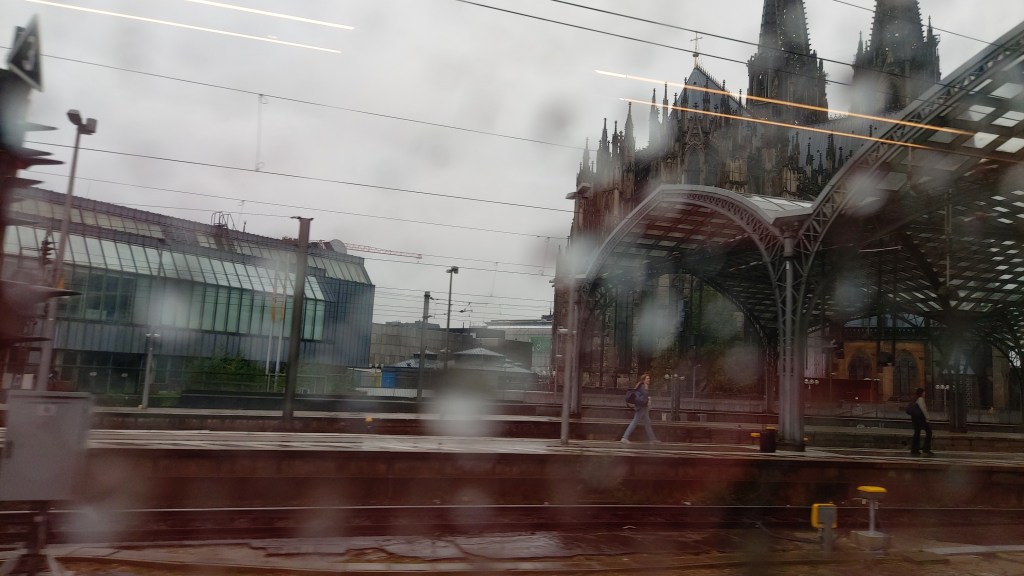
The first stop on the journey back to Belgium was Cologne, where we approached the city’s Hauptbahnhof by crossing the famous bridge across the Rhine and under the shadow of the cathedral. At Cologne the train got quite busy, with my carriage being about three quarters full and me gaining a seat mate for the remainder of my journey. Unfortunately, as expected, the seven-minute delay at Düsseldorf had escalated and we left Cologne 15-minutes late, heading west towards our next stop, the border town of Aachen. Other than the late running, the journey was generally uneventful and, unlike Standard Premier on the other ‘half’ of Eurostar, was broken up by a meal service, as Comfort class didn’t include any food offering. A café bar in the fourth coach was available with a reasonable menu, however with the timing of my journey not really lining up with a mealtime, I decided to give this a miss.
The stop at Aachen passed by without issue and we were soon crossing the border into Belgium, with just a stop at Liège before I arrived back at Brussels. In similarity to Cologne, our arrival into Liège Guillemins was marked by us crossing the city’s major river, in this case the Meuse, before we arrived back under the impressive and interesting train shed. On the run from Cologne and Aachen, we’d managed to make up a few minutes time, which I’d suggest flippantly perhaps indicates the state of Germany’s railways at the moment, and we departed Liège at 1802, 11 minutes late. Whilst the service I was on continued through to Paris, departure from Leige marked the final leg of this part of the journey for me, and it didn’t feel like long until we were passing Trainworld at Schaerbeek on the outskirts of Brussels, somewhere I visited at the start of 2024 as part of my Snoozing to Split trip (read about that here).
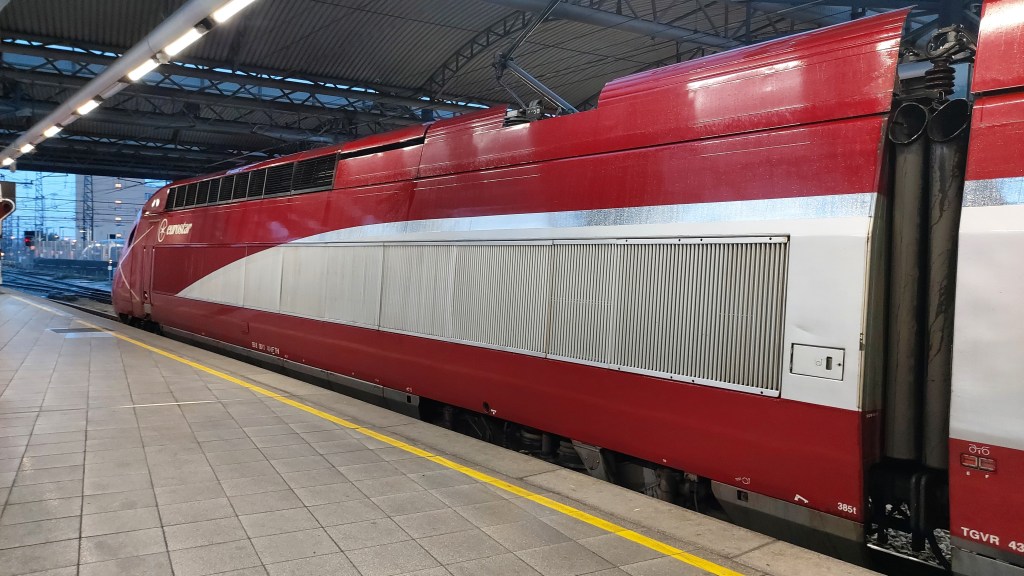
Our arrival into Bruxelles-Midi at 1849, five minutes late, marked the end of my adventure with the former Thalys part of Eurostar into Germany. From Brussels to London I’d be back travelling with the familiar half of Eurostar and it was interesting to see the differences between the two halves when I travelled back in October 2024. Since then, Eurostar has aligned its offering on the two halves, further integrating the former Thalys portion, with the three classes being ‘Standard’, ‘Plus’ and ‘Premier’. This does theoretically mean that a meal service is now provided in what was ‘Comfort’ on former Thalys services, significantly improving the overall offering in that class of travel. I haven’t got any complaints around the rest of the journey with the service from any staff encountered being excellent, and it was good that we recovered most of the delay encountered. Whilst it can end up being a long day, its good to see that with one easy change at Brussels, a lot of Germany is opened up to travel by train from London.
Lounge 0*
Seat/Facilities 4*
Food 0*
Service 5*
Punctuality 5*
Overall Rating 14/25 (read about my rating system here!)
 Flights & Times
One thought on “DUS-BRU Eurostar – Comfort”