
Having arrived into Düsseldorf late the night before, I had not explore the city other than catch the S-bahn out to Gerresheim where my hotel was. With just under 48 hours in the German city, I wanted to make sure I explore both it and some of the surrounding area, and so the morning after my arrival, I headed back to the S-bahn station to catch a train east. This would take me not into Düsseldorf itself but out along the Wupper river valley to the nearby city of Wuppertal, home of a very interesting railway.
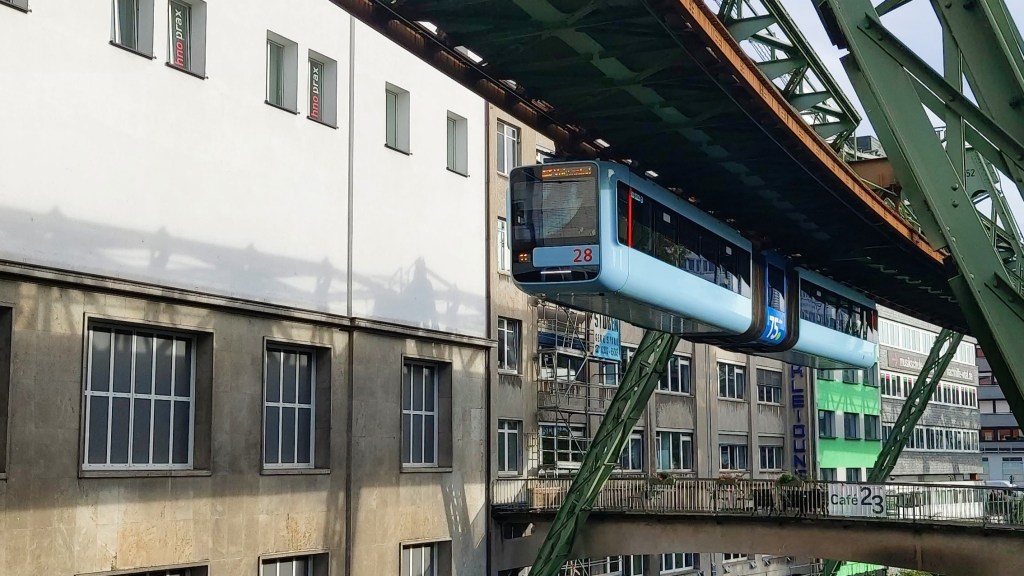
Wuppertal’s Schwebebahn, colloquially known as the ‘Danglebahn’ is a suspension monorail that ‘flies’ through the city, with the stations and track that it hangs from mainly following the river Wupper. Having now been in operation for almost 124 years, it is the oldest electrified elevated railway in the world and is both a functional transit system and tourist attraction of sorts. It had been my intention to have some breakfast in Wuppertal and explore the town whilst taking some rides on the Danglebahn, however the first part of the plan fell through when the café I found didn’t take cards and for the second part, lets just say there’s not loads to do in this small city in industrial North Rhine-Westphalia. However, I did fully complete the final part of the plan, taking a few rides on the Danglebahn before heading to Wuppertal Oberbarman station to catch the S-bahn back into Düsseldorf.
If you want to visit Wuppertal to take a ride on the Schwebebahn, the city is only 20 minutes or so from Düsseldorf on the S-bahn, with services running every half hour or so throughout the day. If you DO want to make a full day of your visit to Wuppertal, rather than spend a couple of hours wandering, the city does have a Botanical Gardens and a Zoo that seem to be worth a visit if you have time. There is also the Schwebodrom, or ‘Danglebahn Museum’, although looking at the website there isn’t an English translation and so I was concerned about it being the same case at the Museum itself and so decided to give it a miss. After all, €14.50 is a lot to spend and not understand anything! So anyway, with the Danglebahn ticked off, I made my way back into Düsseldorf before heading down to the city’s U-bahn (which is realistically a tram system that’s partly in a tunnel).
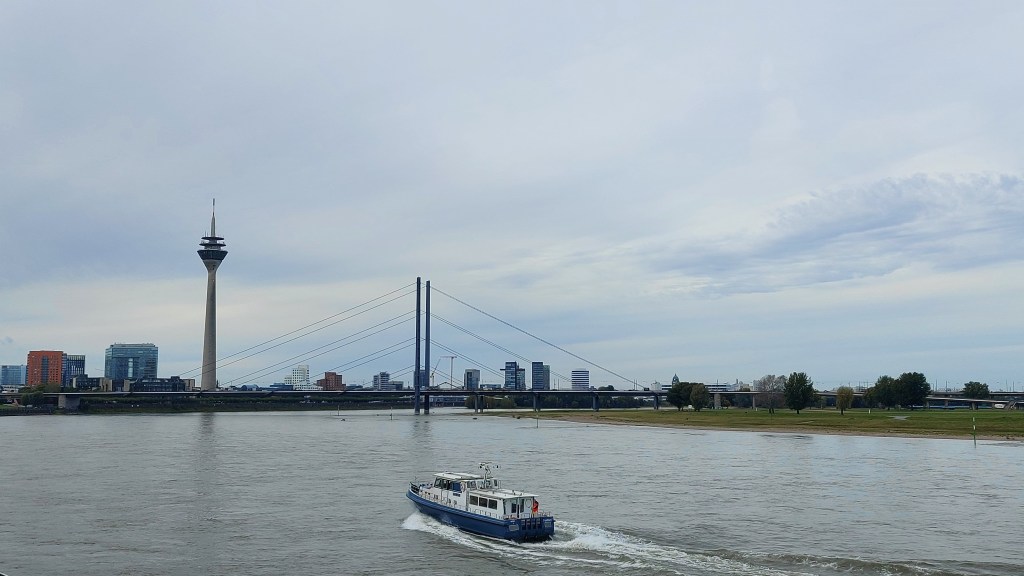
Unfortunately, I was able to find a walking tour of Düsseldorf to join and so I was left to my own devices to explore what the city had to offer. Deciding to head to the U-bahn’s ‘Tonhalle’ station, to the north of the Altstadt (old town), I could then make my way south and see what I stumbled upon. First up was Burgplatz and the Schlossturm, or Castle Tower, the only remnant of Düsseldorf’s 16th century castle which was destroyed by fire in the 19th century. The Schlossturm is now home to Düsseldorf’s Maritime Museum (Schifffahrtsmuseum) which is the oldest ‘inland navigation museum’ in Germany. My initial walk from Tonhalle to Burgplatz had mostly been along the Rhein, however at this point I headed slightly deeper into the Aldstadt and on to Martkplatz.
Martkplatz, as the name suggests was once home to Düsseldorf’s market, and is still home to the city’s Rathaus, or town hall. Constructed in the 16th century by Heinrich Tussmann, a ‘master builder’ from nearby Duisburg, the Rathaus has been renovated and expanded multiple times since, with the Town Hall having multiple wings from various centuries. Marktstraße is the main artery for the northern half of the old town, leading from Burgplatz, through Martkplatz and down to the crossroads at the centre of the Altstadt where it meets Bergerstraße, Flingerstraße and Rheinstraße. It was at this crossroads that I found my spot for an early lunch, Uergie.

Uerige is a brewery with its own ‘brauhaus’ attached, and I had an excellent lunch of roast suckling pig with beer sauce, creamed cabbage and roast potatoes. With the nice weather, I decided to sit at one of the tables outside and enjoyed both the scenery and food along with a couple of their own brewed lemonades. All in all, my lunch came to about €30, well worth it for what I had, however be warned that Uerige don’t accept card payments and so I had a mad dash to a nearby cash point a few doors down to be able to pay.
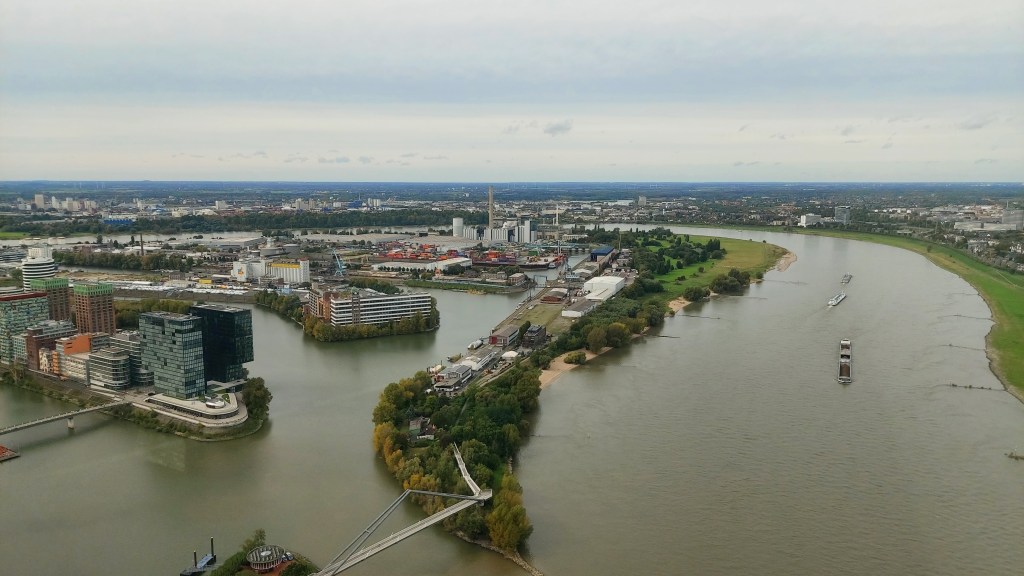
From Uerige, I continued through the Altstadt, making my way back towards the river Rhein, and took a stroll along the Rheinuferpromenade. Until 1990, the Rheinuferpromenade was actually a major road, separating the city from the river, however this was put into a tunnel allowing for the modern day promenade to be opened in 1997. Just beyond the southern end of the Rheinuferpromenade is the Rheinturm, a 172.5 meter tall communications tower with an observation deck towards the top. Opened in 1981, it costs €12.50 for the lift ride to the observation deck, from where on a clear day you can see for miles. Unfortunately, the weather was a bit grey when I headed up, but I still got a spectacular view across the city and Rhein.
After making my way back down the lifts to ground level, I found a nearby e-scooter and rode the few minutes to Düsseldorf Völklinger Straße station, an S-bahn station a couple of stops away from Düsseldorf Hauptbahnhof and helpfully on the same line as my accommodation. Be careful if you do head to this station though, a weirdly Google Maps has two different pins for the station, showing different train services, however there is most definitely and only one entrance, located at the more easterly pin. The other thing to be careful of when travelling around Düsseldorf (and probably most German cities) is making sure you have the correct ticket.
Verkehrsverbund Rhein-Ruhr (VRR), the transport authority of the Rhein-Ruhr region, splits the region into numerous fare zones, and the most basic level of ticket ‘fare category A’ only covers you within one of these. This type of ticket will be sufficient if you’re staying in the city centre and not venturing out of it, however if you’re accommodation is out of town then you may need a ‘fare category B’ ticket which covers a central zone and any directly adjacent fare zones. Finally, if like me, you want to explore some of the other towns and cities in the Rhein-Ruhr region such as Wuppertal, then you need a ‘fare category C’ ticket which covers all zones. You can buy single tickets in each of these fare categories, however if you’re planning on making more than two journeys in a 24hour period, its better to get a 24 hour pass.
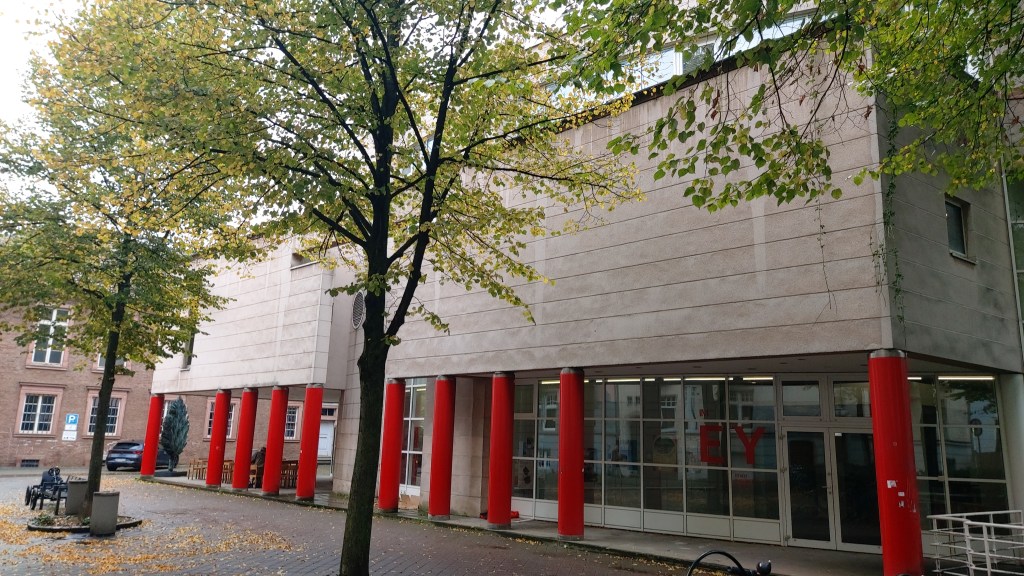
Unfortunately, I didn’t end up getting up to much overall in Düsseldorf, with some time spent spotting at the city’s airport (read about that here), the fourth busiest in Germany. I did however have a bit more time to spend in the city, and with the weather turning horrible, I headed to the Stadtmuseum, or City Museum, which I could explore whilst being inside. Entry to the museum costs just €4 and it’s got an interesting mix of exhibitions telling the city’s history, historical artefacts and art. These range from models of the city and castle in medieval times, to historic horse drawn carriages and even one of the sculptures celebrating when Düsseldorf hosted the Tour de France’s ‘Grand Depart’ in 2017. The museum really has got something of interest for pretty much everyone and for €4 I’d certainly recommend visiting if you have a couple of hours to spare.
Düsseldorf was an interesting city to visit, although not being a fan of art did mean I struggled to find things to do as Düsseldorf’s tourist industry seems to be focused on art. It’s a good city to base yourself in to explore elsewhere in the Rhine-Rhur region and I did enjoy wandering around the Altstadt as well as the other bits and pieces I did. Whether it was just the city didn’t ‘click’ with me as others have done, I don’t know, but I’m sure others, especially art lovers, would love visiting the city. Unfortunately for me, its probably somewhere I wouldn’t head back to.
 Flights & Times
One thought on “Düsseldorf & Wuppertal – Exploring the Rhine-Rhur Region”