
Back in September 2024 it was announced that the process would be started to replace ScotRail’s Inter7City fleet, their short-set HSTs, marking the beginning of the final chapter of the iconic HST’s operation in the UK. In November 2024 I was in Scotland for work and with most of a day free, I found myself at Glasgow Queen Street early one morning with a plan to ride these iconic trains for more than 300 miles over some of Scotland’s railways. My plan for the day would see me travelling onboard four different Inter7City sets, as I headed to Montrose, Edinburgh, Perth and finally back to Glasgow.
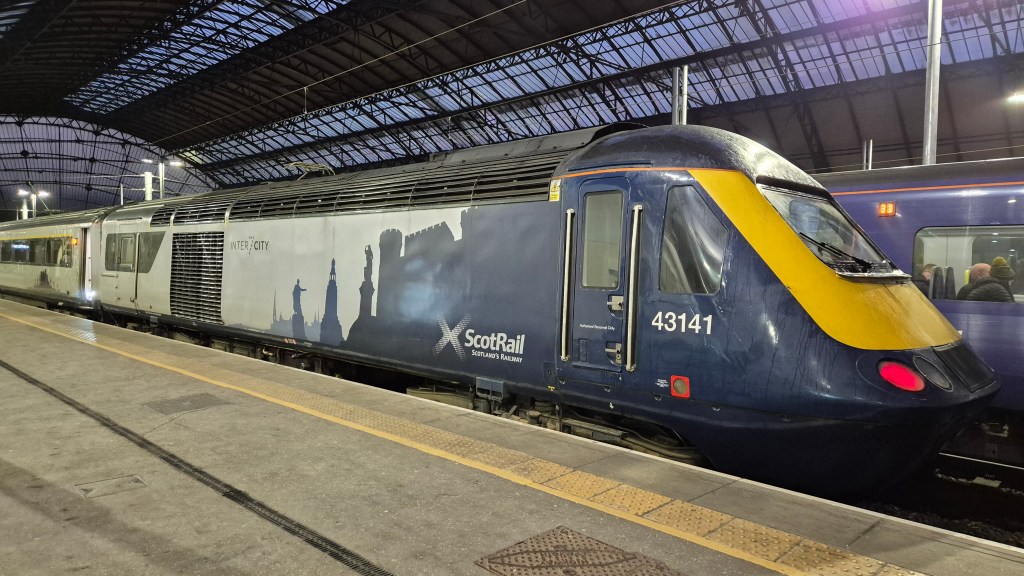
Introduced into service on the Great Western Mainline (GWML) in 1976, the HSTs (High Speed Trains) quickly became a workhorse of the British Rail fleet, operating services on the Great Western, East Coast, West Coast and Midland Mainlines as well as on the Cross-Country route. Essentially, at their peak, the HSTs were running on services in most corners of Great Britain and 197 of the class 43 power cars were eventually produced by British Rail Engineering Ltd’s (BREL) Crewe works. After 43 years of operation, 2019 saw the close of the first chapter of HST operations as both LNER and GWR replaced them on their inter-city routes with Hitachi units, although the latter converted some to ‘Castle’ sets with four coaches to work regional routes in the south-west.
With the majority of GWR’s class 43 and HST sets not being required for ‘Castle’ duties, ScotRail arranged to take on 26 shortened sets to operate between Glasgow, Edinburgh and the Highlands. Branded as Inter7City in honour of them connecting Scotland’s seven cities, the ScotRail sets were refurbished at Wabtec in Doncaster to meet modern accessibility requirements and formed into a mix of four and five car sets. With the first introduced to service in October 2018, on a service from Aberdeen to Edinburgh, the fleet came into scrutiny less than two years later following the tragic death of three people when 1T08 derailed at Stonehaven in August 2020. The damage sustained by another power-car in a collision with a tree in December 2023 increased this scrutiny and, less than 12 months later, the Scottish Transport Minister announced the process would begin to replace these now almost 50-year-old train.

First up for my day was 1A35, the 0841 departure from Glasgow Queen Street to Aberdeen, which I’d be riding as far as Montrose. The set forming the service arrived into Glasgow Queen Street from Perth, with the platform being officially announced for boarding around 10 minutes before departure. For this first leg I’d be travelling in standard class and had been allocated seat 08F in coach D at the front of the train. Standard class on the Inter7City sets is laid out in the usual 2-2 configuration with a mix of ‘airline style’ seating and groups around tables and, whilst the seats are not quite the ‘ironing boards’ you find on some new trains, they were relatively streamlined and minimalistic.
Whereas, prior to their retirement, LNER’s HST’s had had an electronic seat reservation system retrofitted to the bottom of the luggage rack, this had not happened to the ScotRail sets either during their time with GWR or during their overhaul prior to starting Inter7City operations. As such, seat reservations on these services are still handled by a piece of card stuck into the back of the seat and so boarding was a bit chaotic, despite being a relatively quiet service, as people stopped blocking the aisle to check the paper reservations. In terms of other modern technology, the ScotRail HSTs do have WiFi although this is obviously reliant on the onboard router having signal, resulting in quite patchy coverage across Scotland. There’s also standard plug sockets available, although no USB power outlets.
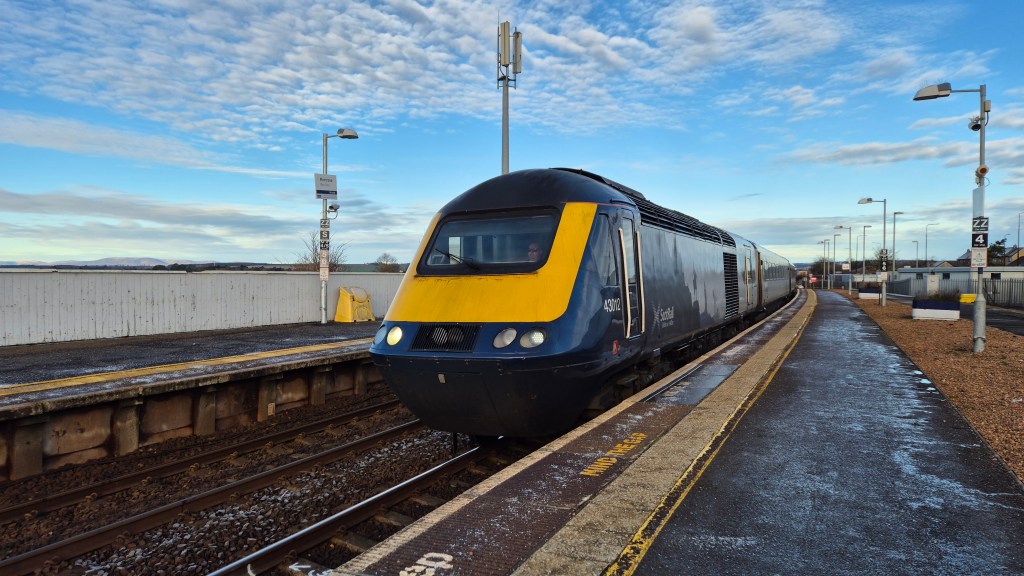
Departing Glasgow Queen Street on time, we were treated to a whiff of diesel fumes as we emerged out of the other end of the Queen Street railway tunnels. Whilst the HST’s crashworthiness is one of the main points of scrutiny, they’re also not the ‘cleanest’ of trains, with a large diesel engine in each power car running over electrified routes for parts of their journey. Whilst the Scottish Government does have an ongoing scheme of electrification for the rail network in Scotland, it doesn’t yet include the Highland Mainline or the route to Aberdeen beyond Ladybank and so fully electric trains would not be suitable replacements for the Inter7City. However, with widespread electrification across the Scottish Central belt and this soon to be expanded to parts of the Fife Circle, Bi-mode trains would be ideal replacements for the aging HSTs.
All of the ScotRail Inter7City sets have a café bar area built into coach A, between standard class and 1st class, however since the Covid pandemic these haven’t been used and for a long period there was no catering onboard these long inter-city services. These days however, catering is provided by an at seat trolley service which had a reasonable range of drinks and snacks available, however having just visited the new Greggs at Queen Street station, I decided not to partake. The first stage of this journey was a non-stop run under the wires from Glasgow to Stirling, where we arrived on time just under half an hour after leaving Glasgow. From Stirling, we continued along the Highland Mainline to Perth, where some unneeded stand time enroute meant we arrived 11 minutes early.

From Perth, we headed along the Tay estuary to Dundee and into Angus, winding our way along the coast with stops at Broughton Ferry, Monifieth, Carnoustie and Arbroath, before crossing the South Esk viaduct and arriving into Montrose on time at 1050, two hour and 10 minutes after leaving Glasgow. At Montrose I had around 45 minutes until the next Inter7City that I was due to catch and so retreated from the cold November morning to the vague warmth of the waiting room. Unfortunately, the 45 minutes didn’t really give me enough time to head into the town to explore, but the glimpses I caught from the train did catch my interest for a possible revisit in future.
The next leg of this four-train day was to Edinburgh, with 1B78, the 1101 service from Aberdeen being my ride from Montrose to the Scottish capital. Leaving Montrose a few minutes after our scheduled 1137 departure time, this service provided a slightly quicker run to Dundee, with only a stop at Arbroath in-between. After calling at Dundee, we turned to the south, crossing the famous Tay Bridge and making stops at Leuchars and Cupar before winding our way through most of Fife non-stop. In fact, the only other stop on this service after Cupar was after we had crossed the Forth Rail Bridge into the City of Edinburgh. Haymarket, Edinburgh’s second station was the final intermediate stop, before we passed through Prices Street Gardens and into Edinburgh Waverley. My trip from Montrose to Edinburgh had taken around an hour and 45 minutes, whilst the full journey from Aberdeen took around two hours and 20 minutes.

My change of trains at Edinburgh was the tightest connection in my plan for the day, with only 10 minutes from arriving in from Montrose until my penultimate train of the day departed towards Inverness. I wouldn’t be travelling all the way to the capital of the Highlands, in fact I wouldn’t barely be making it out of the Scottish Central belt on this part of the trip, with me taking 1H17, the 1332 departure from Edinburgh Waverley as far as Perth. Thankfully I made the connection at Edinburgh and settled into 1st class, which I had upgraded to for this leg to allow me to compare the differences between standard class and 1st class.
With the HSTs having ‘grandfather’ rights from some modern safety legislation, 1st class onboard the Inter7City sets have large leather seats, something that isn’t allowed onboard modern rolling stock as seats have to be made from a more fire-resistant material. As with most inter-city first class areas, ScotRail’s are laid out in a 1-2 configuration with every seat having access to a table. Aswell as the standard power sockets that are also available in standard class, 1st class has USB sockets installed, although from my experience these didn’t work that well and I ended up using my power bank instead. In terms of catering, the only items included are bottles of water and biscuits, both of which are available at the end of the carriage close to the external doors.

The journey from Edinburgh to Perth was scheduled to take around an hour and 15 minutes, with stops at Haymarket and Stirling enroute. Leaving Edinburgh on time, I was surprised how busy the service was, with 1st class almost completely full by the time we left Haymarket, and I was glad to have upgraded and got some extra space. As with my journey from Glasgow earlier in the day, the journey from Edinburgh to Stirling is entirely under the wires, meaning that if these services were operated by bi-mode trains, the stretch through Scotland’s most populated areas would be much cleaner. Another similarity with my journey that morning was a lot of unused stand time and so we ended up arriving at Carmuirs East Junction early and having to wait for an Alloa to Glasgow service to cross the junction before we could continue.
An on-time arrival into Perth gave me time to grab a coffee and make my way through the vast and empty station from platform 7 to platform 1 in time for the final leg of my day. This journey would take me back to Glasgow onboard 1T42, the 1346 departure from Aberdeen, which would have called at Montrose, Abroath and Dundee before picking me up from Perth at 1519. I was back in standard class for this final leg and once again it was a fairly busy train which became very full after the final stop at Stirling. From Perth to Glasgow it was exactly an hour’s journey, although we did end up arriving into Queen Street a couple of minutes early, despite slowing down around Cowlairs to let a local train head into Queen Street ahead of us.
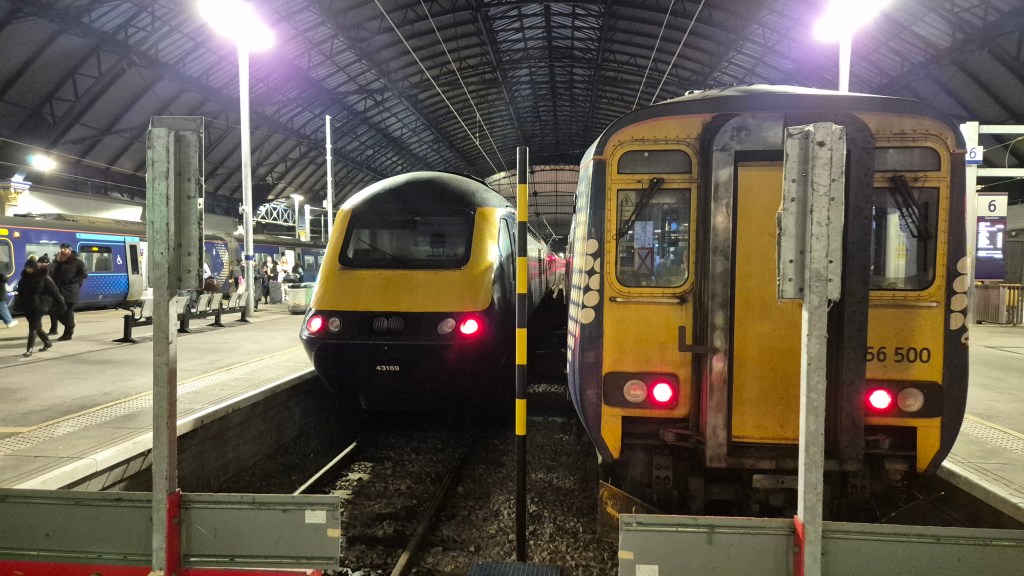
I had a great day riding around on ScotRail’s Inter7City HST sets and it was nice to see so much of Scotland’s stunning scenery whilst I did it. The Inter7City sets are nice trains and of course the HSTs are a classic piece of British engineering, however ultimately, they don’t meet modern standards and do probably need replacing. Hopefully when they are, ScotRail will opt for bi-mode trains to benefit from the electrification in the Central Belt whilst also specifying level boarding, something that is desperately lacking with the Inter7City sets. Not so secretly, I’m hoping for some Scottish Stadlers!
 Flights & Times