
Having arrived at Cork airport on an Aer Lingus flight from Heathrow (read about that here), I made a very quick exit from the aircraft with it taking just seven minutes from touchdown to reaching landside. Unfortunately, this quick exit was then slowed down by the wait for a bus into the city centre, with me waiting more than 20 minutes for a 225 or 226 bus to appear. Signs around the bus stops and in the terminal suggest buying your bus ticket on an app, however I couldn’t get this to work and ended up buying a physical ticket from the machine just inside the terminal by bus stop A. Physical tickets are €2.20 instead of €1.35 on app, however make sure you buy before you board as the buses themselves only take cash.
The buses from the airport connect to both the city centre and Cork Kent railway station and I decided to continue all the way through to the latter to take a ride out to Cobh. Recommended by a friend, Cobh is Cork’s port town, located about 20km from the city on the south side of Great Island within Cork Harbour. Carrying on through to the station also gave me the opportunity to get a feel for the place ahead of my early train to Dublin the following day and the general impression that I got was that there was lots of construction work going on to develop the station as part of the Cork Area Commuter Rail Programme. The line to Cobh is one of those that will hopefully benefit from the programme with an increase in trains, however at the time of my visit services were only hourly on the line.
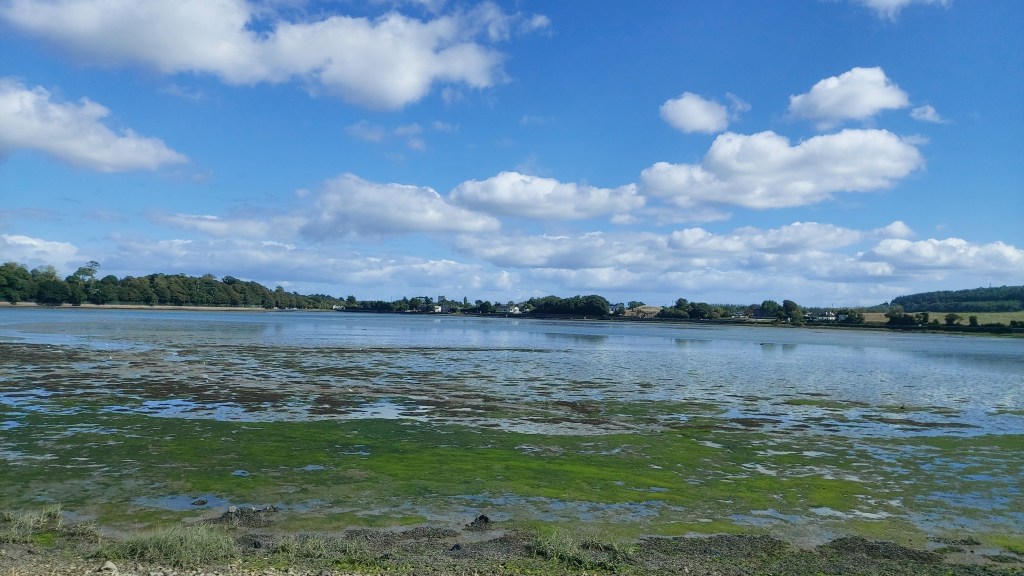
Departing Cork Kent to the east, the line follows the north bank of the River Lee with Páirc Uí Chaoimh, the home of Cork GAA, being visible on the other side of the river. Unfortunately, the view is then blocked by industry just before Glounthaune station where there is also the junction of the Cobh and Middleton lines. The Cobh line then crosses Cork Harbour on a pair of viaducts, with stunning views for much of the remaining journey to Cobh station. As we approached the end of the line, Cobh’s status as a port town was clear to see as the cruise ship Disney Dream was docked alongside the station as part of a cruise around the UK and Ireland.

Cobh station is now a shadow of its former self, with a single platform adjacent to the grand former station building. This building is now home to the Cobh Heritage Centre, and I decided to pay a visit to this first, including a visit to the Kilkenny Café for lunch. Entry to the Heritage Centre is €15 and it tells the history of Cove from its early days as Cove, through its time as Queenstown and to its present day as Cobh. Being the final port visited by the Titanic prior to its fateful voyage across the Atlantic, a large portion of the exhibition focuses on this, but it does well to also cover other key parts of the town’s maritime history. My only criticism is that due to the layout the exhibition can be quite hard to follow at times with there not being a ‘flow’ around the different exhibits.
Having had a look around the Heritage Centre, I wandered into the town centre itself to have a look at the Lusitania and Titanic memorials and see what else Cobh had to offer. Whilst it was busy, given the docked cruise ship, it wasn’t as busy as I expected, and I was able to wander around without it feeling too chaotic. Sitting prominently above the town centre is St Colman’s Cathedral and this combined with the colourful buildings in the centre provide a beautiful picture of the town. The harbour front is also home to the Titanic Experience, which I didn’t visit, although my first thought as I walked past was “experience what exactly?!”

Having had an enjoyable time exploring Cobh, I caught the train back into Cork and decided to walk to my accommodation for the night to get checked in and drop off my bag, before exploring Cork itself. As I headed west from the station entrance, I passed St. Patrick’s Church, a catholic parish church that was constructed in the 1830s having been funded by local merchant Matthew Honan. Whilst the first mass was held in the church in October 1836, it wasn’t finished for a good few years after this and the bell in the tower is inscribed with the year 1843. Constructed on a site that had been a brick factory, St. Patrick’s was originally called Brickfield Chapel, later being renamed, and was designed by architect George Richard Pain who designed many of the important buildings in Cork city centre.
Having checked in, had a bit of a rest after the early start and attended the talk that was the purpose of the trip, I headed back out into Cork to have an explore and wander as well as find somewhere for dinner. Located on MacCurtain Street to the north of the River Lee, Son of a Bun is a burger restaurant that had a great selection of options. I went for the Chicken & Waffle Burger as well and some Mac & Cheese and everything was delicious. These and a beer cost me around €25 which I thought was relatively reasonable for a city centre restaurant.

Taking an evening walk around the city, I headed passed the Opera House and Crawford Art Gallery, with the Opera House being mid-way through hosting the Cork Podcast Festival. The Crawford Art Gallery looked to have late opening hours on a Thursday evening, but that kind of thing isn’t my cup of tea, so I gave it a miss. Heading down a couple of side streets, I came out on one of Cork’s main streets, Oliver Plunkett Street, although I was a bit disappointed as there didn’t seem to be the charm or vibes that was suggested in reviews online. At the end of Oliver Plunkett Street is Cork City Library and Bishop Lucey Park, the latter which contains parts of the city’s medieval walls but was unfortunately closed as part of a city regeneration project. With the majority of Cork city centre being on an island between two branches of the River Lee, my wander had now brought me to the southern branch, with the National Memorial located at the end of Grand Parade by the river.
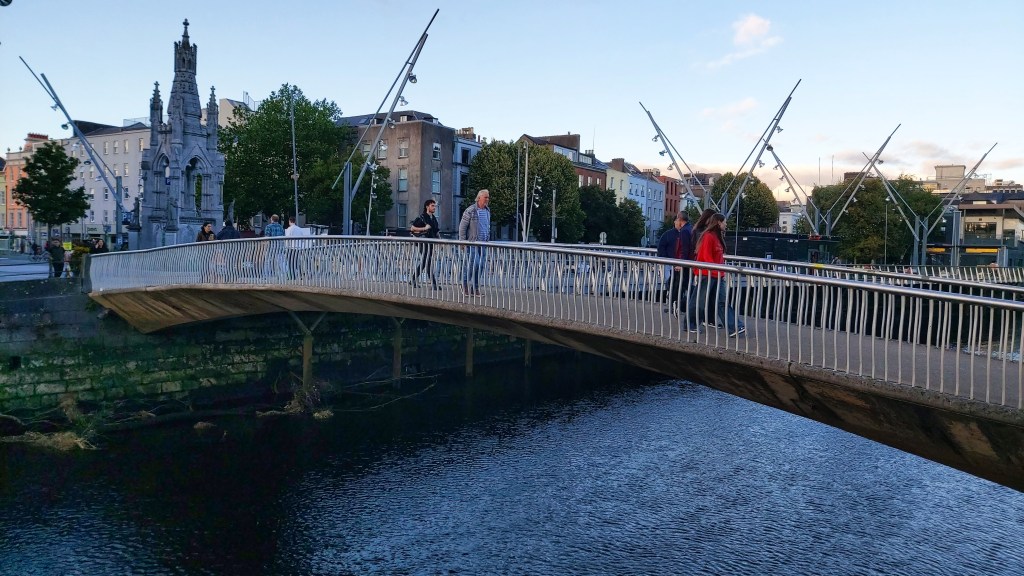
Connecting the open space by the National Memorial with Sullivan’s Quay on the other side of the river is the Nano Nagel Bridge, named after Honora Nano Nagle, the founder of the ‘Sisters of the Presentation of the Blessed Virgin Mary’, in Ireland. In trying to research the bridge, I can’t find a date for when it was constructed although it was one of the structures built to commemorate Cork’s 800th anniversary of being a city. Given that anniversary was in 1985, I’d suspect the bridge was built around then. From Nano Nagel bridge, Sain Finn Barrie’s Cathedral is visible in the distance on a hill on the south side the River, although at this point I decided to head back into the city centre and to my accommodation rather than climb the slope.
After a brief stay in Cork, the following morning it was time to begin my journey home and after an early morning walk back to Cork Kent station, I caught an Iarnród Éireann service to Dublin (blog on this coming soon). Arriving in Dublin around 0930, I had a few hours before I needed to head to the airport and so had some time to grab some breakfast and see some more of the Irish capital (you can read about my previous visits to Dublin here, here and here). My go-to breakfast option in Dublin is Brother Hubbard, and so I caught the Luas red line a few stops to Four Courts and walked the couple of blocks to Brother Hubbard North on Capel Street. Rather than my usual choice of ‘The Full Hubbard’, I decided to mix things up on this occasion and went for ‘The Brunchy Eggs: Mushroom Edition’ which is essentially poached eggs on toast with mushrooms. The thing that made me laugh was the bacon I’d added as an extra came in its own bowl rather than with the rest of my breakfast!
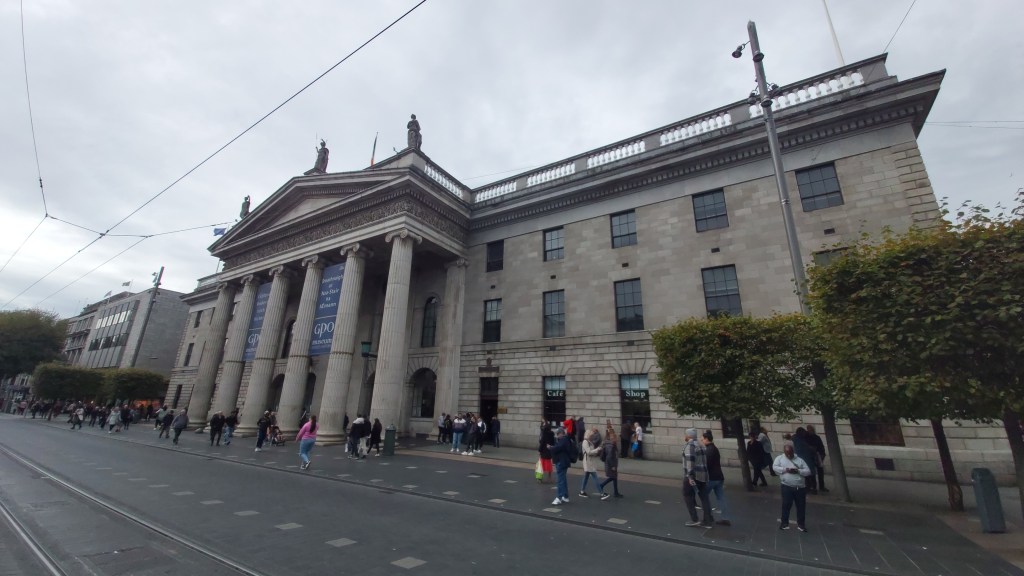
After a hearty breakfast, I headed along Abbey Street until I reached Dublin’s famous O’Connell Street that leads north from the river. O’Connell Street is home to the General Post Office (GPO) a significant building during the 1916 Easter Rising, which as well as still being a functioning post office, is also home to the GPO Museum. Covering the history of both the Easter Rising and Ireland’s fight for independence, the museum was interesting but chaotically organised with no real flow. As well as the main exhibition, there was a small exhibition on the history of the Irish flag as well as a timeline comparing the histories of the Republic of Ireland and Northern Ireland from 1920 onwards. I spent about an hour in the museum but probably skipped over parts, and I’d certainly recommend paying it a visit. Before catching the bus to the airport, I had one final thing I wanted to check out, the Dublin Portal, although this was unfortunately ‘asleep’ presumably because it was the early hours of the morning at the location of its twin, New York City.
In summary, whilst my time in Ireland was short, I thoroughly enjoyed it and feel I saw a decent amount whilst also only grazing the surface. If I’m honest, and I don’t want to disrespect the city here, I felt Cork was somewhere you visit to visit places nearby rather than visiting the city itself, but that may have just been as a result of my flying visit. Cobh was a beautiful town and I’ll certainly return in future and hopefully see some more of it. I’d think a boat tour around Cork Harbour in the summer would be stunning! Dublin as always was a great city and somewhere I always like to return to, and it was good to finally have ticked off the GPO Museum.
 Flights & Times
2 thoughts on “An Irish Trio – Cobh, Cork and Dublin”