
And so its here, the final part of Exploring the East Coast, my series where I’ve visited every station on the East Coast Mainline (ECML). From the major stations of London Kings Cross, York and Newcastle, to the small rarely used stations of Acklington, Chathill, Pegswood and Widdrington, there were just two stations left to tick off and in this post we’ll visit both. Unlike the majority of the other posts where I’ve visited the stations on the same day, or at least with only a short gap, life meant that I visited the first of these two stations in February 2024 and the final station of the series in September 2024.
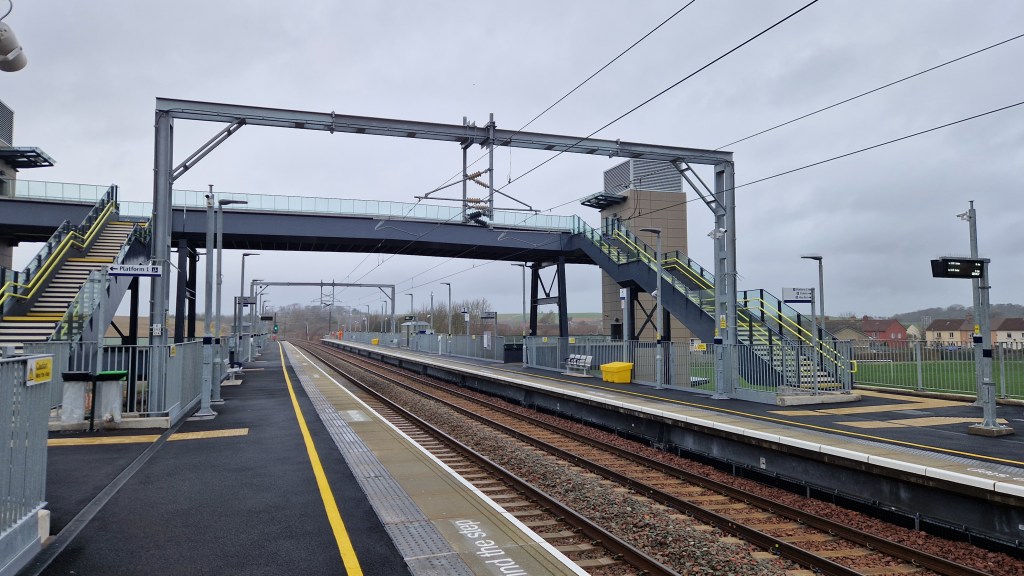
Back in February 2024, on the same day I visited Wallyford and Musselburgh for episode 15 of Exploring the East Coast (read that here), I also headed to what was then Scotland’s newest station, East Linton. Located between Drem and Dunbar, East Linton is a fairly basic station with two platforms, a somewhat interesting overbridge, lifts and access to the street from both platforms. There’s a car park, bike rack and bus stop provided (although currently no bus service) and by heading through the park on the southbound side of the station, you can reach the town’s high street in just a few minutes’ walk.
In terms of service, to put it bluntly, East Linton is a mess. Services are provided by TransPennine Express (TPE) and ScotRail, with both operators providing five trains a day in each direction, TPE between Edinburgh and Newcastle (a sixth southbound train heads to Berwick only) and ScotRail between Edinburgh and Dunbar. Unfortunately, these services are timed to fit between the long distance non-stop LNER and CrossCountry services and so there can be anything between a 15-minute to five-hour gap between services. For example, if you’re heading into Edinburgh in the mid-morning, there’s the 1046 TPE and then 1108 ScotRail service, however if you’re heading to the Scottish capital for evening drinks, don’t miss the 1742 as the next train is the final northbound service of the day at 2228.
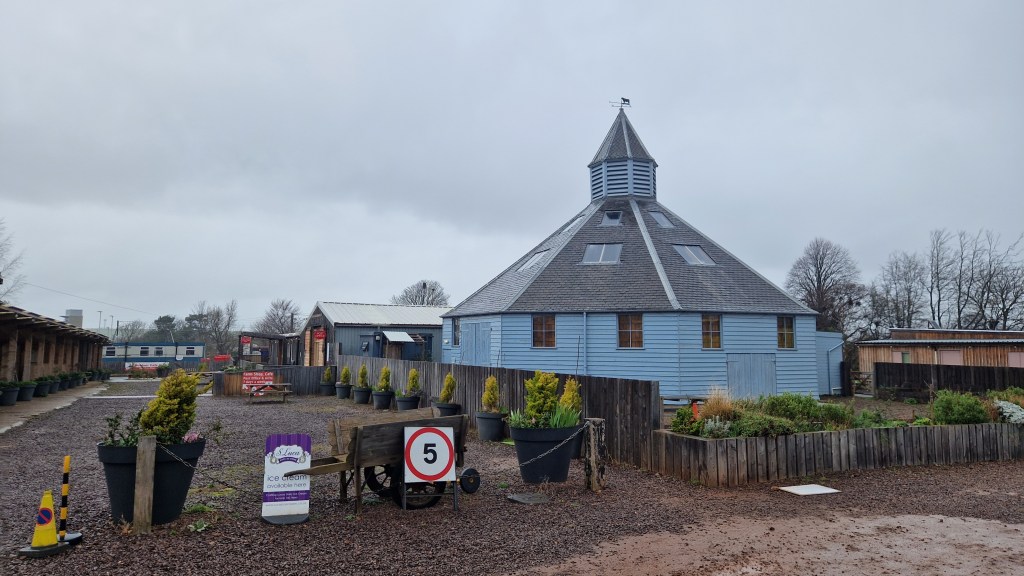
Having arrived on one of the morning TPE services from Edinburgh, I crossed over the footbridge to exit the station via the northbound side and the ‘main’ entrance that is home to the car park. My first stop was The Mart, a large hexagonal timber market building from the 1850s that has survived through the original closure of the railway station in the 1960s and had gained a new lease of life since 2018 as an events space. The Mart is also home to a number of independent retailers, a farm shop and most importantly on a chilly November morning, a coffee shop, where I enjoyed a breakfast roll and a coffee before heading back out to explore the town some more.
East Linton is a pretty little Scottish border village with a few shops and pubs but overall not much to do or explore. However there are a couple of bits a short walk outside the village (which I didn’t do because of the weather) that are possibly worth exploring, and the 2 mile circular walk should take around 45 minutes if you fancy it. The first points of note are Prestonkirk Church and Preston Mill, found by heading out of East Linton on the Preston Road, and these sites both have plenty of history. The original Prestonkirk Church is said to have dated from around the 6th century, however the oldest part of the current building is the tower which dates from 1631. The main building is from 1770, was enlarged in 1824 and finally the interior was redesigned in the early 1890s.
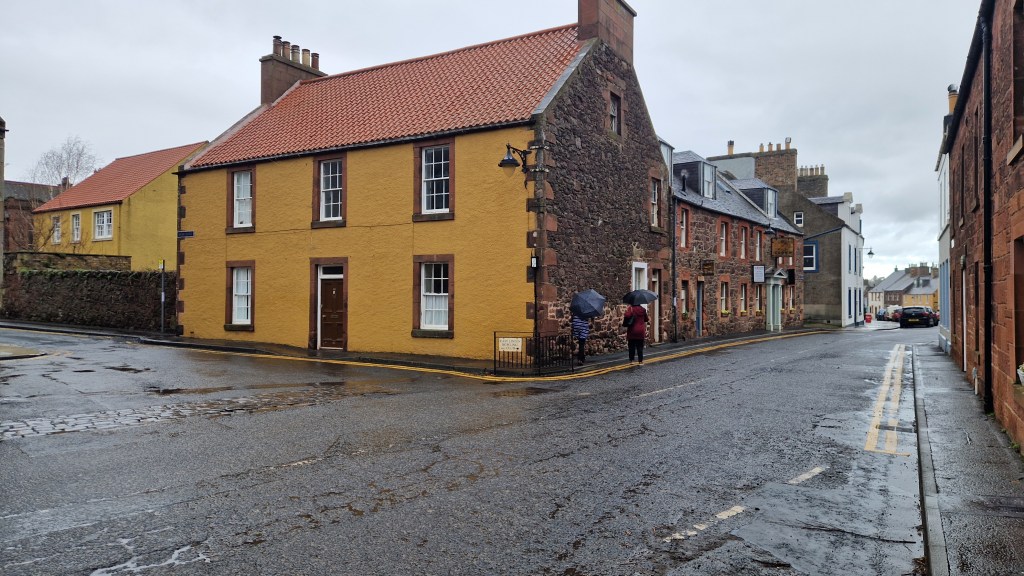
A mill has been situated on the site of Preston Mill since the 16th century, although the present mill dates from the 18th century. Used commercially until 1959, it is now a Category A listed building and is cared for by the National Trust for Scotland. The building is very picturesque with a red pantile roof and the complex, consisting of a kiln, mill and the miller’s house, is open between 1st June and 30th September between 1300 and 1700 every day other than Tuesday and Wednesday. From Preston Mill, if you cross the River Tyne and take the path across the adjacent fields, you’ll reach the final historic building on the loop, the Phantassie Doocot. This beehive doocot, or dovecote, also dates from the 16th century and behind its 4ft thick walls has 544 nest boxes which would have sheltered the local landowner’s doves.
For me, after a short walk around the village itself and visiting some of the memorials in the garden at the centre, it was time to head back to the station. After East Linton I went to visit Wallyford and Musselburgh, so to continue with this final episode of Exploring the East Coast we move forward seven months and to the Scottish capital, Edinburgh. The city’s main station, Edinburgh Waverley is the northern terminus of the ECML lying 393 miles and 13 chains from the southern terminus at London Kings Cross. Located in the valley between the Old and New Towns of Edinburgh, Waverley is well located to explore the stunning Scottish capital. As with when I visited Kings Cross early on in the series, there’s more to see and do in Edinburgh than can possibly be covered in a single blog, let alone half as one. As such, I decided to do something a bit different and walk from my hotel near Haymarket, through the streets of Edinburgh to Waverley and see what I stumbled across on the way.
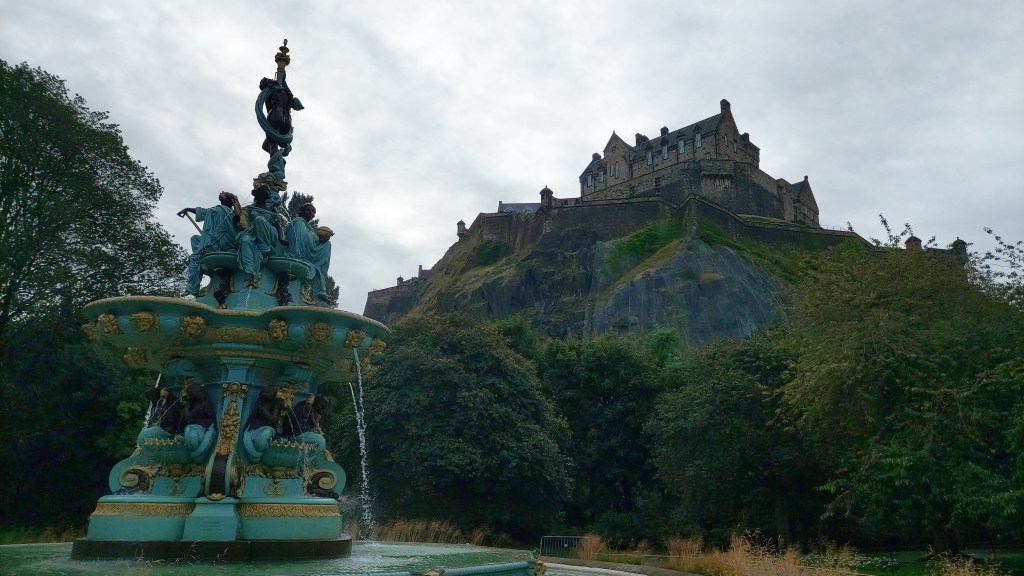
Heading along Fountainbridge and then down towards the railway and Princes Street, I came across the site of Edinburgh Farmers Market, a weekly market that is open each Saturday from 9am until around 2pm. Unfortunately, my exploration of Edinburgh was on a weekday and so the Farmers Market wasn’t there and the site was undertaking its normal function as a car park, but I’m sure its well worth a visit if you’re in the city over a weekend. My next stop, at the bottom of the hill, was Princes Street Gardens, which I entered via the western entrance from St. Cuthbert’s Cemetery, close to the Ross Fountain. An exhibit in the Great Exhibition of 1862, the Ross Fountain was produced in the Antonie Durenne iron foundry in Sommevoire, France and after the Great Exhibition was purchased by Scottish gunmaker, Daniel Ross for £2000 (over £300k today!). Gifted to the city of Edinburgh and transported to the Port of Leith in 1869, it was installed in its current position in 1872 and underwent an extensive restoration in 2001. From the fountain, you get excellent views up towards Edinburgh Castle, so it’s a spot that is well worth a visit.
The West Princes Street Gardens where the Ross Fountain is located, were originally the private property of the nearby properties on Princes Street which overlooked them. With the land being required by the council in 1876 to act as a public park, this purchase also resulted in the widening of Princes Street itself to its current form and the creation of the steep embankment to the northern side of the gardens. The gardens are completely free to entre and whilst being the most popular park within the city, still provide a space of peace and tranquillity away from the nearby hustle and bustle of Princes Street. Splitting the western and eastern portions of the gardens is The Mound, home to The Royal Scottish Academy and The National Galleries of Scotland, with East Princes Street Gardens sitting the other side of The Mound towards Waverley station.
East Princes Street Gardens are probably the most visited portion of the gardens given their prominent location and easy access from both the station and Princes Street itself. They are also home to the prominent Scott Monument, a 200+ft tall monument to the writer Sir Walter Scott, the second largest monument to a writer anywhere in the world. In addition to Scott and his dog, the monument has 68 other statues on it, including various figures from his works as well as sixteen busts of Scottish poets and writers. East Princes Street Gardens also crosses over the mouth of the railway tunnels forming the western throat of Waverley station and has access to Market Street and Cockburn Street, connecting the gardens to Edinburgh’s Old Town.
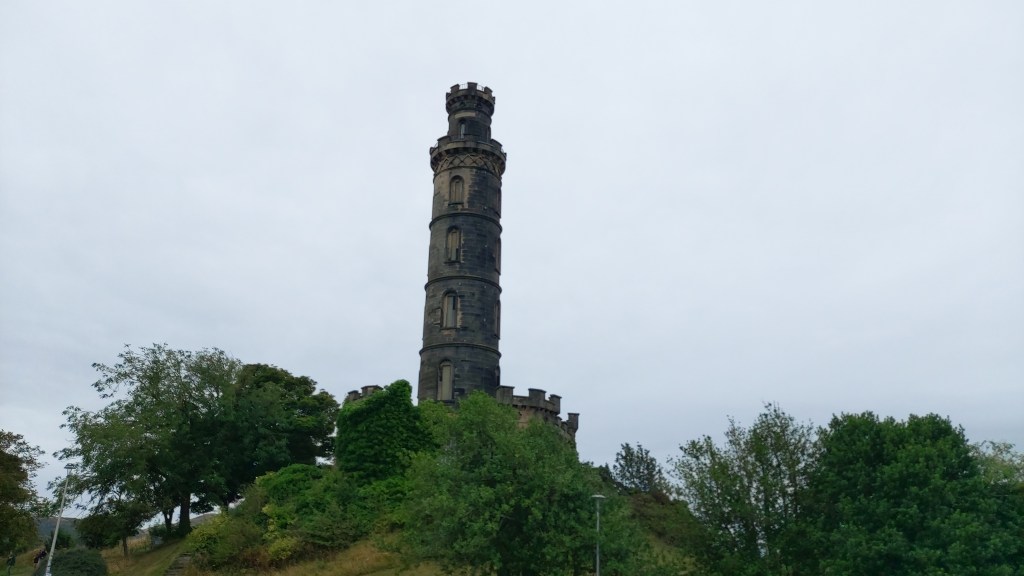
Having reached Edinburgh Waverley, I decided to continue beyond the station to somewhere that is a landmark for me as I arrive into the Scottish capital. Visible from the train as you emerge from tunnels at the eastern end of the station, Calton Hill is a prominent feature of the city and, once you’ve climbed to the top, provides great views out over Edinburgh. Calton Hill also has a number of monuments and buildings located on its summit and slopes, including the National Observatory, National Monument and the Nelson Monument. The summit of Calton Hill sits 103m above sea level, with a prominence of 46m above the surrounding areas of the city. Access is via steps and proper footpaths, making it a relatively ‘easy’ climb and its well worth it for the views!

Another spot well worth the views is somewhere I visited the day before the majority of my explorations of Edinburgh. Starting early from outside the Scottish Parliament, I climbed the Salisbury Crags, the cliffs forming the northern edge of the former volcano that is now Holyrood Park. Whilst not as high or as famous as the neighbouring Arthur’s Seat, the Salisbury Crags are still a decent hike and, being to the north of Arthur’s Seat, still provide amazing views over the city. The climb is definitely more challenging than Colton Hill and will require walking boots rather than trainers, but in good conditions is solid underfoot and there’s views almost immediately that keep getting better to motivate you as you walk.
I enjoyed exploring both East Linton and Edinburgh, the former being somewhere new and different that I would like to return to during the warmer months, and the latter being a city that I love to visit and am lucky enough to have the opportunity to ‘drop in’ on a semi-regular basis. With the stations of the East Coast Mainline all now under my belt, my focus now turns to the branches, loops and other extremities.
 Flights & Times