
Operator: Avanti West Coast
Headcode: 1A68
Route: CTR-EUS
Class: Standard Class
Seat: B33
Date: Tuesday 25th June 2024
Having arrived in Chester on a delayed Transport for Wales service from Manchester Airport, I had a reasonable length connection before the last leg of my tour of the north-west, the train taking me south. To finish this mini rail tour I would be travelling on what was, at the time, Britain’s newest class of train, Avanti West Coast’s (AWC) class 805s. This journey from Chester to London Euston during the first month of the type’s operation in standard class would be a good test to see how the units compare to other members of the AWC fleet.
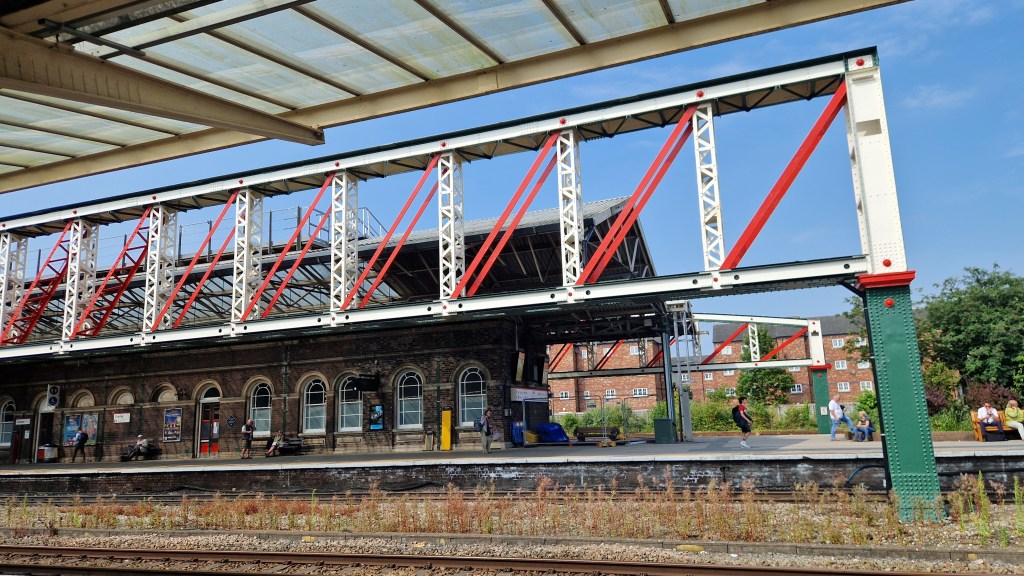
With a bit of time to spare I wandered around Chester station and came to the conclusion it is possibly one of the most architecturally absurd stations I have visited. Parts of the station seem to be ridiculously over engineered and there is apparently no consistency between architectural styles with bits added on with no thought. For example, the bridge connecting platforms 1-3 with platforms 4-7 seems to have just been built through a hole in the train shed wall and the mini-train shed for platforms 5 & 6 is not in any way incorporated into the main train shed.
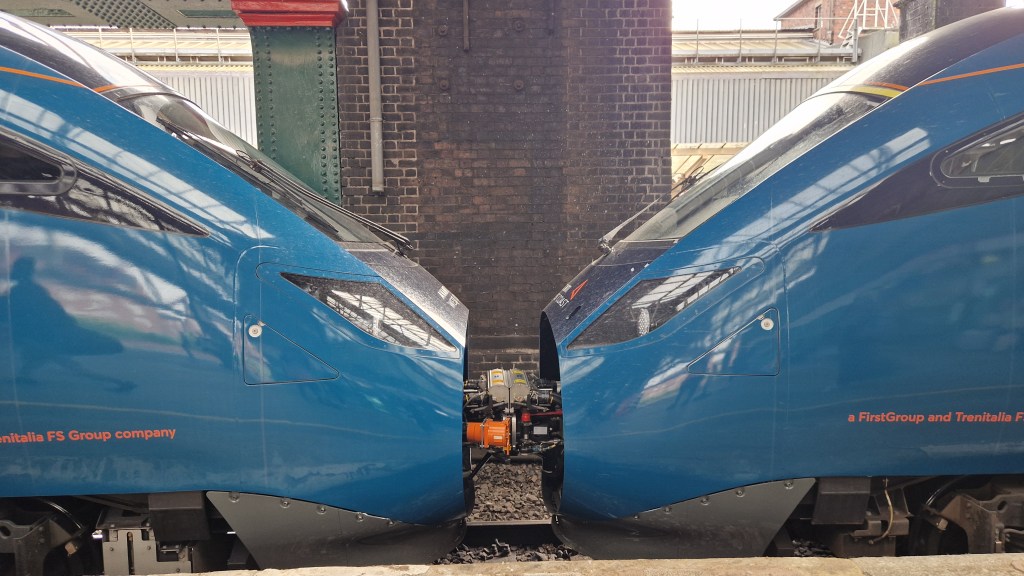
The unit forming my service south was 805012 which arrived as the rear portion of 1D89, the 1501 Euston to Holyhead which splits at Chester. Unfortunately, this arrived a bit late and there was a bit of chaos as everyone was turfed off the rear portion before the split was completed, including passengers that had just boarded this portion to head to London. Eventually we were allowed onboard just four minutes before departure and I was quickly able to find seat B33, a forward-facing table seat in standard class.
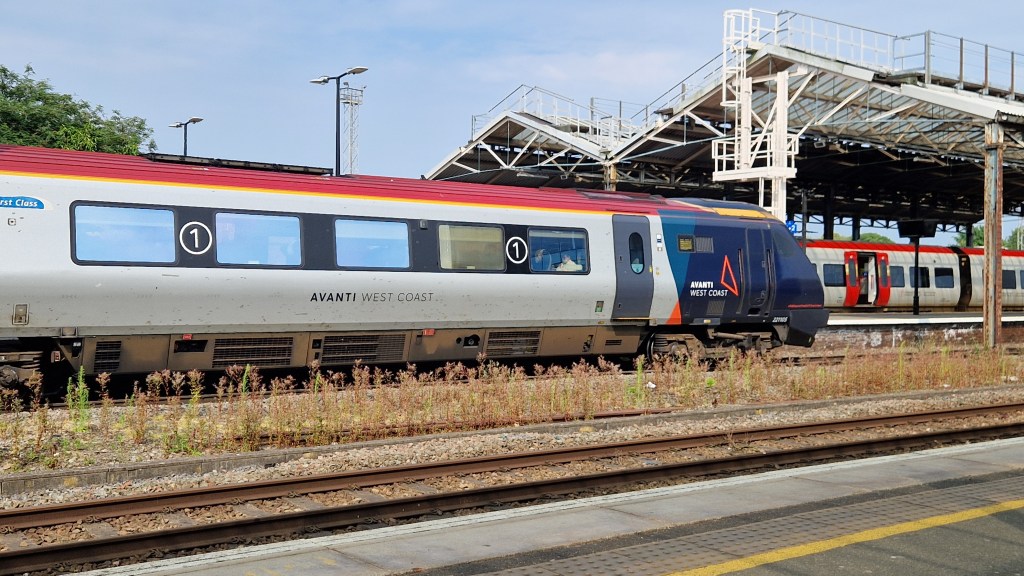
My initial thoughts after getting onboard were generally that I was impressed, although there was a big step (even for me) from the platform up to the train. Don’t worry, I’m not going to go on another level boarding rant (see my last post) but it is worth mentioning. There are plenty of positives though with modern touches such as the tables having wireless charging and the ’airline style’ seats having reading lights above the tray tables. Every seat had access to both USB and standard power sockets, although given the general move towards USB-C it was a bit of a shame not to see these sockets having been installed.
The seats onboard are the same as those on Lumo and on AWC’s refurbished Pendolinos, which whilst still not as comfortable as some older style seats, are still a vast improvement on the ‘ironing boards’ installed on the class 805’s LNER and GWR cousins. The seats have ‘wrap around’ head rests which are a nice touch, although these and the seats as a whole could do with a little more padding. In terms of layout, the class 805s are nothing unusual, with standard class laid out in a 2-2 configuration with a mix of groups of four around tables and ‘airline style’ seats.
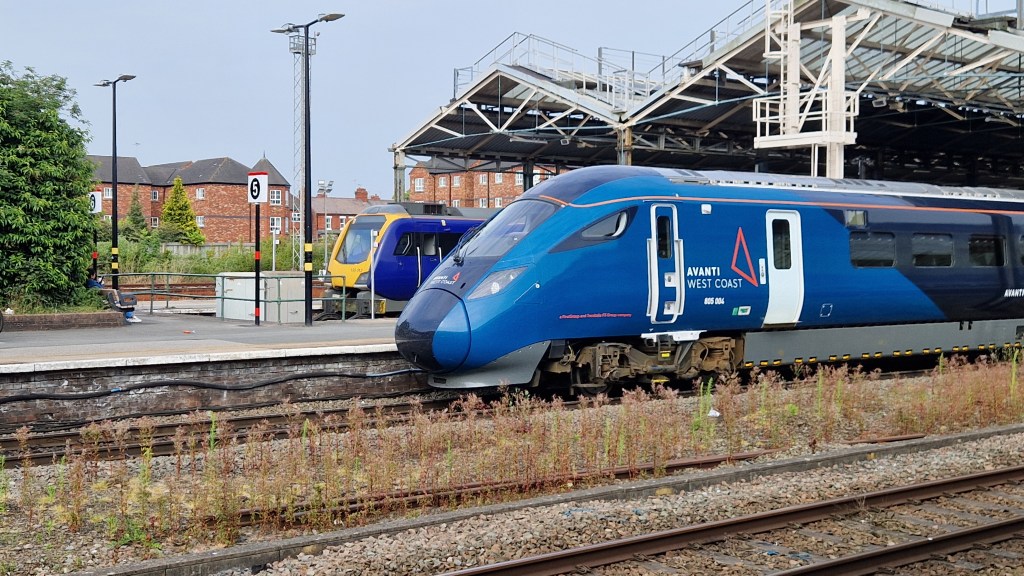
Unfortunately, the chaos of boarding didn’t end with the short amount of time allowed to board as the coaches themselves seemed to be a bit confused by the whole thing. The outside displays and small internal displays showed the ‘correct’ letters for the journey south to Euston, whereas the displays above the internal doors at the coach ends displayed the ‘incorrect’ letters from the previous journey north to Chester. When all of this was combined with the seat reservations displaying until after departure, it was a miracle we departed on time but somehow, we did.
The 180 mile journey south to London Euston was scheduled to take just over two hours, with only two intermediate stops at Crewe and Stafford. This journey from Chester is a prime example of the advantage the new class 805s provide over the class 221s they are replacing, as their bi-mode power supply allows them to run on diesel power over unelectrified routes, but also allows them to use power from the overhead lines where available. This means rather than 180 miles on diesel all the way to London, the class 805s only have to run on diesel for the approx. 21 miles from Chester to Crewe before ‘raising the pan’ and running as an electric train for the remaining 160ish miles.
The first part of the journey from Chester to Crewe was only to last around 20 minutes and the class 805 was perfectly comfortable whilst operating in diesel mode, although it did seem to be a bit ‘juddery’, possibly as I was sat over an engine. As we reached the outskirts of Crewe we began to pass some of the many railway sidings and yards that are a major part of Crewe’s heritage, including Crewe International Electric Maintenance Depot (where the Channel Tunnel class 92s are maintained) and the Crewe Heritage Centre and former Crewe North Signal Box that lie in the V between the West Coast Mainline (WCML) and Chester Line. At Crewe station itself, I could feel the engine shut down and the class 805 came into its own with a much smoother and quieter journey whilst operating in electric mode.
Unfortunately, our on-time departure from Chester didn’t translate to an on-time departure from Crewe as we were re-platformed for a late running Edinburgh service and departed 3 minutes late. Our re-platforming also meant we then had to cross both the Shrewsbury lines and the entirety of the WCML to continue our journey south. We also passed the Arriva Traincare depot that sits between the WCML and the line towards Stoke, where a Transport for Wales class 197 and some West Midland Trains / London Northwestern Railway class 730s were stabled.
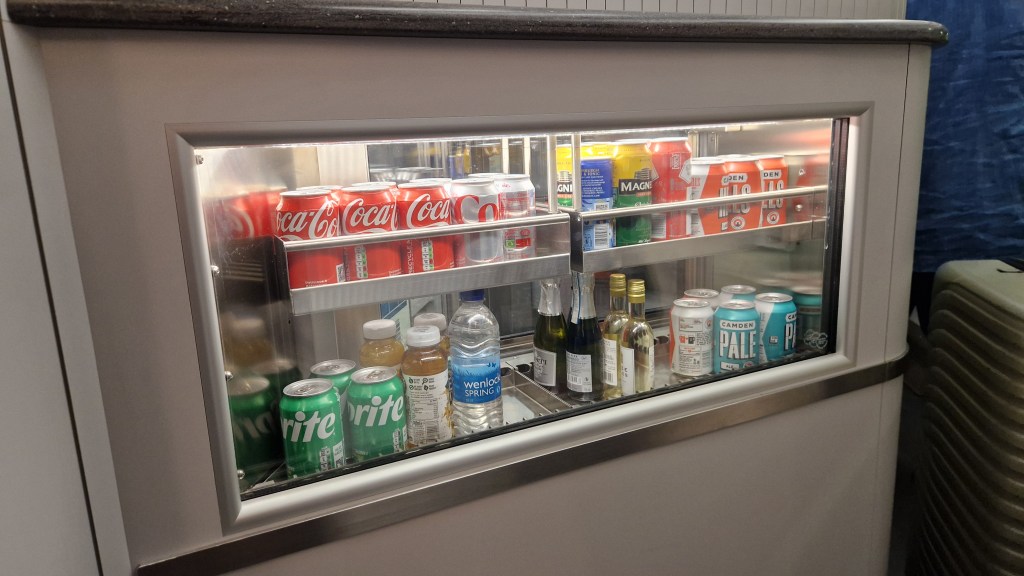
As we departed Crewe I decided to head to the onboard shop, also located in coach B, to check out what they had on offer. The usual range of drinks, snacks and cold food was available and I opted for a meal deal which for £6.50 included a sandwich, drink and a chocolate bar. Essentially everything you’d expect from the shop onboard a train, all perfectly fine but nothing to write home about. One thing that is worth noting is the water refill point that’s available next to the shop, allowing you to top up your water bottle whilst onboard, something that I was quite glad of given the heat throughout the day had depleted my supply.
Enroute to Stafford we passed the disused Norton Bridge station where the line to/from Stone diverges from the WCML. The train service from Norton Bridge was ‘temporarily’ withdrawn in 2004, however was never reinstated and the station was officially closed by previous operator London Midland in 2017. The final intermediate stop on our journey was Stafford and we departed here running four minutes late to continue our journey along the Trent Valley. Out of the window for journey between Stafford and Lichfield you could usually see either the River Trent itself or the Trent and Mersey canal, with the railway following the line of route initially created by the canal’s construction.

The rest of the journey towards London was smooth and fast, unhindered by any further stops. Just south of Rugeley we passed one of the various automotive trains that run on the GB rail network, this one being GB Railfreight’s 6L48 from Garston to Dagenham, returning from delivering new Fords to the Merseyside area. Just north of Milton Keynes we passed through Wolverton, home of Wolverton Railway Works which undertakes the maintenance of the Royal Train and overhauls for various operators. Access to the works is quite unique in that there is a dive under that leaves the mainline between the Up and Down slow lines and then runs under three of the four tracks of the WCML to access the works.
At Milton Keynes we were one of the few AWC services not to stop at the station and as we passed through the station I caught a glimpse of two class 325 postal trains waiting in the station. These have unfortunately now been retired and of the two that I saw, 325007 and 325009, at the time of writing the former is in storage whilst the later has already been cut up for scrap. As we started to pass through the towns forming the London commuter belt, I was able to catch a glimpse of Berkhampstead Castle, somewhere that every time I pass I think “I should visit there” but have yet to get around to. Another GB Railfreight service passed us going north as we continued our journey towards the capital, this one 6M51, a Dollands Moor to Daventry service transporting imported bottled water from France.
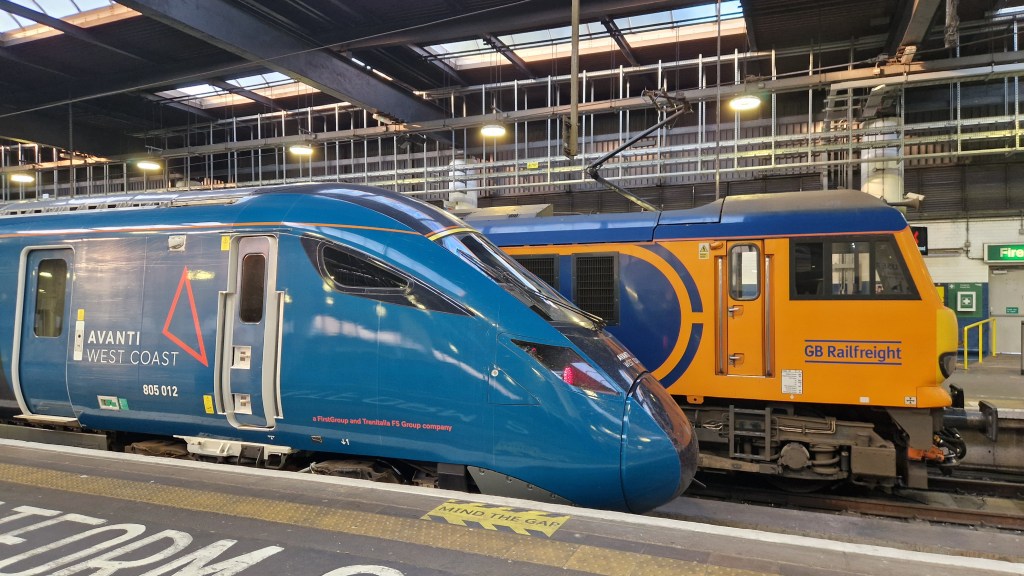
The vast array of railway yards at Wembley passed by the window, marking the final minutes of my journey, with 3 Intermodal services of various operators, an Aggregates service and a collection of stored class 321s not even beginning to fill the available space. Making our way through the London suburbs and past the former railway roundhouse at Camden, now an entertainment venue, we finally arrived at London Euston’s platform 2 at 1945, a total of 10 minutes late. All in all this was a good journey with AWC and I certainly enjoyed travelling on one of their new Evero trains and look forward to seeing if they open up any new routes for AWC in the future.
Lounge 0*
Seat/Facilities 4*
Food 3*
Service 5*
Punctuality 4*
Overall Rating 16/25 (read about my rating system here!)
 Flights & Times