
Snoozing to Split had been a marathon rail trip across Europe, with 10 countries passed through, five trains, four intermediate cities and four days, however at around 2200 on Monday 8th January, I stepped off the final train of the trip (read about that here) and onto the platform of Split’s main railway station. Having started the day on a sleeper train between Zurich and Zagreb, waking somewhere in western Slovenian, I was ready for bed and so enjoyed a short stroll through the quiet streets to my hotel to end the day.
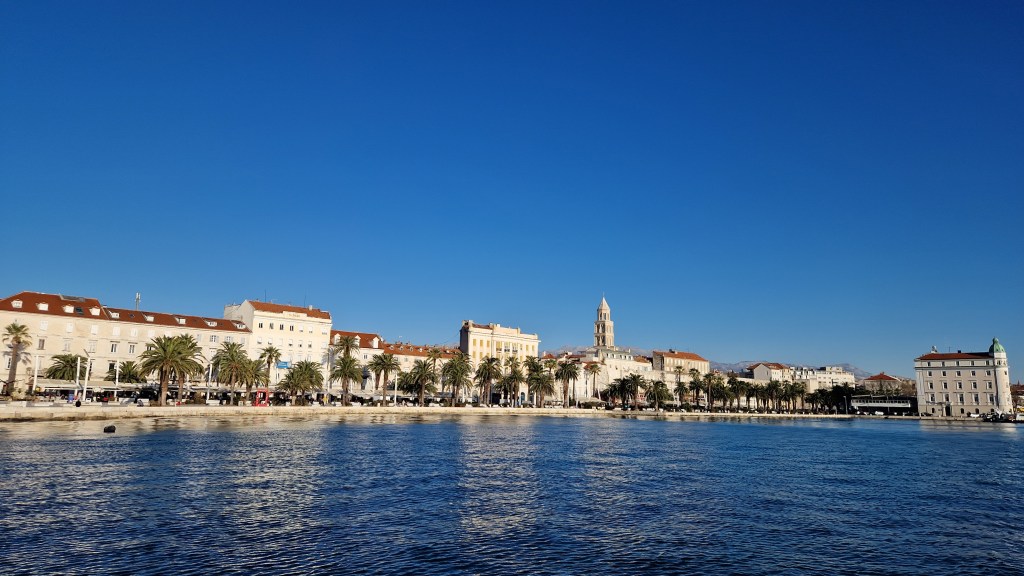
Having slept in a proper bed for the first time in three nights, I woke refreshed and ready to explore, motivated by the good weather and the fact I could walk around without a coat of woolly hat. I decided to start the day with breakfast by Split’s beautiful harbour and settled down at Bobis for a relaxed latte and croissant, costing me just €2.60. A second latte and some more relaxing brought my total bill to €5 and an hour after arriving, I headed off to explore the harbourfront.
Unfortunately, the free walking tour I had booked onto was cancelled as I was the only person to have booked onto it (January isn’t peak tourist season for Split) and so I began an erratic wander around the city in an attempt to see the key sites. My first stop was the Church of St Dominic, just outside the Silver Gate of old city walls and next to the Green Market. Not to be confused with the more famous Saint Dominus Cathedral, this church was free to enter, very quiet and has some beautiful interior elements. Given it’ll only take 10 or so minutes to have a wander around, it’s worth popping your head in.
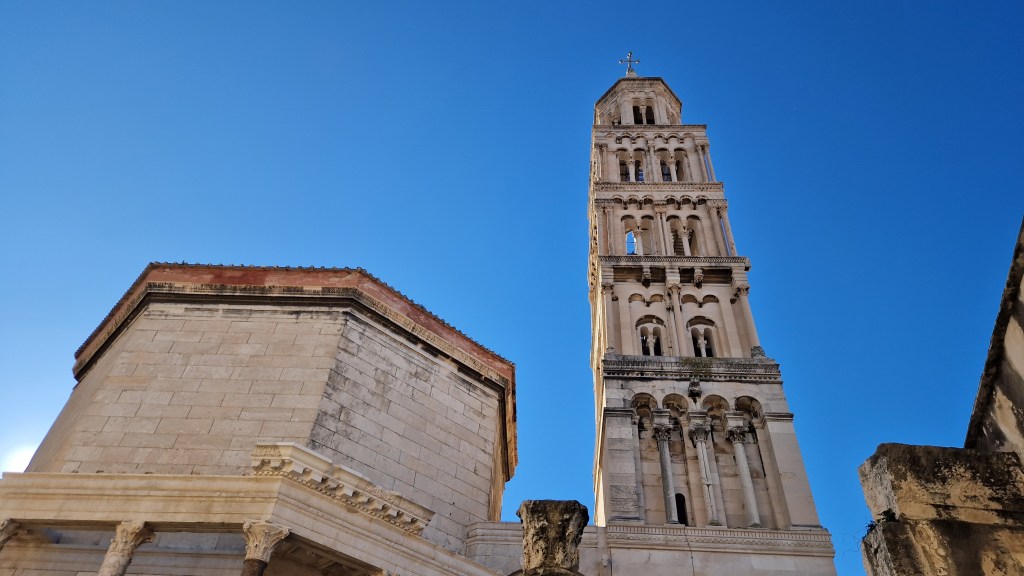
Entering the old walled city via the 4th century Silver (Eastern) Gate, one of the four principle Roman gates of Split, my next stop was one of Split’s main attractions. A combined ticket for entry to Saint Domnius Cathedral, the Bell Tower and Treasury costs just €12 and personally I think this is a bargain! As the ticket office is located there, I started at The Treasury, which is a museum of historic artifacts and sculptures belonging to the Cathedral. Filled with golden chalices, altar pieces and busts of historically important people, The Treasury is spread over three floors and even for those less interested in these kind of things (like me) it can take a while to look around.
Construction of The Saint Dominus Bell Tower began in 1100AD and lasted more than 300 years, although what is seen today is the radically changed tower that was reconstructed in the early 20th century. At 57 meters high, reaching the top of the tower is quite a climb and with some giant stone steps, I wouldn’t want to attempt it on a rainy day. However the weather was good and I eventually made it to the top to enjoy the amazing 360° views of Split, its harbour and the surrounding area.
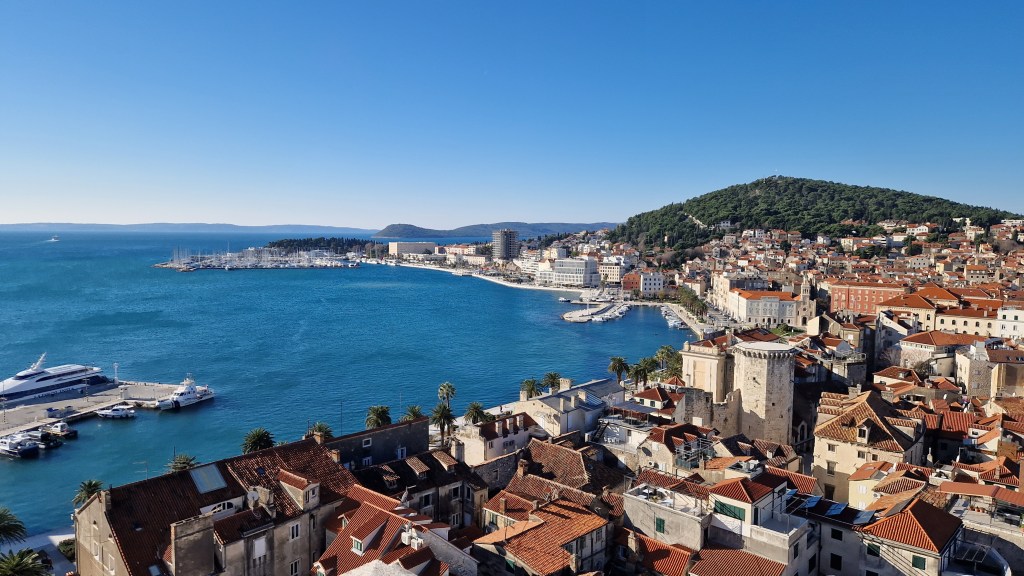
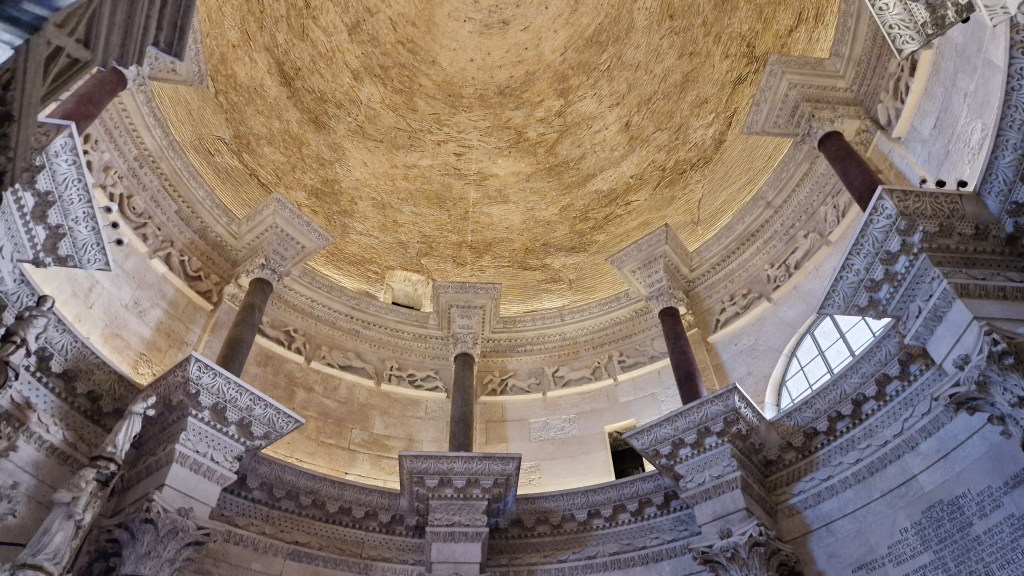
I spent ages at the top of the tower, getting plenty of pictures but also just enjoying the views and trying to spot some of the city’s other key buildings. Eventually descending the winding steps past the bells and back to ground level, I headed into the Cathedral itself and was stunned by the beauty. As cathedrals go, Saint Dominus’ is certainly not the largest, but it is supposedly the second oldest structure in the world in use as a Christian cathedral and the oldest Catholic cathedral still using its original structure.
The dome of the cathedral is incredible in itself when you consider the age of the structure and with the incredibly ornate decoration, there is plenty to look at around the small space. I spent a couple of hours between the Treasury, Bell Tower and Cathedral, but you could easily spend longer looking in detail at all of the artifacts and decoration. I genuinely think this was the best €12 I spent throughout Snoozing to Split and would certainly recommend a visit!
Saint Dominus Cathedral is located in the central square of what was the Diocletian’s Palace and from this square there are numerous narrow streets splitting off. One of these, next to the Treasury, leads to another of Split’s religious buildings, the Temple of Jupiter. Constructed towards the end of the 3rd century, parts of the temple remain unfinished owing to Emperor Diocletian’s abdication and earlier arrival at the Palace. Unfortunately, I wasn’t able to go inside the temple and I don’t know if its ever open for visitors, but its entrance is guarded by a small sphinx, so if you do go looking you’ll know your in the right place.
Another of the narrow streets took me to the northern edge of the old walled city and to the Golden Gate, the former main entrance to the walled city and via which the Emperor entered the complex. As such the gate has lots of alcoves where statues were once placed and was very elaborately decorated, however its importance diminished in the Middle Ages and at one point was in fact sealed. Next to the gate is a monument to Gregory of Nin, Bishop of Nin in the 10th century and who introduced the Croatian language into religious services against the wishes of the Catholic church. The large statue is a highly visited tourist attraction and it is supposedly good luck to rub Gregory’s toe, meaning it has been rubbed smooth and shiny as a result.
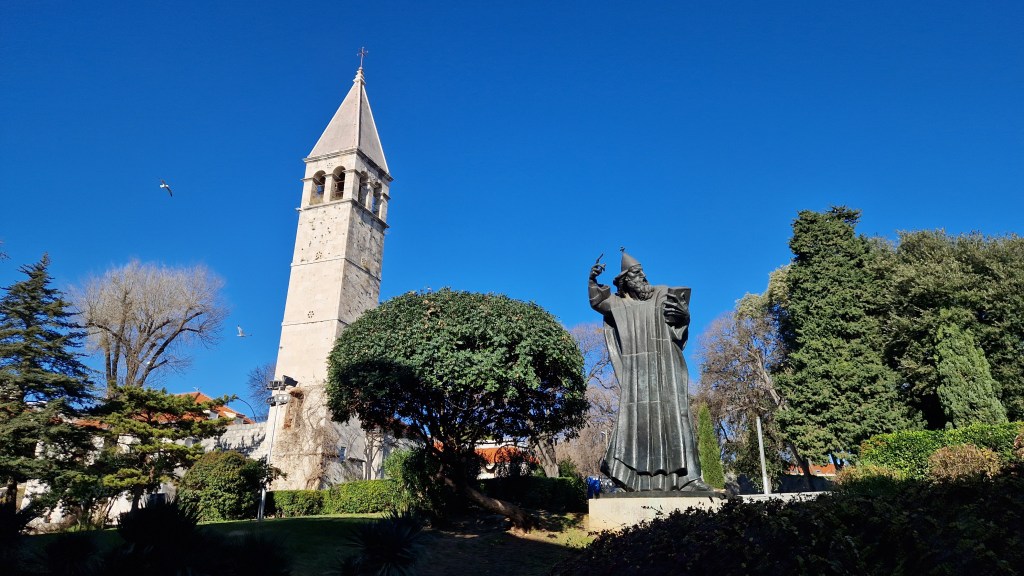
Split is a very nice city for exploring as a tourist as its quite small meaning all of the sights are within walking distance of each other. There’s also plenty of clearly marked public toilets, water fountains and information signs dotted around, with the latter telling the history of an area or specific structure and are either small black signs or larger blue posters. In some cities tourists feel like a necessary evil, but Split certainly seems to welcome them with open arms and does what it can to support the industry.
Having spent the morning exploring I had worked up an appetite and decided to check out a restaurant I’d found online for a late lunch. Villa Spiza is halfway between a Dalmatian konoba and a bistro and tucked away down a small side street in the old town. With just over a dozen seats split across four tables and the bar, the menu changes on a daily basis, as it is based on the local ingredients that the family are able to purchase from the market. As such the menu’s are handwritten to allow for things to be crossed out as they sell out and so its good to get there early to see the full offering.
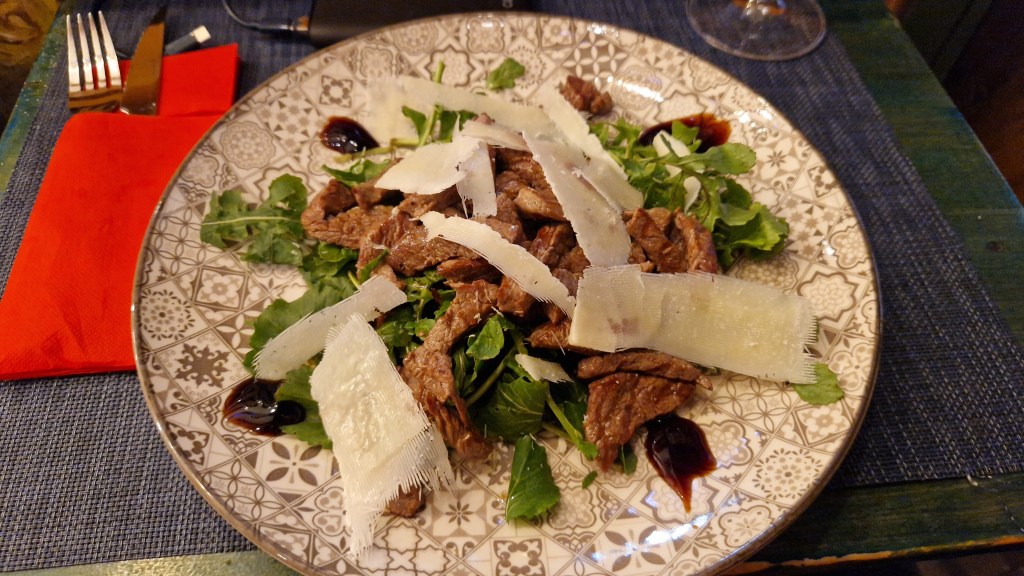
I’d read really good things about Villa Spiza, so I decided to have a main meal at lunchtime and started with the Tagliata, followed by Sote Stroganoff for my main. Sitting at the bar I was able to watch my meal being cooked and prepared and see the fresh ingredients going into it. I was also able to say hello the restaurant dog that was very well behaved and mostly sat watching the comings and goings. As I was on holiday I decided to indulge in a couple of glasses of wine and a dessert and all in all the delicious three course meal came to €48. One thing to note is that Villa Spiza doesn’t accept card, so make sure you have enough cash to pay for your meal before you pay them a visit.
After that delicious and very filling lunch, I was ready for a short break back at my hotel before heading back out for some more exploration. The first stop of the afternoon was Trg Republic (Republic Square), one of the largest public squares in Split and designed to mimic St Mark’s square in Venice, having been constructed in the Venetian style. Trg Republic is a popular location for festivals and concerts and during my visit was home to an ice rink for the festive season.
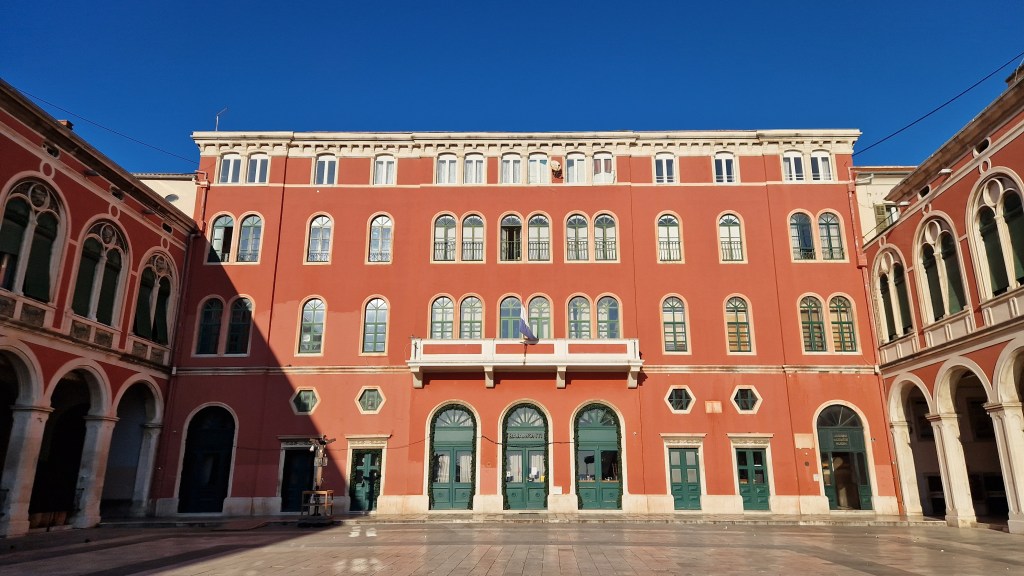
Having spent longer than I should have trying to get a decent photo of Trg Republic and the surrounding buildings, I had a wander around the back streets at the western end of the harbour to see if I could find another hidden gem for somewhere to have dinner that evening. Unfortunately, I was unsuccessful and headed back out to the harbour front, almost getting my feet wet as I headed to the end of a jetty to get a view out across the city.
Also at this end of the harbour is the Church and convent of St Francis, a pair of bright white buildings a stone’s throw from Trg Republic. Once again the church was beautiful and a peaceful place to spend a few minutes, although unfortunately I couldn’t find out anything more about either building when researching after. About the only piece of info I could find was that the church and convent are sited on an early Christian site from the 3rd century which was home to the grave of St. Felix, a martyr from the Diocletian era.
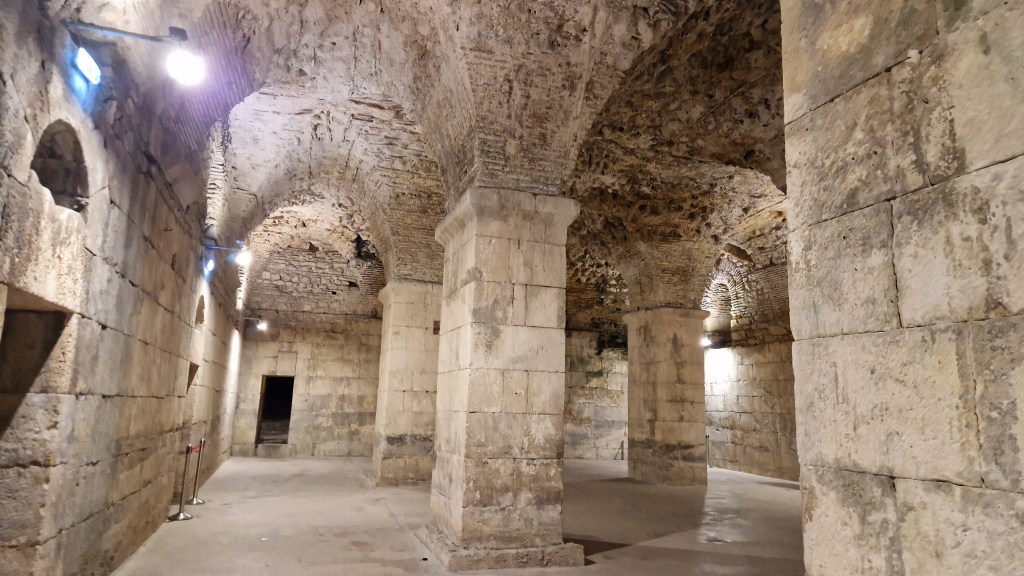
Walking back along the harbourfront, I saw what I thought would be a shortcut through the city walls back to the very centre of the old town and it was, but it was also so much more. The inconspicuous wooden doors in the wall lead to the substructure of the Diocletian Palace, and the central corridor is now home to stalls selling various wares. Either side of this central corridor are the depths of the substructure and you’re able to pay €8 to enter and explore.
I ended up only paying €6.40 as during my visit the eastern side was undergoing restoration, but I was still in awe as I wandered around the western side. In total the western side contains 28 connected halls, a mix of cavernous cellars with towering pillars to smaller storage rooms including one housing a replica of a Medieval oil press. Given most of my explorations of Split hadn’t cost me anything, I was glad to have spent money on visiting the substructure as it was definitely worth seeing in real life as no picture will ever do it justice.
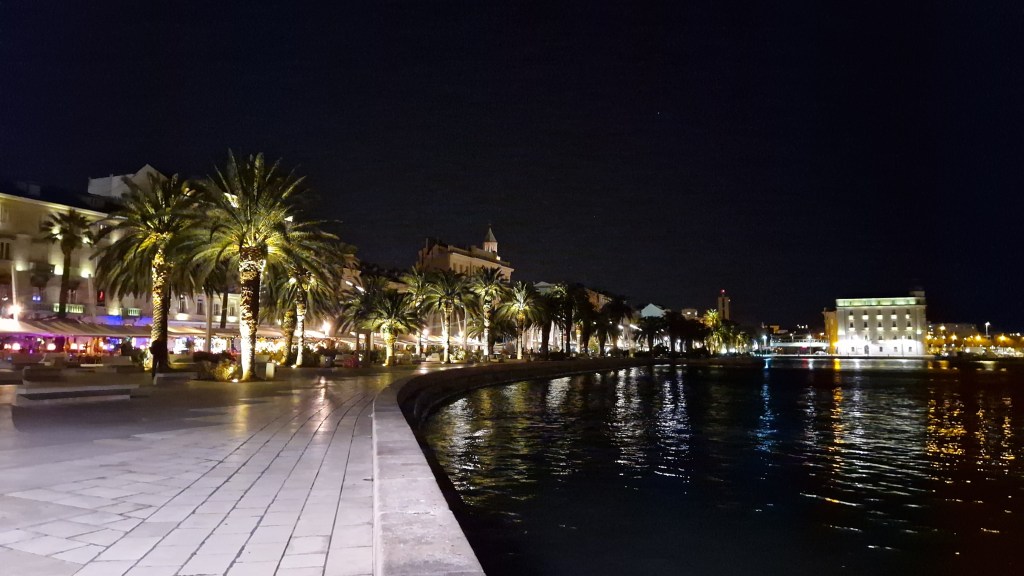
With my one full day in Split coming to a close I decided to treat myself to another good meal to end the trip, something I felt I could justify after a couple of picnic meals onboard sleeper trains over the previous few days. As such, I headed down one of the streets close to my hotel to Apetit Split, which was a bit more upmarket compared to Villa Spiza but had similar prices. With pumpkin soup having been on the menu at a few different places I had eaten during the trip, I decided to go for it on this occasion and thoroughly enjoyed it. An excellent prawn and salmon gnocchi was my main, with the meal accompanied by some more wine and finished by some strudel (the first of the trip!). All in all it was another excellent meal, although felt a bit less authentic than Villa Spiza.
I absolutely loved my time in Split and would certainly recommend it as a destination. I only spent money on two ‘attractions’ during my visit, the Cathedral and the substructure and both were well worth what they cost and are much cheaper than equivalent things elsewhere in Europe. Visiting in the off season meant that the city was quite quiet which I enjoyed but I think a visit in the Spring or Autumn probably balances this with warmer weather and the city having more of a ‘buzz’. During the ’peak’ season there are also plenty of direct flights to the city, which some might prefer compared to my multi-day journey.
 Flights & Times
One thought on “Split – Mediterranean Flower”