
Day two of Snoozing to Split started early as I arrived into Berlin onboard the European Sleeper (read about that here) at just after six in the morning. After an amble around Berlin’s Hauptbahnhof whilst dropping of my bag and having a lazy breakfast at McDonalds (its foreign food if you can’t buy it in the UK right?), it was finally a reasonable hour and time to head into the centre of Germany’s capital.
For most visitors to Berlin wanting to make use of the city’s public transport a ‘Zone AB’ ticket will probably suffice as these cover all public transport within the city centre and up to the city boundary (including the entirety of the U-bahn network). A ‘zone AB’ ticket costs €9.90 for a 24hr ticket, however I paid an extra €1.50 for a ‘zone ABC’ ticket which covers the Greater Berlin area and would allow me a bit more freedom to decide on some ideas of things to do later in the day.
Until 2009 Berlin Hauptbahnhof was not served by any of the city’s nine U-bahn lines and it wasn’t until 2020 that the station was served by more than a shuttle connecting it to two other stations. Line 5 now runs from the Hauptbahnhof to Hönow in the east of the city, connecting many of the key tourist sights including the Bundestag, Brandenburg Tor and Alexandraplatz. As such, my day in Berlin started with a ride on Line 5 for a few stops to Rotes Rathaus, where, perhaps unsurprisingly, you can find the Rotes Rathaus, Berlin’s City Hall.

Berlin’s Rotes Rathaus (Red City Hall) was constructed in the 1860s, modelled on the Old Town Hall of Toruń in Poland and gets its name from its distinctive red bricks. Housing Berlin’s mayor and the Senate of the State of Berlin, the building was heavily damaged by bombing during World War 2 and was rebuilt to the original plans between 1951 and 1956. I had headed to the Rathaus as it was the starting point for the walking tour I was booked on, however still being a bit early I wandered towards Alexandraplatz station via Germany’s tallest structure, the Fernsehturm.
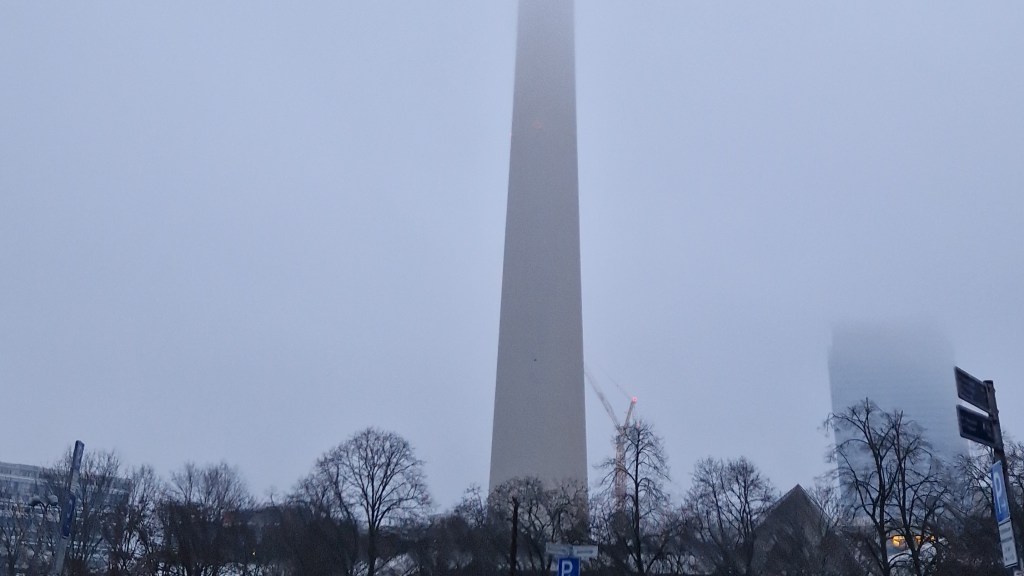
The Fernsehturm is Berlin’s television tower, constructed in the late 1960s by the East German government both for its functional use as a transmitter but also as a symbol of Communist power. Standing at 368m (including its antenna) the Fernsehturm now also serves as a viewing tower, however during my visit I couldn’t see the top from the ground, so decided the view from the top was probably shrouded in cloud. If you visit Berlin when the weather is a bit nicer, you can head up the Fernsehturm for €22.50 if you buy your ticket online.

Starting the walking tour back at the Rotes Rathaus, our guide gave us some background on the city of Berlin (which is more than nine times the size of Paris in area) whilst also giving us a bit more information on the Rathaus itself. The City Hall needed more than 50,000 new bricks during its reconstruction following World War 2 and it now also houses, amongst other gifts to the city, a model of the Brandenburg Gate constructed from garlic!
From the Rathaus we headed to Museum Island, an island located between two branches of the River Spree that is home to a number of the city’s museums, along with the Berliner Dom (Berlin Cathedral). My day in Berlin turned out to be one day too early as on the first Sunday of each month, all of the government ran museums in Berlin offer free entry, although as our guide pointed out this can be both a blessing and a curse.
As always, I don’t want to include too much of the walking tour in this post as I actually want you to go to Berlin and take part in one yourself, however rest assured that it covered all of the ‘must see’ sights including Checkpoint Charlie, some remains of the Berlin Wall and the Brandenburg Gate. The tour I joined was organised by Walkitiv and led by Tina, an Australian that has been living in Berlin for six years. The tour lasted about three hours and in that time we covered around 4km and I took more than 12,000 steps. If you do book to go on a tour, try to do so directly with the organiser rather than via FreeTour or GuruWalk as these websites charge the organisers a fee, meaning less of your money goes to the guide.
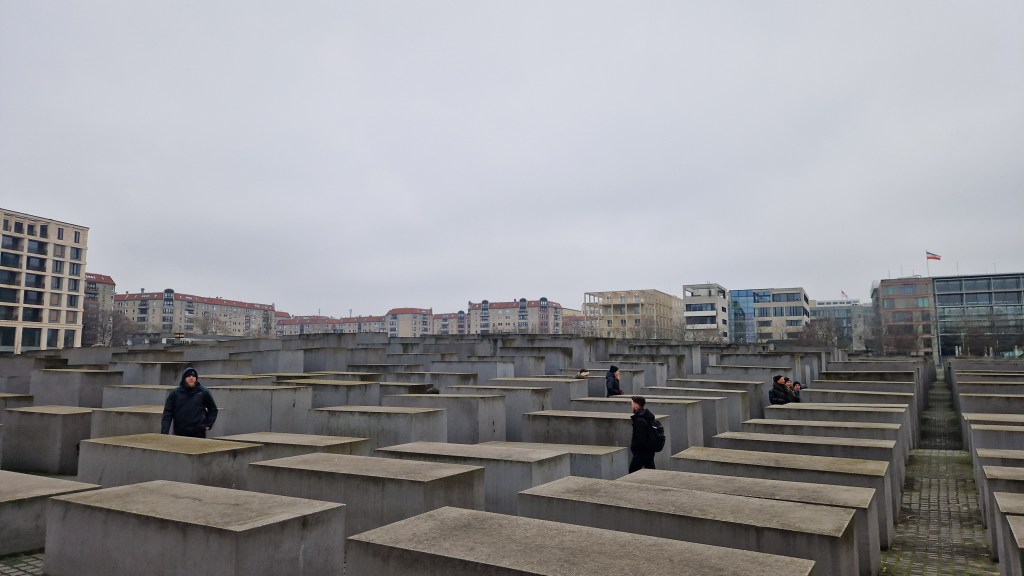
One final bit of the walking tour that I’ll share is our penultimate stop, at the Holocaust Memorial. This ‘field’ of 2,711 concrete slabs is designed to allow you to walk through the monoliths and get lost between them as the ground falls away and they increase in height. The architect, Peter Eisenman, has been very determined to not share any symbolism that he may have had whilst designing the memorial and as such you are able to reflect and decide what it means to you. The memorial was inaugurated on 10 May 2005, exactly 60 years after the end of World War 2 and an adjacent information centre located under the memorial contains the names of approximately 3 million Jewish Holocaust victims.
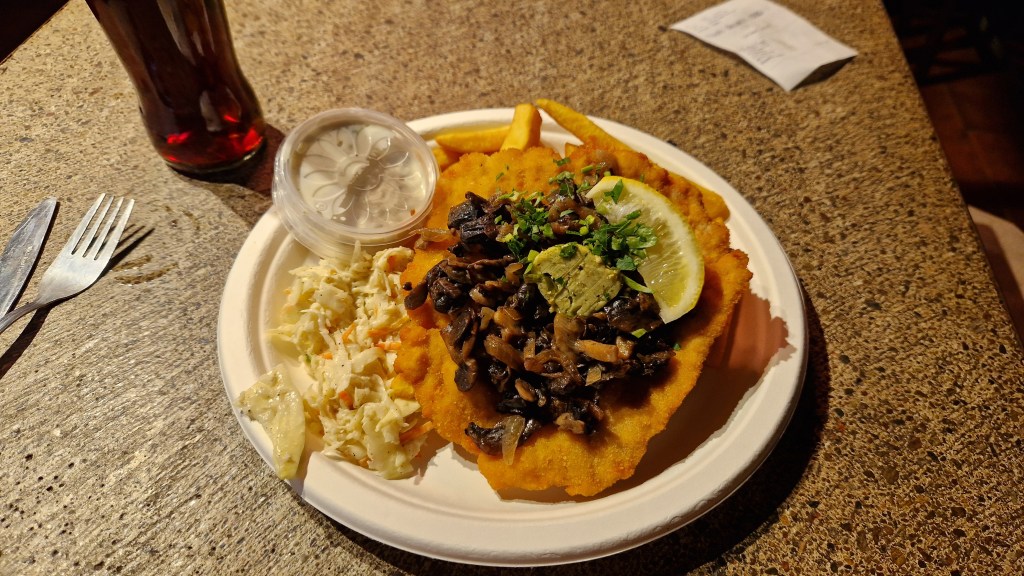
With the walking tour finishing around 1300, it was time for some lunch and so a trip on the U and S-bahns from Brandebruger Tor station to Warschauer Straße in the east of the city took me to my lunch destination. Scheers Schnitzel is located in the arches under the Warschauer Straße U-bahn station, just before the Oberbaumbrücke and is an excellent place to visit to try the traditional German fare of schnitzel. The menu is limited to Schnitzel with varying types of topping, although there is a choice of Pork, Veal or Vegetarian schnitzel. I went for a Pork schnitzel topped with mushroom along with a side of chips and couple of sauces which, along with a bottle of Coca-cola cost me a very reasonable €15. I found Scheers Schnitzel recommended in a post by ‘Natalie etc’ and I’d certainly also recommend a visit!
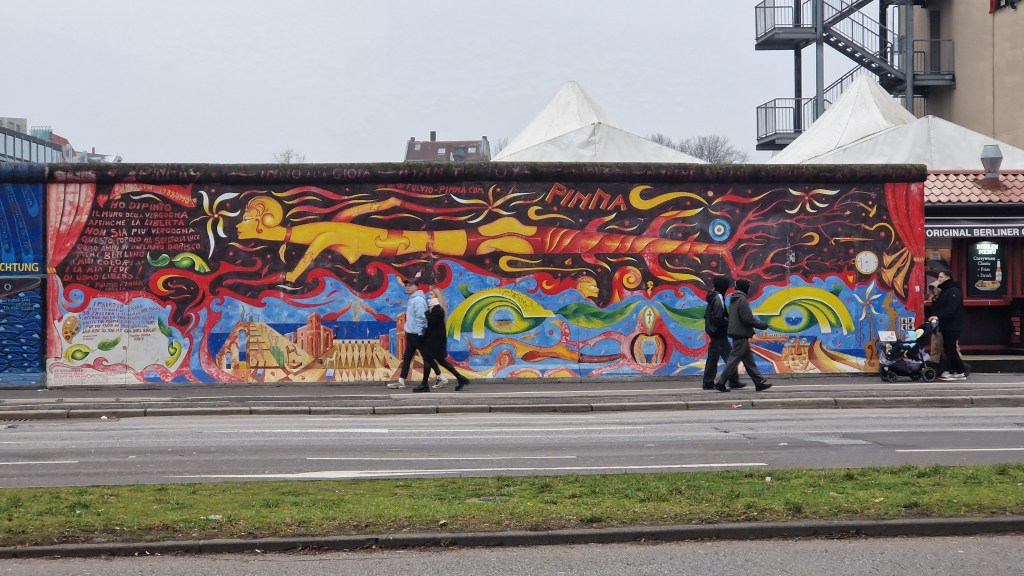
Just across the road from Scheers Schnitzel is the East Side Gallery, a permanent open-air gallery on the longest surviving section of the Berlin Wall. This section is 1,316m long and following the wall’s opening, it was painted by 118 artists from 21 countries in the spring of 1990. Unfortunately, due to urban development measures, it is no longer completely preserved, and instead of the originals from then, only the replicas from 2009 exist today, however it is still well worth a visit. To get a good view of the artwork, make sure to head to the East Side Gallery during daylight hours.
Heading back up the hill to Warschauer Straße U-bahn station, I caught a train across the stunning Oberbaumbrücke for a few stops to Wittenbergplatz. From here it was a 10-minute walk to the Kaiser Wilhelm Memorial Church, an impressive church that I’d seen illuminated as I headed along Berlin’s Stadtbahn on the European Sleeper that morning. The church reminded me a bit of Coventry Cathedral, with the original 1890s building having been heavily damaged by bombing in 1943 and a newer church constructed adjacent to the ruins. Unlike Coventry which has most of its ruined cathedral still standing, only the damaged spire of the original Kaiser Wilhelm Memorial church remains. A new, hexagonal, church was opened adjacent to the ruins in 1963 and the ground floor of the original spire now houses a memorial hall.
With the weather having turned again to be even colder and more miserable than it had been during the day, I decided some time on a warm train was needed and so headed to Zoologischer Garten station to make use of the ‘C’ portion of my ‘Zone ABC’ ticket. My destination was the ‘new’ Berlin Brandenburg airport, formerly Germany’s national embarrassment (that could be a blog in itself!) with the aim to spend an hour or so making use of their spotting area. Unfortunately, on arrival I found it closed due to the weather and so spent another 45-minutes on a warm train heading back to the city centre. Thankfully I’d only spent €1.50 extra on the ‘C’ portion of my ticket so the failed spotting trip didn’t cost too much and it did give me the opportunity to warm up.

With not too long before I needed to be back at the Hauptbahnhof to collect my bag ang get ready to board my next sleeper train, I headed one stop on the S-bahn to Postdamer Platz station to find somewhere for dinner. Settling on the Pauliner Wirsthaus, less than a minutes walk from the station, I enjoyed an excellent meal of pork knuckle, sauerkraut and bread dumpling along with a couple of pints of Munich’s finest beer! Whilst not a local restaurant and also not the cheapest, this was a great place for dinner as I could be guaranteed a hearty meal before a long overnight train without a dining car.
This was my second visit to the German capital and once again I was disappointed that I didn’t have more time to spend in the city. Having existed through some dark and difficult period in history, the city does not hide this but displays it with sensitivity and has made extensive efforts grow. With almost 200 museums as well as a huge number of other tourist ‘attractions’ there something for everyone and it’s a great city to visit even if the history doesn’t interest you. I will certainly visit the German capital again and hopefully for a longer stay in future!
 Flights & Times
One thought on “Berlin – A Reunited Capital”