
Having arrived at Geneva on an easyJet flight from Luton (read about that here), and having made sure I didn’t accidently exit the airport into France, my first task was to head into the city itself. With the airport’s underground railway station being the terminus of a number of Switzerland’s intercity railway service, it was easy to catch a train for the short journey into town.
Having paid just three Swiss Francs for a one-way ticket (about £2.70), I caught the 1001 InterRegio (IR) service towards Brigg which took just seven minutes to make the journey from Gare de Genève-Aéroport to Gare de Genève. Switzerland’s rail network is famously reliable and this journey, although short, certainly met the standard.
From Geneva’s main railway station, it was a 10-minute walk downhill to the Tour de l’Île and Bel-Air bridge from where the walking tour I was booked on would start. With over half an hour to spare, I had a wander around the local area looking in the windows of a few pricey shops and sat watching the waters of the Rhône leave Lac Léman.
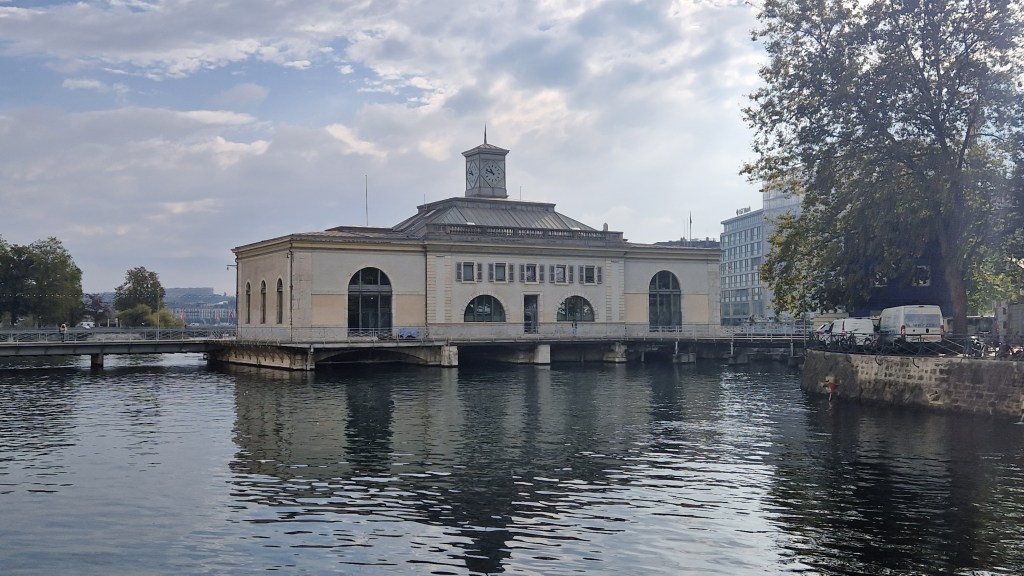
Just down from the Tour de l’Île is the Pont de la Machine, a pedestrian bridge dating from the late 1800s which provides access to an industrial building that was formerly a water pumping station. This pumping station provided water to several of Geneva’s industries and the overflow at a weekend became Geneva’s first Jet d’Eau as the safety valve released spouts of water 30m into the air. The building on the Pont de la Machine is now an exhibition hall, with a collection of Swatch’s on display.
Having headed back to the Bel-Air bridge to start the free walking tour (operated by Free Tour Switzerland), the guide started by giving us an overview of the city of Geneva in the present day. With a population of between 200k-250k, Geneva is Switzerland’s second largest city and almost 40% of the population is made up of foreign nationals. With the city being home to a large number international organisations such as the Red Cross and the UN, the city’s population is a melting pot of cultures with there being more than 180 nationalities.
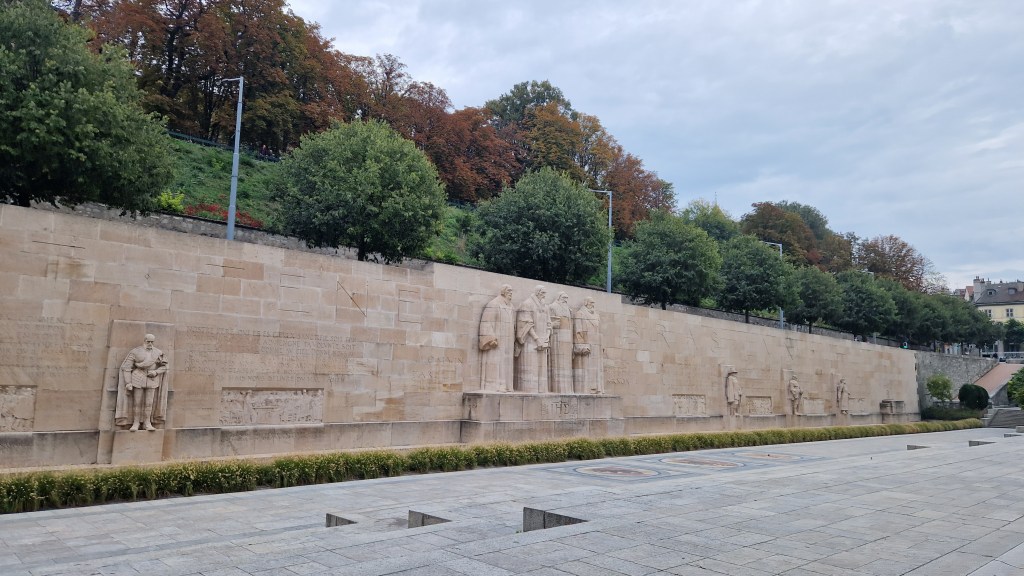
Whilst I won’t include everything we covered on the walking tour, I will include some highlights such as the Reformation Wall. The International Monument to the Reformation, better know as the Reformation Wall, was constructed in 1909 to honour many of the individuals and events of the Protestant Reformation. As we learnt more about the Reformation, it was clear how large a role it had played in the city’s and country’s history, including the large number of Swiss watch makers.
Having then climbed up the steps of one of the great walls of the city, we headed to the City Hall to see the Alabama Room where an 1872 international arbitration court ended a conflict between the United States of America and Great Britain over the latter providing ships to the Confederate navy whilst being a ‘neutral’ party in the conflict. It was also here that in 1864 the first Geneva Convention was signed, creating the International Red Cross.
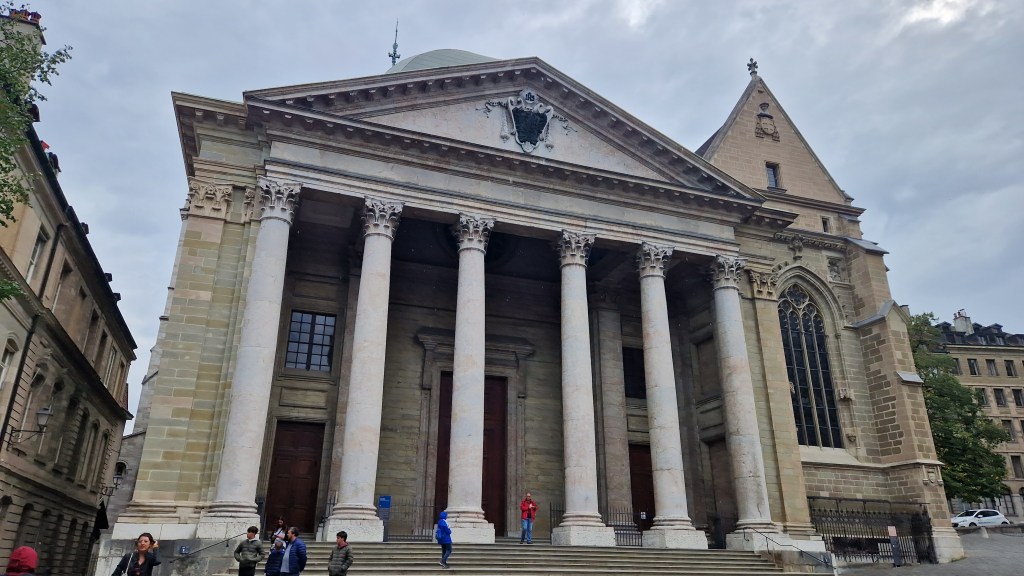
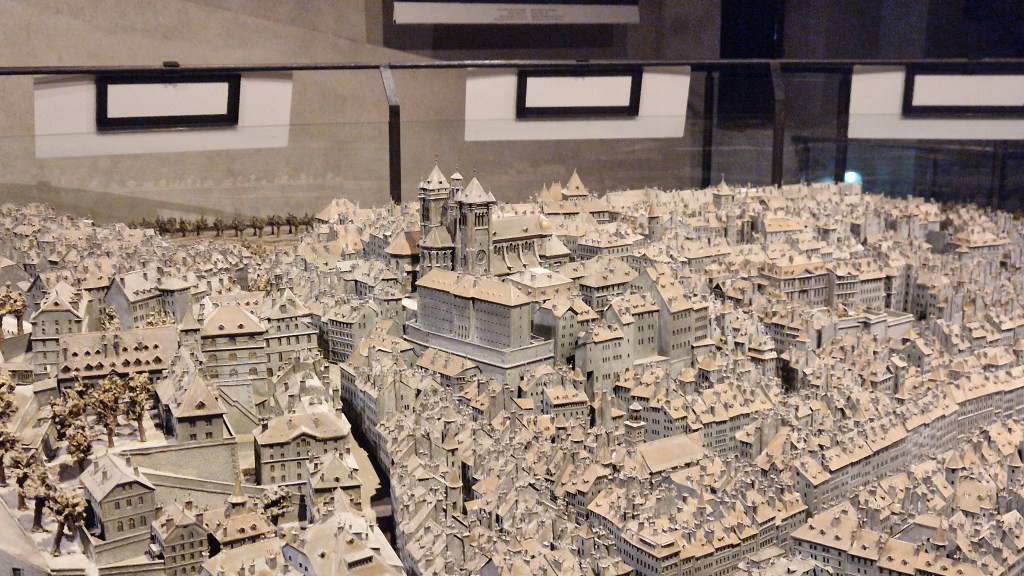
A short diversion into a museum to see a large model of the city made of copper and zinc, we continued to the Cathédrale Saint-Pierre Genève, a former Roman Catholic cathedral that became the adopted church of Reformist leader John Calvin. Whilst the vast majority of the Cathedral is modestly decorated, inkeeping with Reformist views, the Chapelle des Macchabées has had its interior restored to its previous lavish nature and the difference between the two styles is obvious.
We were lucky that the rain only began to properly fall as our walking tour came to an end and after a hurried goodbye to our guide, I crossed the Rhône once again to get some lunch. Heading for Chez ma Cousine which I had seen recommended online and was also recommend by our guide, this restaurant is one of Geneva’s most reasonably priced. With a limited menu of Chicken with Potatoes for CHF17.90, the service was friendly and the food tasty. In total I paid CHF24.90 for my meal, a sauce and a glass of local Swiss wine.
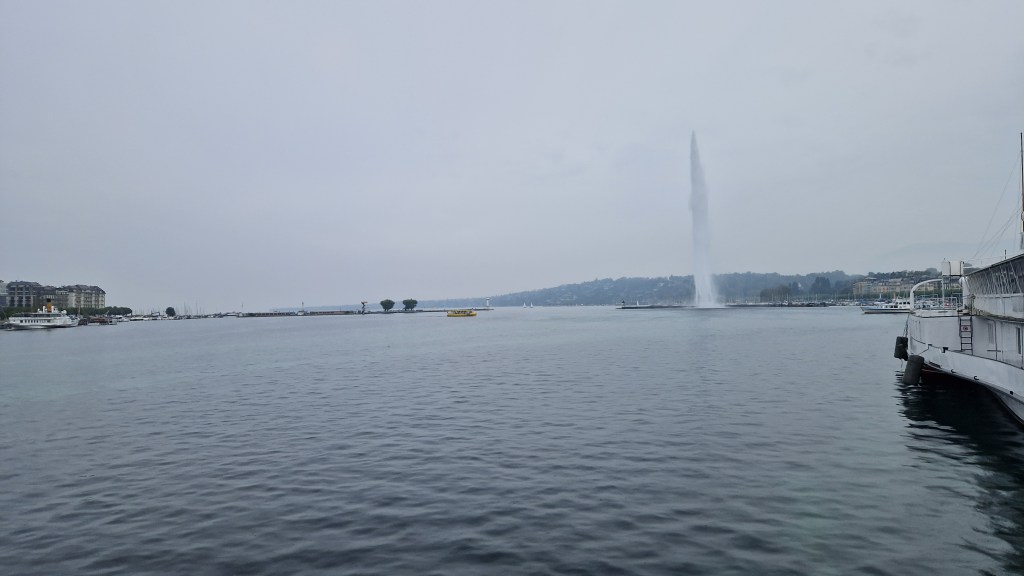
Unfortunately, a combination of the weather, decision paralysis on my part and a timeframe of not quite long enough, I didn’t take the opportunity to head to any of the excellent museums located in the Palais des Nations. Scattered amongst the headquarters of numerous International organisations, museums such as the ‘International Museum of the Red Cross and Red Crescent’ and the ‘League of Nations Museum’ certainly looked interesting and I’d like to spend longer in the city to visit them.
I spent the remainder of my afternoon in Switzerland trying out and comparing OBB’s ‘InterCity’ and ‘InterRegio’ services which you’ll be able to read about in a Bonus Blog coming soon, however as I headed back to the airport I felt disappointed in myself that I hadn’t done more with my time in Geneva. The city was nice and I enjoyed exploring it, however something on this trip just didn’t ‘click’ which is a shame. I will have to return to Geneva in the future and see whether it was just this particular trip that left me feeling as though something was missing, or the city in general.
 Flights & Times