
Having arrived at the City of Derry airport following a delayed but enjoyable flight with Loganair (read about that here) I was looking forward to heading into the city to explore. Unfortunately, public transport connections are pretty non-existent with a bus every 2-3 hours which does not link up with flight times and would have departed six minutes before we landed if we’d been on time.

Not wanting to hang around the airport for more than an hour until the next bus, I opted to get a taxi from outside the terminal into the city centre, initially planning on aiming for the bus station as a central starting point. My driver for the ride into town was very friendly and helpful, telling me about the city and also suggesting that he dropped me off in Ebrington, on the other side of the River Foyle to the city centre, giving me the opportunity to walk across the Peace Bridge on the way.
Before I continue I want to address the elephant in the room, the name of the city I visited! With various names throughout its history, the city is now known as either Derry or Londonderry dependent upon political views and is often known as Derry/Londonderry to avoid causing upset. For the rest of the post I am going to refer to the city as Derry, purely as it requires less typing. Inevitably this will annoy someone, but you’ll have to cope!
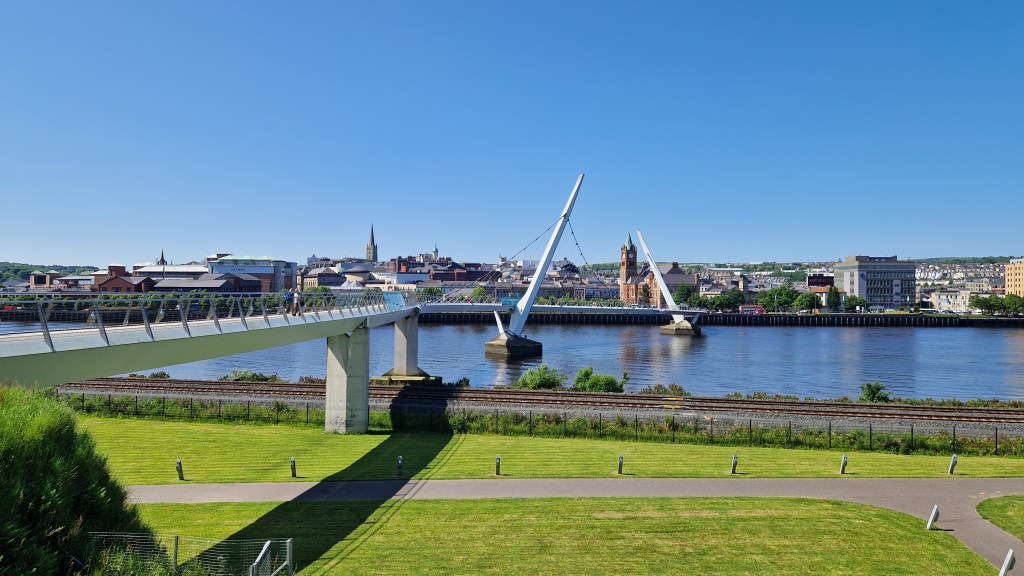
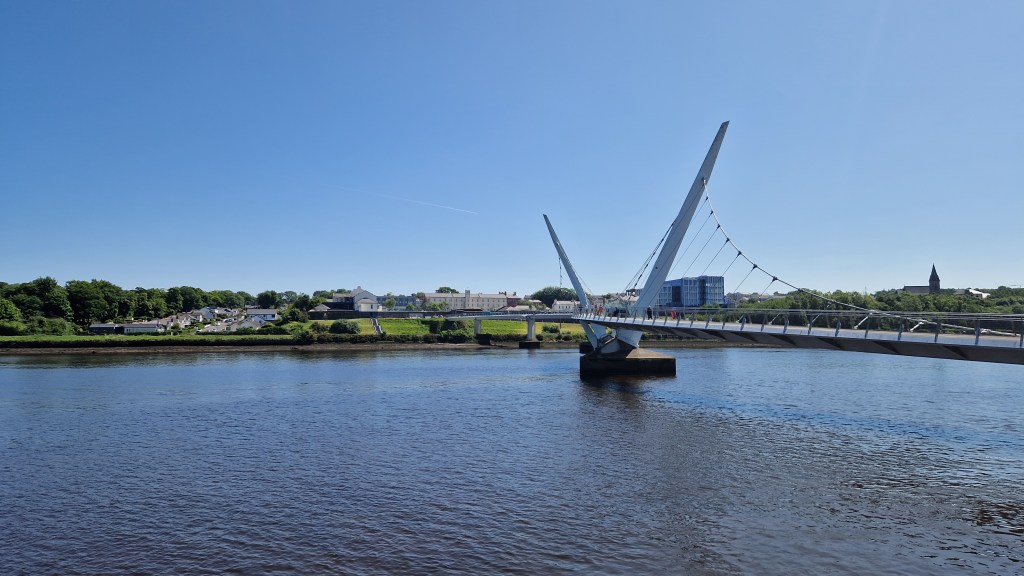
Having been dropped off in Ebrington, I paid a quick stop to ‘The Bakery’ to get an iced coffee and started to make my way across the Peace Bridge. Constructed in 2011, the bridge was partially funded by the European Union and intended to improve relations between the largely unionist Waterside (about 65% Protestant) on the east bank and the largely nationalist Cityside (about 95% Catholic) on the west side. Leading from Ebrington Square on the east bank to the Guildhall on the west bank, the bridge provides great views across the River Foyle and the city.
Arriving into the city centre, I had a few hours until I was able to check in to my accommodation and so initially decided to head to the Guildhall Taphouse for an early lunch. Located just a stones thrown from the Guildhall itself, the Taphouse had an outdoor seating area from where I could people watch as I enjoyed a delicious steak sandwich and chips along with a pint of local ale (I was on holiday, why not?!).
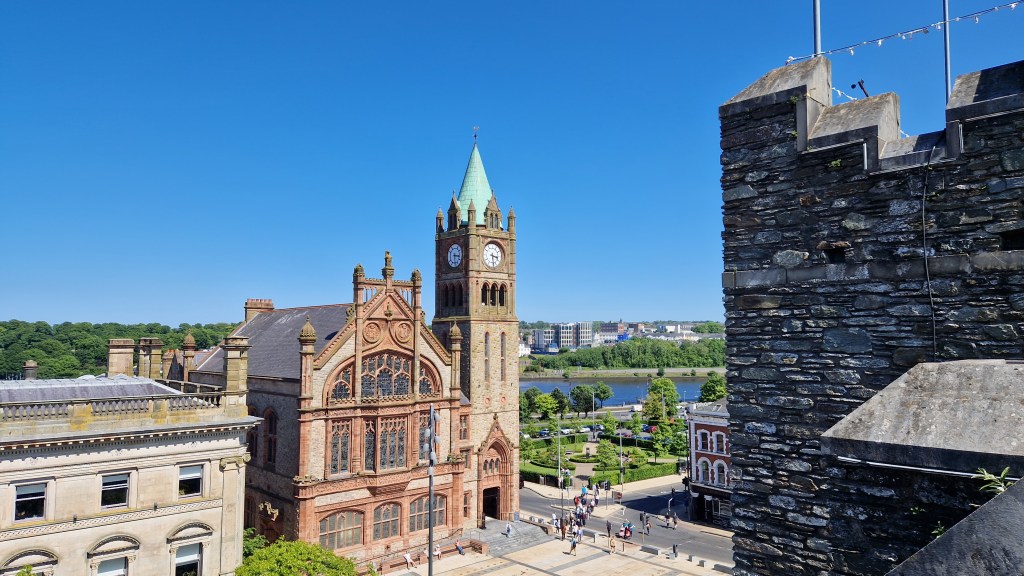
The other notable feature on the Guildhall square is part of Derry’s historic walls. Constructed between 1613 and 1619 as part of the settlement of the area by the English and Scottish as part of the Plantation of Ulster. The previous settlement at Derry had been destroyed by an Irish chieftain and so the walls were constructed to protect the new city. The walls are a key feature of the city and one of the city’s many nicknames is ‘The Walled City’.
After my enjoyable lunch in the sun, I headed across the square to the nearby ‘Visit Derry’ shop and tourist information. Inside, in addition to the usual tourist memorabilia, is an exhibition on Ameilia Earhart, who on one of her flights across the Atlantic, landed in a field not far from the city. The tourist board has also used this as an introduction to city, with the animated video showing Amelia circling the city and seeing the sites.

Close by to the tourist information, just through one of the gates in the city walls is the Tower Museum, which at £4 for entry is an absolute bargain! The Tower Museum fulfils the role of the generic city museum in telling the story of the city from the prehistoric age through to today. Obviously at times that history has been difficult, but the museum told the story in a sympathetic way and managed to remain fairly neutral on topics that are politically sensitive.
The museum also has an exhibition on the Spanish Armada, something that initially struck me as odd given the main battle between the English and Spanish fleets occurred in the English channel. However the fleeing Spanish ships were forced to head north through the North Sea and around Scotland, before encountering storms to the north of the island of Ireland. With ships wrecked around various parts of the Scottish, Irish and Northern Irish coasts, one of these wrecked not far from Derry and was rediscovered in the 1970s.
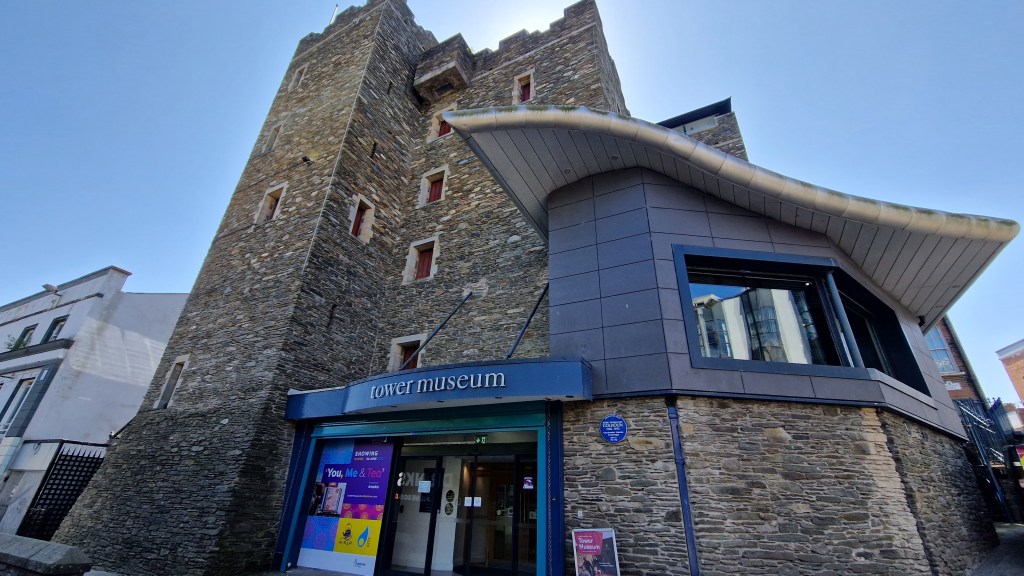
Given I’d gone into the Tower Museum to waste away an hour, I ended up in there for nearly two and could have easily spent three or four going through all the exhibits in detail. For £4, I’d certainly recommend a visit and suggest you leave sufficient time to do it justice. There’s also other museums in Derry covering various parts of the city’s history in more detail and a couple of these will be covered in part 2 of this post.
With a day of travel and adventure behind me, I was ready to head to my accommodation to check in and rest for the evening ahead of some more exploring. Derry has an reasonably good bus network (although some of the frequencies are terrible) and with my accommodation having a bus stop right outside I decided on public transport over a taxi. The one off journey cost me £1.80 in cash, however I did discover that you can buy a day ticket on the Translink app for just £2.10. I got this the following day and my three journeys worked out at just 70p each.
I’ve decided to split this blog into two parts, partly as I ran out of time to write a full post, so here ends part one. In part two I’ve got another day and a half in the city of Derry, including some more museums, a walk of the walls, the obligatory walking tour and some excellent food. Check out that part coming soon!
 Flights & Times
3 thoughts on “Derry – A City of Many Names – Part 1”