
With the one full non-travel day having been spent exploring the city and country of San Marino (read about that here), I had made sure that my train out of Rimini was late enough to give me a chance to explore the city before I had to head to the station. As such day 5 of (Not Quite) All the Small Things started with me heading away from Rimini’s station to the first of many Roman ruins, the Roman Amphitheatre.

Rimini’s Roman Amphitheatre is the only one partially remaining in the Emilia-Romagna region and in its heyday would have held between 10 and 12 thousand spectators. A similar size to the Colosseum in Rome, it was constructed in the 2nd Century AD under Emperor Hadrian and is one of Rimini’s main Roman ruins. Unfortunately, tours are only possible for groups at special request to the city museum.
From the amphitheatre on the outskirts, I started to make my way towards the city centre, via my next stop, the Malatestiano Temple. This unfinished church, dedicated to St. Francis, also known as Francis of Assisi, is the city’s Cathedral with construction beginning in 800AD, but stalling at the excommunication and subsequent death of architect Matteo di Andrea de’ Pasti in the 1460s. Most recognizable for its wide marble façade, the church was severely damaged during World War 2 but reconstructed using pieces salvaged from the rubble by men from the Monuments, Fine Arts, and Archives unit (see the Monuments Men film!)
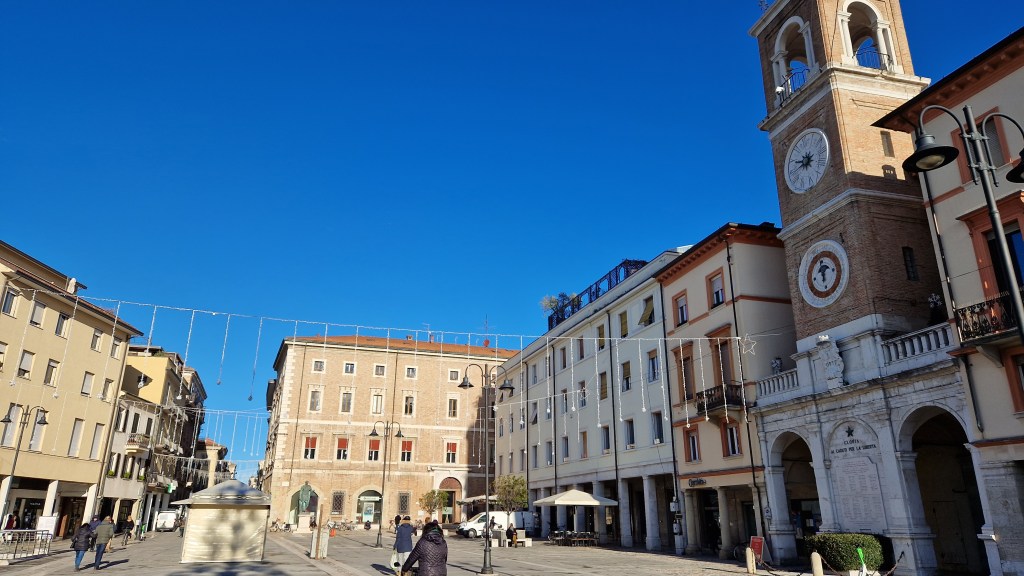
A few minutes’ walk from the Malatestiano Temple is the Piazza Tre Maartiri, or Three Martyrs Square. Originally the Ancient Roman Forum at the crossroads of the “decumanus” and the “cardo” maximi, the square is the centre of the city and was renamed Three Martyrs Square in memory of three people executed there in August 1944. There is now a marble insert in the square commemorating these martyrs as well as the Monument to the Fallen which commemorates more generally the tragic events of World War 2.
Heading down Giuseppe Garibaldi Street, I reached what was at one point the outskirts of the city, with the Porta Montanara being one of the historic city gates. Constructed in the 2nd Century BC, the Porta Montanara formed part of the defences of the Roman city of Ariminum, whilst in the Middle Ages it was the main entrance to the city. After being damaged during WW2, the remains of the gate was moved close to the Malatestiano Temple until 2003 when restoration of the remains saw them move back to their original location.

From the Porta Montanara I followed the line of where the city walls once stood until I reached the north-west corner of the old city. Guarding this corner of the city is the Castel Sismondo, a 15th century castle constructed by Sigismondo Pandolfo Malatesta, lord of Rimini. Unfortunately, only the central keep of the castle remains, with the external walls demolished and moat filled in the mid-1800s. The castle today is used for cultural exhibitions.
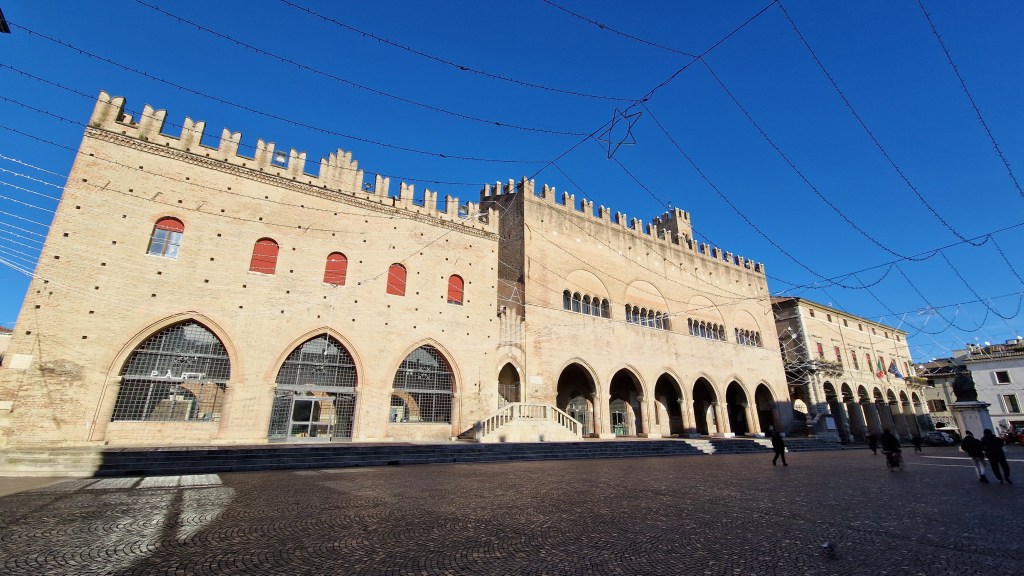
Just along from the Castel Sismondo is the large building of Teatro Amintore Galli of which the grand frontage sits in Cavour Square. The Teatro Amintore Galli is Rimini’s main theatre and was constructed in 1857 to hold 1,400 theatre goers. Unfortunately, the theatre was severely damaged during WW2 and subsequently looted, leaving only the façade and part of the original foyer intact. Reconstruction only started in 2014, with the new theatre being completed in October 2018 and now able to hold 800 people.

Cavour square is also home to the City Council and the Palazzi dell’Arte Rimini so is full of grand buildings, however another piece of Rimini’s history is almost hidden in one corner of the square. On the side of a building on the corner of Cavour Square and Corso d’Augusto is a plaque commemorating Giuseppe Garibaldi, an Italian general, patriot and republican from the 19th century who played a large part in the reunification of Italy and the creation of the Kingdom of Italy.
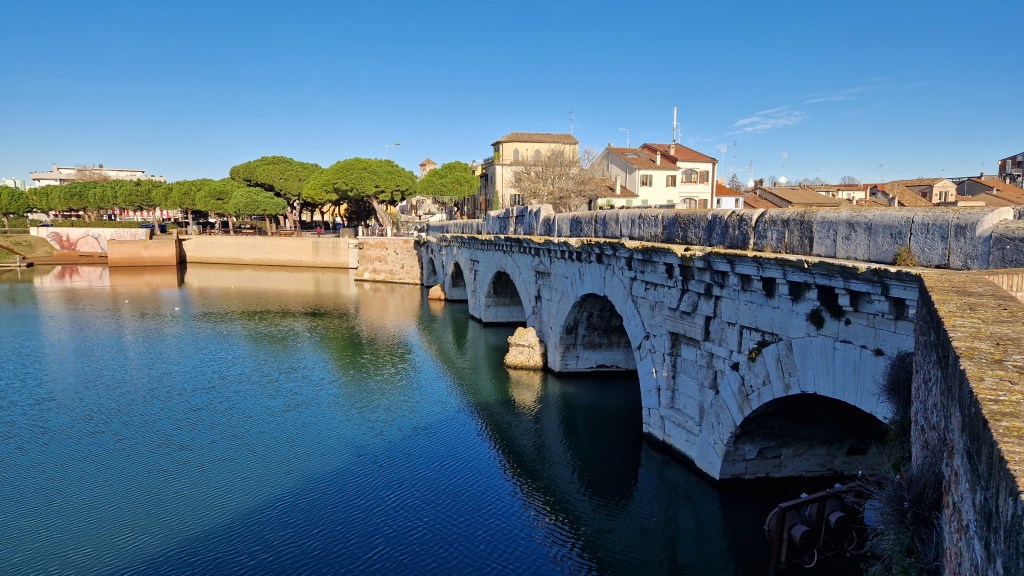
From Cavour Square I followed Corso d’Augusto to the north to reach one of Rimini’s most famous sites, the Ponte di Tiberio. This bridge over the Marecchia is more than 2000 years old, with construction finishing in 20AD, having been undertaken under the reigns of Emperor’s Augustus and Tiberius. The bridge was the only crossing of the Marecchia not destroyed by the retreating German army during the Battle of Rimini as it was judged militarily pointless and it still carries both pedestrian and vehicular traffic to this day.
With the morning drawing to a close, it was time to head back in the general direction of my hotel and the station, however there was still time to see a couple more sites en route. The Domus del Chirugo is the ruins of the city surgeon’s house, now on display and covered in Perspex to allow everyone to see the extensive Roman ruins. You can also pay €7 to walk around inside the Perspex and explore the ruins, however I didn’t really have time to do this justice on this visit.
My final stop before picking up my bag was the ruins of Chiesa dei Teatini back near the Malatestiano Temple. This church was constructed in the early 17th century and served the Roman Catholic population in the city for more than 300 years before being destroyed during the bombing of the city in WW2. Only one wall of the church now remains and can be seen from the gardens of Piazza Teatini along with a plaque commemorating the church.
The city of Rimini is a great place to explore and, despite wide spread destruction in WW2, has a large number of beautiful old buildings still extant along with plenty of Roman ruins. There’s also plenty I didn’t explore including the banks of the Marecchia and harbour which I’ve read are wonderful places to wander. I’d certainly recommend visiting the city and giving yourself a few days to explore, plus a bonus day to head across to San Marino.
 Flights & Times