
For episode 10 of Exploring the East Coast, it was time to head south from Peterborough once again to tick off the final six stations on the southern section of the East Coast Mainline (ECML). Not only were these the last six stations to do in the southern section, they were in fact the last six stations south of Morpeth, meaning episode 11 onwards would mean some trips based out of Newcastle. Helpfully, although I filmed footage for the Youtube video (coming soon), I somehow forgot to take many photos, so some of those below are via Wikimedia Commons.
This section of the line is mostly covered by suburban Great Northern services between Moorgate and Welwyn Garden City, however the starting point for the day, Potters Bar, is also served by Thameslink services between London Kings Cross and either Letchworth or Cambridge. Potters Bar sees four services an hour in each direction, with the southbound evenly split between Moorgate and Kings Cross, whilst the northbound sees two Welwyn services, and one each to Letchworth and Cambridge.

The largest of the six stations in this section, Potters Bar served 1.4million passengers in 2021-22, with the station situated centrally on the main thoroughfare, Darkes Lane. The town centre has the usual mix of coffee shops, restaurants and chains, along with the odd independent shop. Unfortunately my visit occurred during the period of snow and ice in December and whist the roads had been gritted, the pavements were ice rinks, minimising the amount of exploring that could be done.
Unfortunately my lack of wandering meant I missed the Old Manor House pub (as the name would suggest, it is located in part of the old manor house) and the Potters Bar museum, however I would certainly recommend paying both a visit to see some of the town’s history. The museum is open Tuesdays & Wednesdays 1430-1630 and Saturdays 1100-1300 and is free to visit, whilst the pub is a pub and has the usual opening times and offers both food and drink.
Sliding my way back to the station, I realised I had just missed a Moorgate bound train and the next one was delayed, meaning I had time to grab a coffee to warm me up. Unfortunately, with cold weather, some of the rail infrastructure wasn’t fairing well, with a couple of crucial sets of points freezing and causing some disruption on the ECML. However, with the lack of investment that the railway has seen in recent years, this isn’t unsurprising and you only need to read the report into the 2003 Potters Bar rail crash to see what a lack of investment can do.

The next stop on this Exploring the East Coast was New Barnet, two stops further down the line towards London and part of the core commuter belt. A key theme to this post is suburbia, and with New Barnet pretty much equidistance between High Barnet and Cockfosters, its about as much commuter belt as you can get. If you make your way over to High Barnet, there is a rather nice town centre with buildings dating from the late 1800s, however New Barnet is exactly that, new. Unfortunately with limited time as a knock on of the train delays, I didn’t have time to venture away from the immediate station area, so that’s pretty much it…
As mentioned earlier, Potters Bar is the only station of these six that gets bonus Thameslink services, and so the rest of the day was very much a Great Northern day, with their Moorgate suburban services all being operated by relatively new class 717s. These are excellent trains and are much better designed than their class 700 cousins on Thameslink, with every seat having power sockets and Wi-fi being available onboard. The only downside to them is that there are no toilet facilities, with the thinking being that only short journeys would be being made.
One more stop towards London is Oakleigh Park, the most southern of the six stations being explore in this post, with the station beyond, New Southgate being covered in episode 4 (read about that here). Although slightly further south than the London greenbelt, Oakleigh Park is well situated for green space and exploring nature, with Oak Hill Park, Brook Farm Open Space and the Oakleigh Park Rail Cutting Nature Reserve all within a 15-minute walk of the station.

The 20-acre rail cutting obviously still sees the ECML running through it but also manages to be a Site of Local Importance for Nature Conservation with various natural species such as oak, ash and sycamore along with brambles, hawthorn and various herbs. This provides an excellent habitat for numerous birds and animals, and you can view the cutting from a footbridge a few minutes’ walk from the station.
Heading back north a couple of stops brings us to Hadley Wood, the last station before the M25 and just a few minutes away from the 180-acre Monken Hadley Common. This area is registered common land, essentially meaning that the villagers of Monken Hadley have ‘common rights’ to use the land. Historically the area used to be part of the large Royal Forest of Enfield Chase, and it remains mostly wooded, although there is a series of ponds in the east of the common.
Hadley Wood station itself felt like someone had made a half-hearted effort to provide facilities but had then given up. Platform 4 has ‘step-free’ access to a side street, however the street itself is rather steep and was particularly fun to walk down with the snow and ice. There’s no step-free access to the southbound platform 1, however there is a ticket ‘easement’ in place to allow those requiring step-free access to travel north one stop to Potters Bar to then head south from there. Platform 4 also has a toilet, which was out of use and the station also has a ticket office, which was closed.
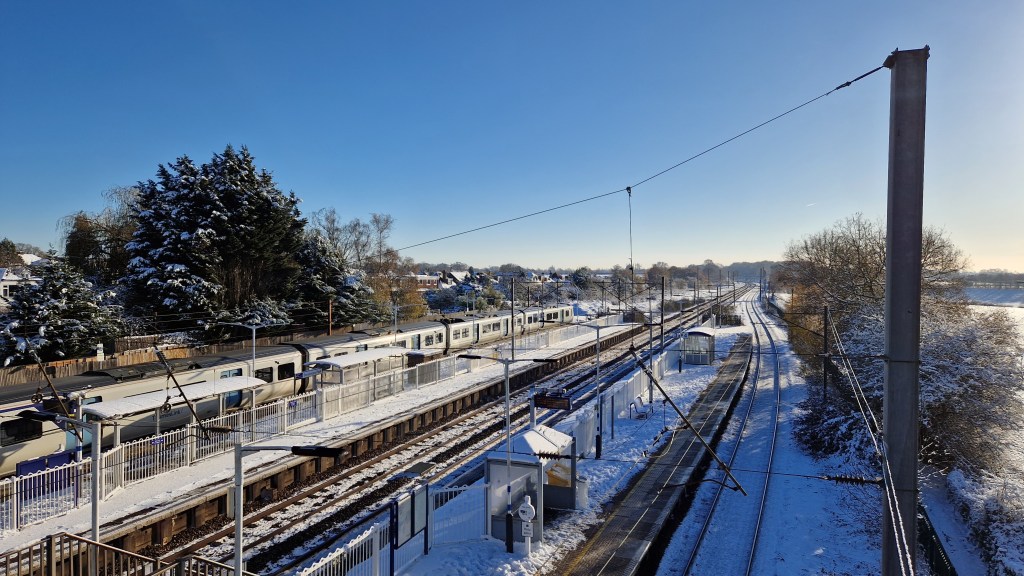
The penultimate station for this Exploring the East Coast was Brookmans Park, back outside the M25 and one stop north of Potters Bar. It was here I decided to stop for lunch and so walked into what was a very nice village centre, with an excellent pub, The Brookmans, that was originally built in the 1930s in the distinctive Mason’s style.
Brookmans Park is most well known for being the home of the Royal Veterinary College, but is also the location of the Brookmans Park transmitting station, the world’s first transmitter station capable of broadcasting two radio programmes simultaneously. Unfortunately the proximity of the transmitter has caused problems for local residents, with the radio waves causing radiators, telephones and toasters to ‘play music’. Brookmans Park is also one of the key navigation beacons for aircraft departing London Heathrow.
The final destination for the day was Welham Green, one stop south of Hatfield and possibly the smallest of the stations visited during this Exploring the East Coast. The station here only opened in 1986, so is one of the newest on the line, and it served 153,000 passengers in 2021-22. The village has remained quite small, with local pressure groups having resisted the large-scale developments that other parts of the commuter belt have experienced.
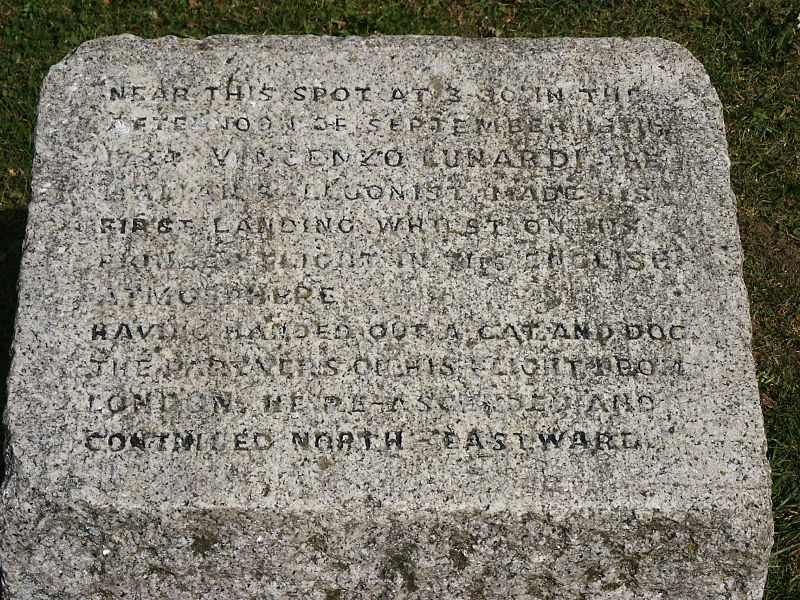
The notable ‘attraction’ in Welham Green is a monument to pioneering aviator Vincenzo Lunardi, who briefly landed a balloon about 3 miles away during his pioneering flight from the Artilley Ground in Islington to Standon Green End near Ware. Reports suggest that on landing Lunardi handed a cat and a dog that had accompanied him from London before re-ascending and continuing north east. Why the plinth is at Welham Green and not closer to the actual location is anybody’s guess.
That’s it for this Exploring the East Coast, unfortunately this one had limited ‘attractions’ or things to explore as it was very much London commuter belt and suburbia. However, it was interesting to learn about Vincenzo Lunardi and his balloon flight and it was especially good to tick off the final six stations on the southern section of the ECML.
 Flights & Times

.jpg)
