
Operator: Eurostar
Headcode: 9I67
Route: AMS-STP
Class: Standard
Seat: C9 S54
Date: Thursday 6th October 2022
Due to a bit of a backlog with posts, I’m writing this blog a couple of months after the event and in fact just a day before I undertake part of the journey in reverse. By the time you read this, I’ll have undertaken another Eurostar trip (read about that soon), but for now let’s focus on my journey from Amsterdam to London in Eurostar’s ‘Standard’ seats.

The Eurostar facilities at Amsterdam are a little strange as they’re essentially located in a suite of upmarket portacabins at the south-eastern end of platform 15. Check-in opens 90 minutes before departure and having arrived slightly earlier, I joined the queue outside the building. Thankfully it was a pleasant autumnal day and so queuing outside wasn’t a problem, however with a significant gap between the Eurostar building and the end of the main trainshed, I wouldn’t want to be queuing on a wet day.
Platform 15 is the main international departures platform at Amsterdam Centraal, with Eurostar, NS Intercity Direct services to Brussels and Thayls services departing from here. With no need for border formalities on Thayls or NS services which wholly operate within the Schengen zone, and the occasionally use by domestic NS services, platform 15 is generally open to the rest of the station for anyone to come and go. When Eurostar services depart, things change a bit, but I’ll come to that later.
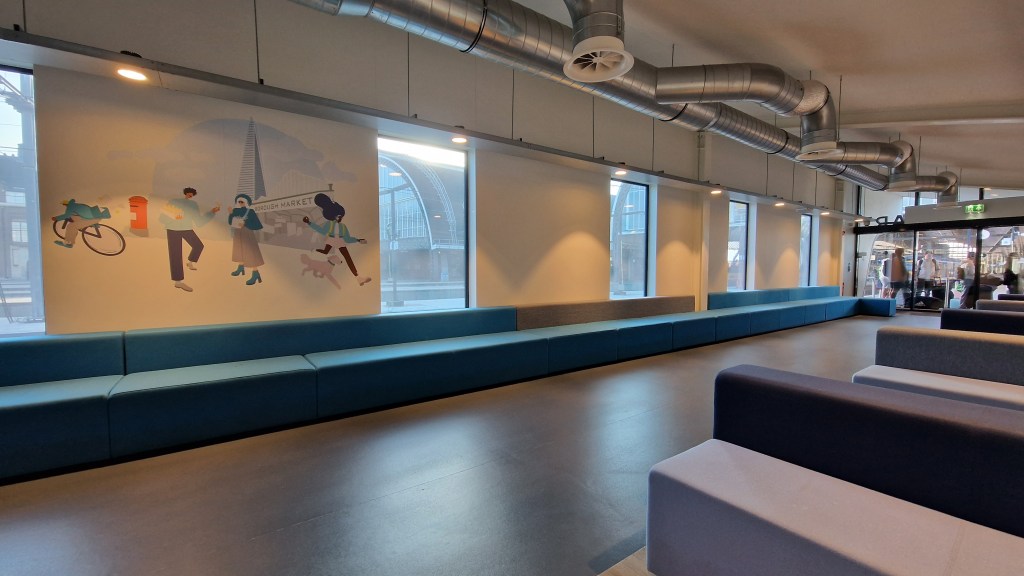
Once check-in opened, the process is similar to that at the other end of the Eurostar network in London. Tickets are checked at a desk immediately inside the doors (meaning queuing outside even once check-in has opened), before you’re able to pass through security. Unlike airport security, you don’t have to remove electronic devices from your bags and there is no limit to the liquids you can take onboard. Successfully through security, the next step is border control with separate Dutch and British controls. Once you’ve successfully passed through these steps, you find yourself in the departure lounge.
Whilst very modern (Eurostar only commenced departures from Amsterdam in 2020), the departure lounge is quite basic, with toilets, a couple of vending machines and a coffee machine the only facilities. Unfortunately the coffee machine was out of order and having had a filling lunch in Rotterdam (read about that here) I opted just to find a seat where I could do some writing for a while.
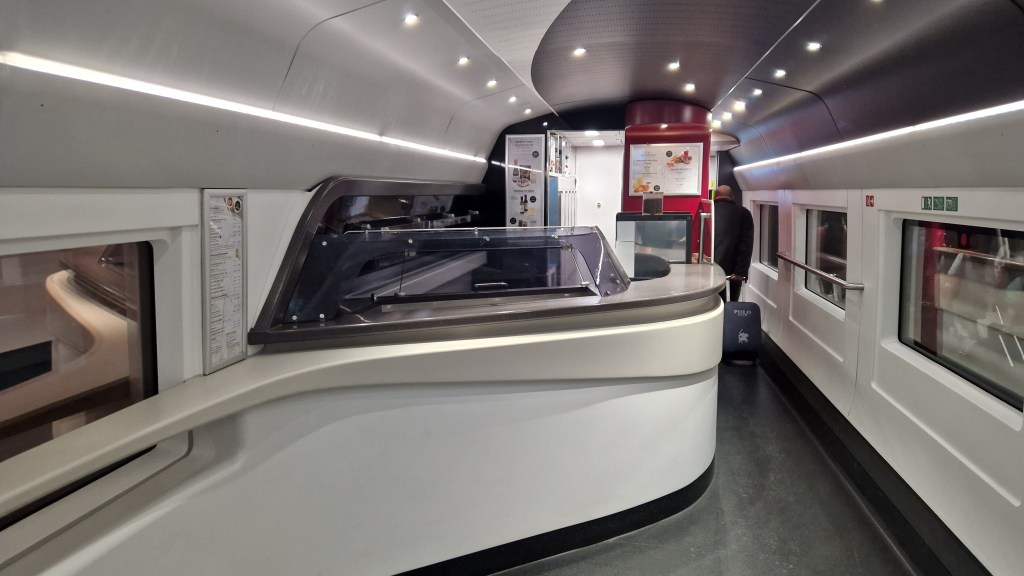
As I mentioned earlier, Eurostar’s departure platform at Amsterdam, platform 15, is an open platform and so when it is time for departure, the southern end is blocked by a temporary barrier and Dutch police. Owing to this, and what I believe is a similar arrangement in Rotterdam, Eurostar is only able to sell half a train’s worth of seats, with the stops in Brussels and (sometimes) Lille necessary to fill the remaining seats. Onboard there is a barrier between the two halves of café (coaches 9 and 10) that is removed upon departure from Rotterdam. In all honesty it was quite lucky that only the rear half of the train was being used, with the stock arriving into the platform just 9 minutes before departure, and a mad rush to get everyone boarded for an on-time departure.
I had chosen a seat in coach 9, one of the coaches that is half seating and half part of the café. With the forward-facing window seat at a table, I initially had plenty of space on departure from Amsterdam with the other three seats vacant. Unfortunately, my luck didn’t continue, with three other passengers joining me from Rotterdam and from this point I found it a little bit cramped, with certainly no elbow room to use my laptop.
The journey home followed the same route as the journey to the continent (read about that here), with the small exceptions of us successfully utilising the Dutch high-speed line and a stop at Lille Europe, which we had passed through without stopping on the trip to Amsterdam. From Amsterdam, we wound our way out of the city before joining the HSL-Zuid to Rotterdam. Leaving Rotterdam, we entered the tunnels to take us under the city’s various waterways, before speeding across the Dutch countryside towards the Belgian border.
As with the Amsterdam-bound services, Eurostar services from The Netherlands have an extended stop in Brussels whilst a crew change takes place, with the Dutch crew alighting and us being joined by a UK based crew for the second leg. The stop on this journey was a whopping 20-minutes, meaning our total journey time hit 4-hours 10-minutes, as opposed to the just under 4 hours on the way out. From Brussels, it was back out of the city over the imposing railway viaduct, before crossing the French border and shortly afterwards stopping at Lille. From there it was a quick 90 minute high-speed run across Northern France, through the Channel Tunnel, and along the UK’s HS1 to St Pancras.

With the service running in the late afternoon and evening, I decided to have my dinner onboard and so shortly after Rotterdam paid the café a visit. Opting for a ham and cheese mini-baguette, a coke and a piece of fruit cake (plus a latte), I was a little disappointed at the quality of the food, especially given the price. Whilst the cake and coffee were fine, the baguette was quite hard, with ‘plasticy’ cheese. I certainly wouldn’t go for that option again as the four items cost me over €15!
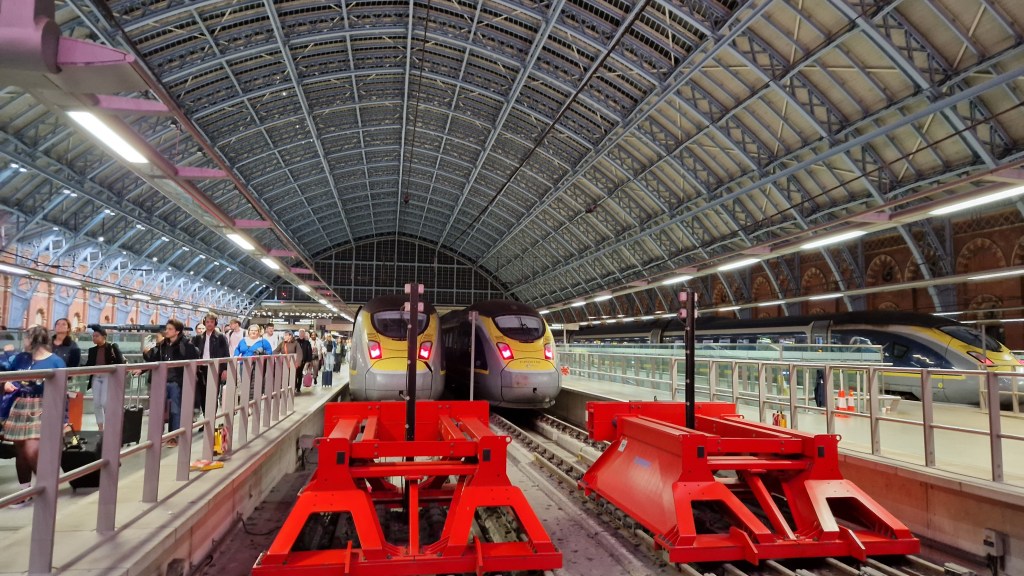
Arriving into London St. Pancras was nice and simple, with everyone exiting at the buffers end of the platform, passing through a warren of passageways which included customs, before exiting the Eurostar terminal close to the entrance to the tube. This is the advantage of going through UK border controls prior to departure, as nothing is required when arriving, meaning I was on a Thameslink train just 15-minutes after stepping off the Eurostar.
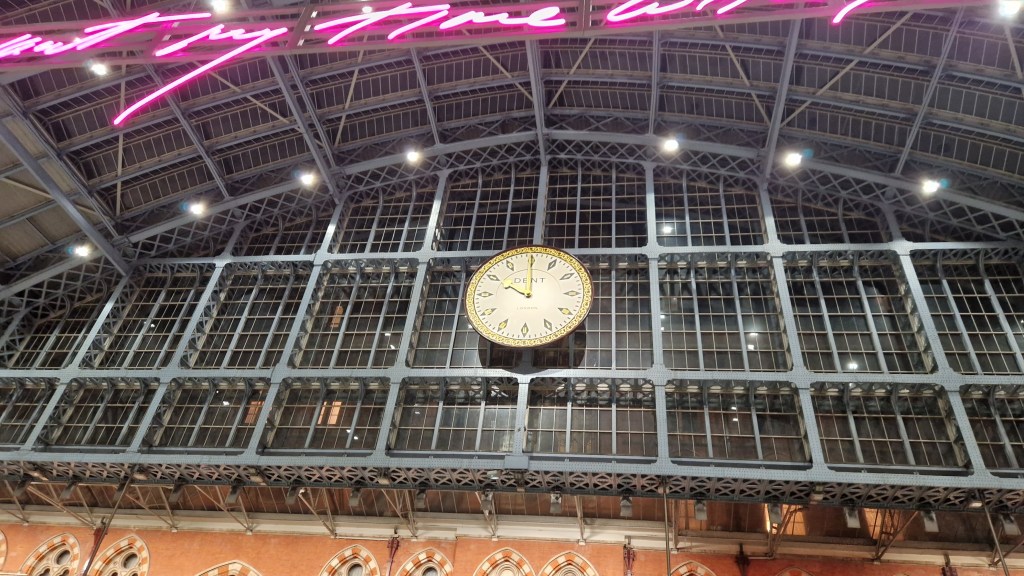
All in all, Eurostar is definitely a pleasant way of travelling, and can be as quick as flying when you take into account the time in the airports at either end. In terms of Eurostar’s different products, I’d certainly recommend upgrading to Standard Premier if you’re heading to/from The Netherlands as the extra space is great for the four hour journey. For shorter trips to Brussels, Lille or Paris, Standard seating is fine and comfortable enough, and the extra costs of Standard Premier probably isn’t worth it for this. Overall though, I’ll definitely be travelling with Eurostar again (spoiler alert!)
Lounge 0*
Seat/Facilities 4*
Food 2*
Service 5*
Punctuality 5*
Overall Rating 16/25 (read about my rating system here!)
 Flights & Times
One thought on “AMS-STP Eurostar – Standard”