
Once known as the ‘Venice of the West’ for its many quays, Nantes lies on the banks of the river Loire and is France’s sixth largest city, ahead of cities such as Bordeaux, Lille and Strasbourg. Having arrived into the city onboard an SNCF Intercités service from La Rochelle (read about that here), I had about 18 hours to both explore the city and sleep, before my train back the following day.
Despite Nantes’ railway station sitting slightly to the east of the city centre, it is well connected with Line 1 of the city’s tram network running past the north side. Single tickets to ride the tram cost €1.70 (about £1.45) and allow travel for up to one-hour, no matter how many trams you actually use. The journey three stops into the city centre took about five minutes and left me standing on one of Nantes filled in former waterways.
Between 1926 and 1946, the city’s landscape was dramatically changed with the filling in of significant parts of the Loire and Erdre rivers, with the latter being diverted via a tunnel under the city and the former being restricted to its main branch. The islands of Feydeau and Gloriette which made up part of the old town, became part of the city’s north bank, whilst the bank of the Erdre adjacent to the station was also widened.
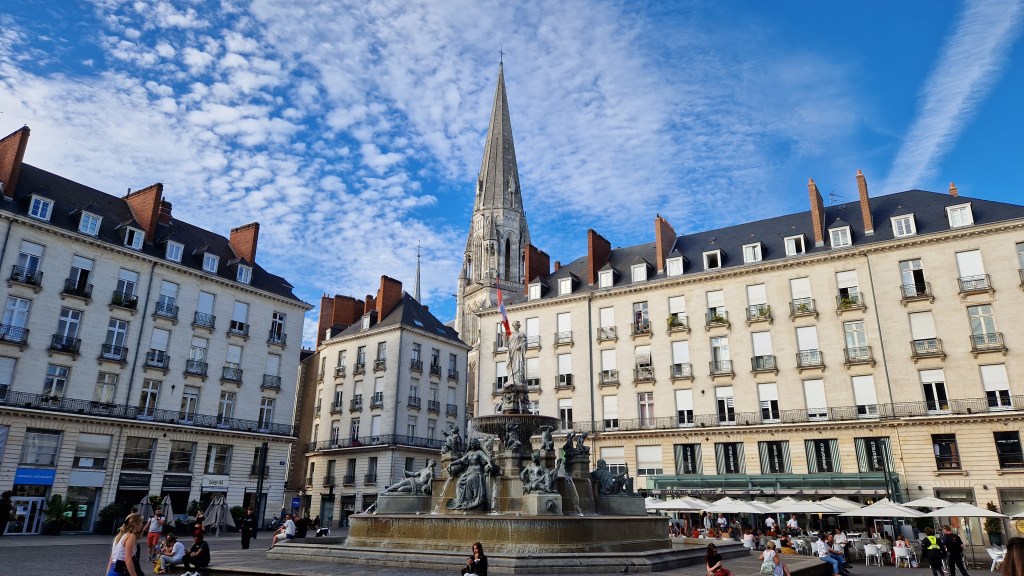
Having successfully made it to my hotel and checked in, it was time to go and explore the city, following a short nap of course! Having found a few things that looked interesting on Google Maps, I managed to come up with a route than encompassed most of these and set of to wander the city. The first stop on my self-guided tour was Place Royale, a large pedestrianised square with a fountain representing various local & regional mythology.
From Place Royale it was also possible to see one of Nantes’ many impressive churches, with Basilique Saint-Nicolas de Nantes (or the Basilica of St Nicholas of Nantes) sitting just the other side of the square, off one of the many roads leading out to the rest of the city. However, before I continued on my wanderings, I decided it was time to get some food and so headed to Crêperie Heb Ken which is located just off Place Royale on Rue de Guérande.
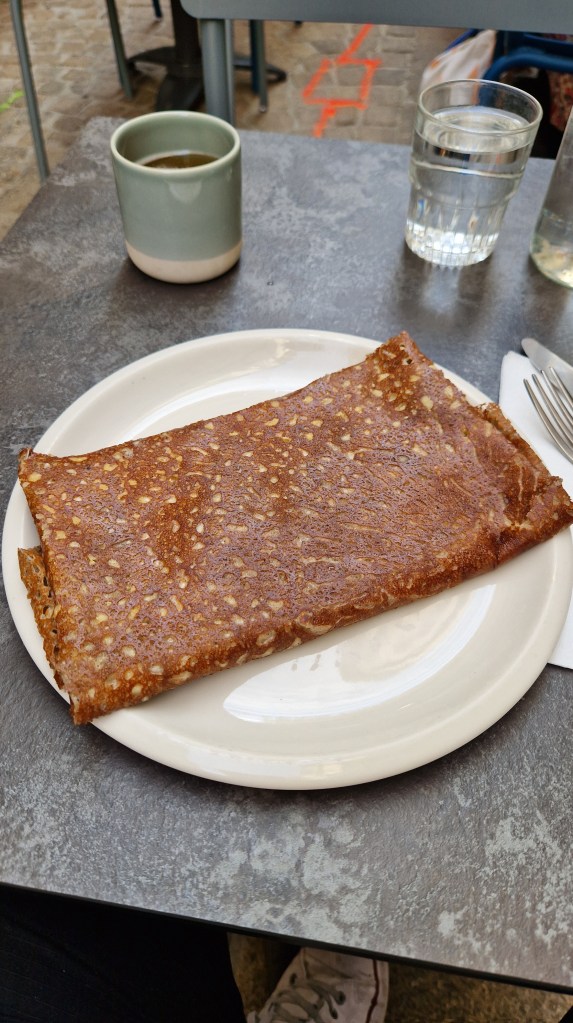
Heb Keb serves both sweet Crêpes and savoury Galettes, and so I decided to try one of each, starting with the Andouille Galette which contained mushrooms, egg, cheese and andouille sausage. I went with the Pomme Flambée Calvados Crêpe as my desert which was packed full of apples cooked in alcohol and essentially set on fire, which were just amazing. Both the Galette and Crêpe were proper melt in the mouth food and deliciously creamy, whilst the local cider I had decided to try was sweet and smooth and almost as easy to drink as apple juice.
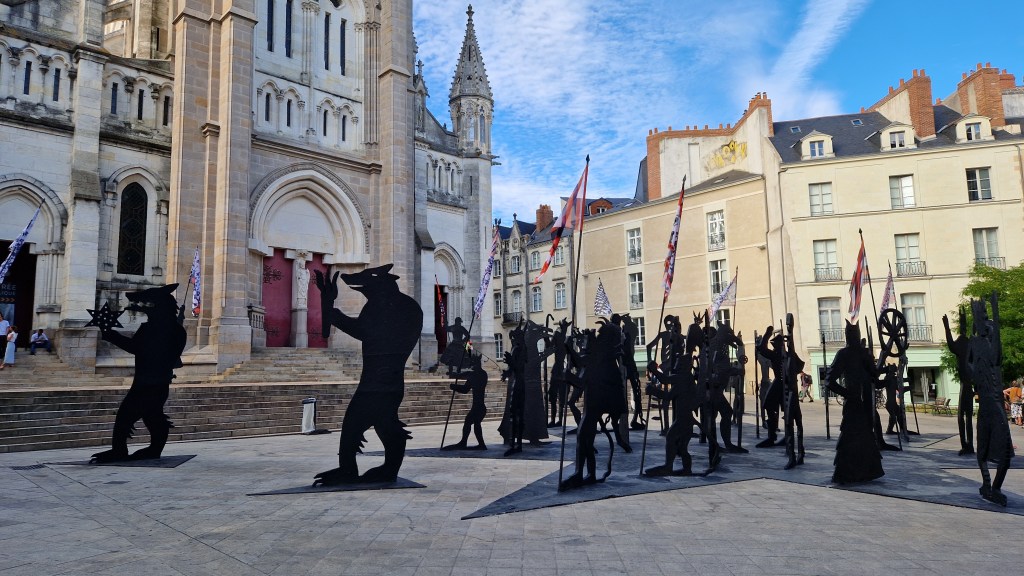
Continuing on my self-guided tour of the city, I headed over to the 19th century Basilique Saint-Nicolas de Nantes and found that outside was a collection of metal figurines showing part of the city’s history. This appeared to be one of the various pieces of public art that Le Voyage á Nantes has put on display around the city and whilst I didn’t go looking for others, I did see one or two dotted around.
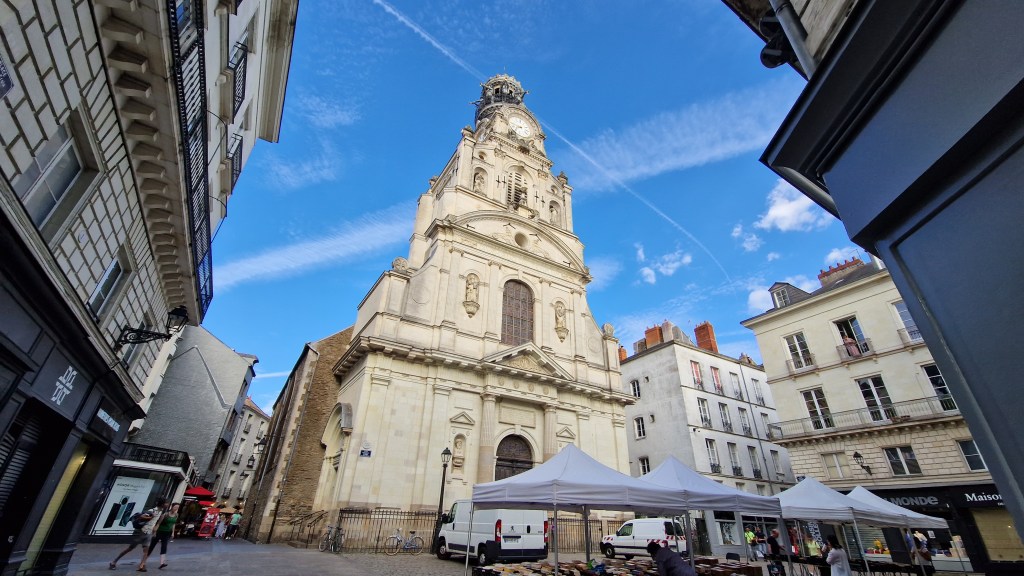
From the Basilique Saint-Nicolas de Nantes I headed east across the city centre towards another of the city’s numerous churches, Église Sainte-Croix. With parts of the church dating back to the mid-17th century, Église Sainte-Croix was adapted in the 19th century to provide a new choir and an updated façade. The belfry is home to a bell that weighs more than 8 tonnes and was cast more than 350 years ago in 1663.
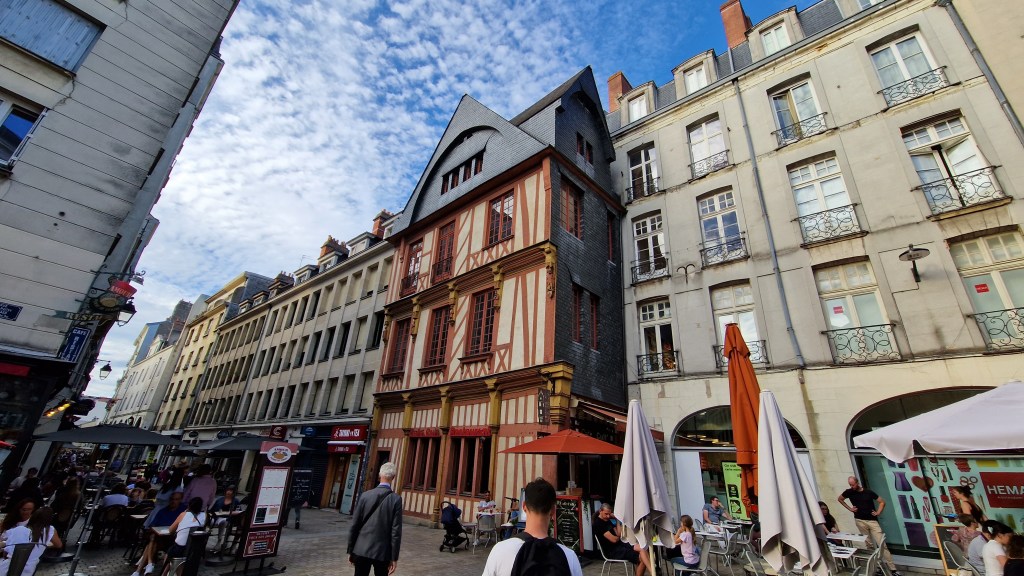
Next to the Église Sainte-Croix is the Rue Sainte-Croix, one of many narrow winding streets that fill this part of Nantes. As I followed it and the Rue de l’Emery towards Nantes’ Château I had to work my way around diners from the many restaurants that have spilled out into the streets, making the already narrow space even tighter. At points the space to pass through led walking in single file, however it was great to see the city alive and both locals and tourists enjoying the evening.

The biggest ‘must see’ in Nantes is its impressive Château des ducs de Bretagne (or Castle of the Dukes of Brittany). Originally constructed in 1207 and rebuilt in 1466, the castle is listed as a Monument Historique by the French Government and now houses the Nantes History Museum. As the name suggests, the château was home to the Dukes of Brittany between the 13th & 16th centuries before becoming a residence of the French Monarchy.
In the early 1990s, the city of Nantes began a large project to repair and restore the caslte that lasted 15 years with the castle completely closed to the public for three years. Re-opening in 2007, the castle has been restored to its former imposing grandeur, with part of the moat once again filled with water. Unfortunately, due to some very poor planning on my part, I arrived just as the castle was closing for the day.
However, if you’re a bit better at planning than me, the courtyard and ramparts are open for free between 0830 & 1900 everyday (extended to 2000 01/07-31/08, but closed on 01/01, 01/05, 01/11 & 25/12). The interior, museum & exhibition are open 1000-1800 daily, although closed on Mondays between 01/09-30/06. Entrance to the museum & exhibitions is €8 or €5 in the last hour before closing, however on certain days there is free entry to everything, so make sure to check before you visit.
Just up from the château is the Cathédrale Saint Pierre et Saint Paul de Nantes (or Cathedral of St. Peter and St. Paul of Nantes), which is unfortunately is currently closed for refurbishment work. Whilst construction of the Cathédrale began in 1434, building work took 457 years to complete, with the work finally finishing in 1891. Work took so long that the French Government designated it a Monument Historique before it had even been completed.
Walking back down from the Cathedral and round the edge of the castle, I dedicded to head south and, after crossing the railway lines stumbled upon Le Lieu Unique. Housed in a former biscuit factory, Le Lieu Unique is a cultural centre, bar and restaurant with a grand tower that was added to the building in 1909. Unfortunately, I didn’t get chance to head inside and see what was on offer at Le Lieu Unique, however it has various contemporary displays on throughout the year. The tower itself is open Wednesday to Sunday from 1400-1900, however opens an hour later on Sundays.
Just down the west bank of the Erdre river, not far from Le Lieu, is La Cité des Congrès de Nantes, Nantes’ exhibition centre and concert hall. Whilst a sprawling complex, La Cité is most well known for its circular glass and steel auditorium that sits alongside the river Erdre.

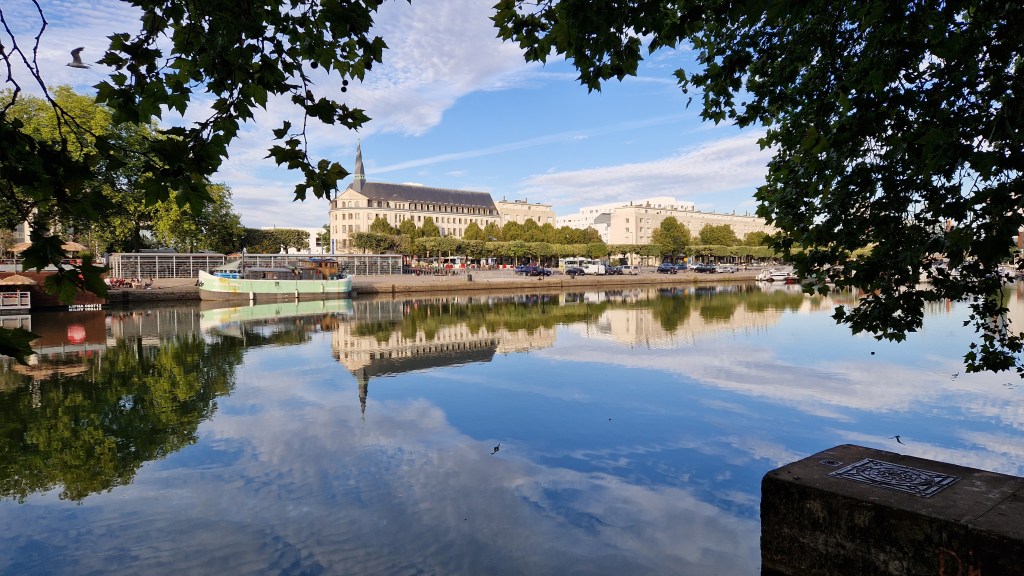
With my legs beginning to tire and an early start ahead of me the following day, I decided to start making my way back to my hotel, via the north bank of the river Loire. Not far after La Cité is the confluence of the Erdre and Loire rivers, and after a quick stop to watch the meeting of the waters, I continued along to the Pont Général Audibert (Louis-Alexandre Audibert was a leader in the French resistance and commander in the Secret Army during WW2), where I was able to catch a Line 3 tram back to my hotel.
Whilst my time in the ‘Venice of the West’ was brief, I thoroughly enjoyed exploring Nantes and definitely want to go back and explore some more. I’m aware I saw only a small part of the city and there is so much to do, so I’d definitely recommend a minimum of a long weekend if you do decide to visit.
 Flights & Times
4 thoughts on “Nantes – The Venice of the West”